Ashling Park, or the Cape near Chichester
A vineyard tour, a tasting and an overnight stay at Ashling Park Estate near Chichester — and a Sunday roast that has upset the standings. On one of the hottest weekends of the summer, West Sussex did a very passable impression of the Cape.
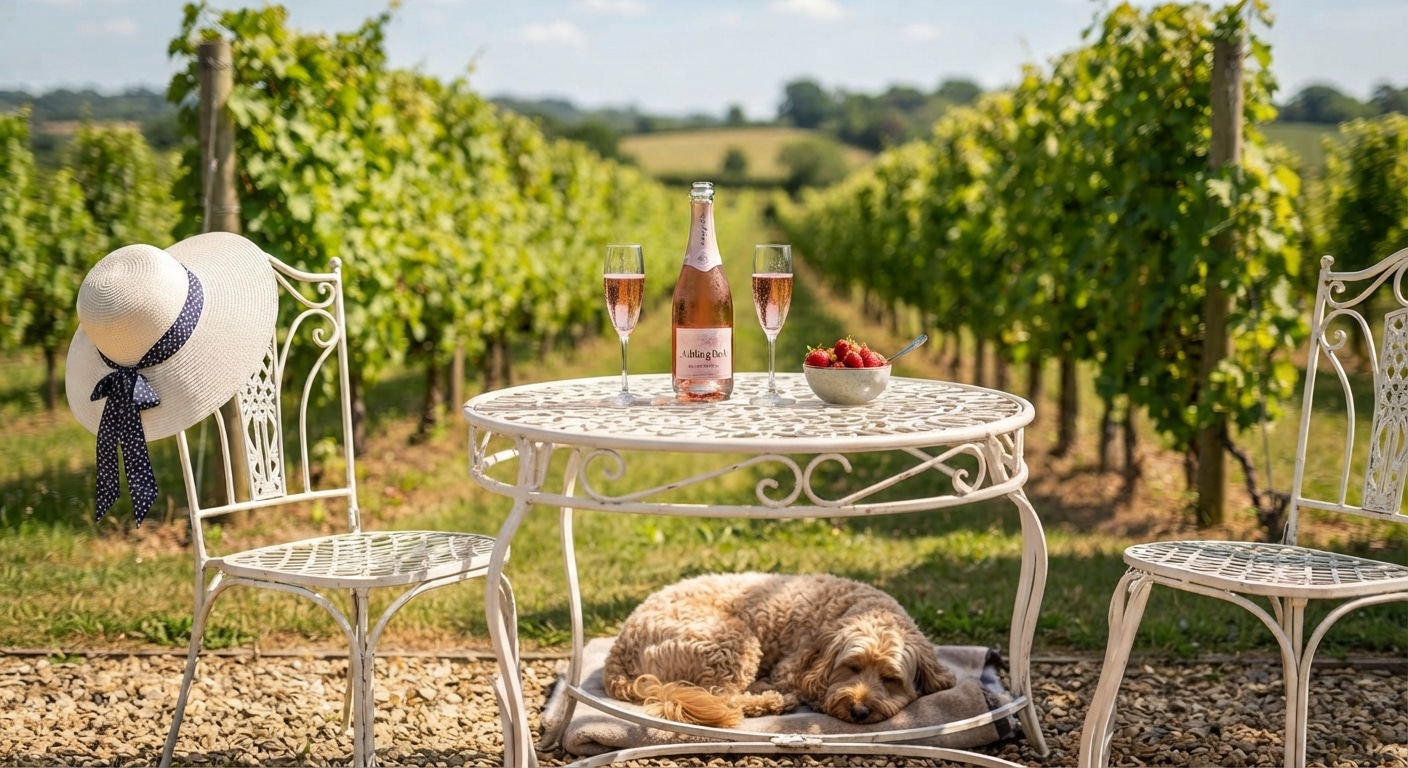
At some time after lunch, I looked up and thought: we could be in South Africa. The air over the vines had gone completely still, the way it does when nothing has moved all day and nothing intends to, and the rows ran away downhill into a heat haze that belonged several countries further south. There was a glass of something pale pink and sparkling on the table, beading in the sun. Otis was flat out underneath it in the only patch of shade going, having worked out within about four minutes of arriving his strategy for making friends with every guest, staff member and visiting dog in the place.
My wife had booked the whole day for my birthday — the vineyard tour, the tasting, a night on the estate — which is the sort of present that tells you someone has been paying attention. Ashling Park Estate sits a few miles west of Chichester, close enough to home that we did not have to make a big production of getting there, but far enough that it counted as going somewhere.
What is under the table
The tour was given by the vineyard owner’s daughter — the third generation of the family to have a hand in the place. She was funny, unhurried, and entirely at ease with a group of people who had turned up for the wine and then found themselves interested in the farming, which is a harder trick than it looks. I have sat through enough briefings in my life to have a real appreciation of people who say the same thing every day and still manage to sound as though they mean it, and who can adjust the script to fit the occasion. She managed it, and after the wine tasting was over, we told her so.
I have done enough vineyard tours, here and abroad, and this one was among the better ones.
The vines went in comparatively recently. Chardonnay, Pinot Noir and Pinot Meunier — the three Champagne grapes — plus a splash of Bacchus, which is the odd one out. The first three are headed for sparkling wine. Bacchus is not. It makes a still white, sharp and aromatic, and it is the closest thing England has to a grape of its own, a title it managed to acquire while actually being German.
Loam over chalk.
Now, the chalk. That seam runs east along the South Downs, pops out at Dover as the white cliffs, ducks under the Channel and comes up again in Champagne. Not similar rock. The same rock. Twenty-odd miles of water and a great deal of national pride on both sides of it, all sitting on one continuous seabed. The French didn’t get entirely different geology. They got a more forgiving climate.
That last part has been changing, and it is why I was sitting there at all.
The Champagne houses worked this out before the rest of us did. Taittinger has planted vines in Kent, and Pommery makes an English sparkling wine at Hattingley Valley, a few minutes down the road from my house — I can be at the winery quicker than I can reliably get to any local restaurant that serves it. Nothing grown on this side of the Channel can ever be sold as Champagne, and they planted regardless. It does not protect Champagne itself. It protects the business.
Mention that in a conversation and someone will usually tell you what they have heard, which is that English grapes now go over to Champagne to top up a thin French harvest. Nice story, completely untrue. Champagne can only be made from grapes grown inside the delimited region, and it is a rule the French have been willing to riot over — in 1911, growers who accused the big houses of buying cheap fruit from the Loire intercepted the lorries and tipped the grapes into the Marne.
What is above it
The other thing I came away with was about the trees, and this is really a story about a family.
The estate belongs to the grandfather. Some years ago he gave ten acres of it to his daughter, who planted the vines and owns the vineyard, and it is her daughter who now walks visitors round it. Three generations, one field, and it still feels like a family business rather than a company with a vineyard attached.
He attached one condition to the handover. The old trees stay.
Ashling Park is ringed and broken up by mature timber, oaks of a century and more, standing in and around the planting rather than politely at the edge of it. That is a more expensive condition than it sounds. Trees are a nuisance to a vineyard in a list of ways: they throw shade onto rows that need every hour of sun this latitude can manage, their roots, which spread wide, help themselves to the water in the exact ground you have just spent a fortune preparing, they keep the air still where you want it moving, and they house a large and well-fed population of birds who probably feel they have a better use for a ripening grape than a bottle of wine. The straightforward commercial decision would have been to take them out.
He gave away the land and the say over what was grown on it, but protected the one thing that could not be replaced in his lifetime or his daughter’s. The estate is unrecognisably better for it. A vineyard with no trees in it is an agricultural installation. A vineyard with old oaks standing about in it is a destination.
The wines
The wines were superb. We tasted rather more of them than the itinerary strictly required, and I regret none of it.
The sparkling rosé was the standout — properly good, not good-for-England good, just good — and I would happily serve it to anyone without a moment’s hesitation.
Back to that glass of pale pink on the table. It is the wine the estate is known for, and it has collected a shelf of awards on the way to being known for it. Mostly Pinot Noir with a little Pinot Meunier. Thirty-five pounds a bottle, which for a traditional-method sparkling wine with this much time behind it is not a great deal of money.
The time is the part worth dwelling on. Eight years, they told us, from the fruit coming off the vines to a bottle they are willing to sell — the same as a vintage Pol Roger — and most of that spent lying on the lees, which is where a sparkling wine stops being merely sharp and starts having some breadth to it. Eight years is expensive. The wine sits in a building doing nothing visible whatsoever, and every year it does that is another year the money spent making it has not come back.
Which means the glass in front of me was a record of a summer that happened a very long time ago, made by people who had to hope in advance that it would be worth the wait.
The estate’s own note promises sun-warmed summer fruit, strawberry and redcurrant, a little citrus, elderflower. I am not going to pretend I picked all that apart in the sun, with a dog beside me trying to explain to all and sundry that he would rather like to make friends. The honest version is shorter. It was the best thing we tasted out of a very good bunch. We joined their wine club before we left.
Wine at that level being made here at all is a fairly recent development. English wine spent decades as something you were kind about, and sparkling wine changed that: Champagne grapes went into Sussex chalk in 1988 and the bottles were winning trophies within a decade.
The winemaking has come on enormously, but the larger reason is the weather. The growing season here has warmed by something like a degree and a half since the middle of the last century — the difference between grapes that ripen in the good years and grapes that ripen most years, and most years is what you need before anyone will plant a field and wait.
So the wine in my glass was, in a fairly direct sense, made possible by a warming climate. The thought stayed with me all afternoon, and I will come back to it.
There is no winery at Ashling Park. The grapes are picked here and then leave — pressed, fermented and made into wine somewhere else — and the finished bottles come back to the estate to be labelled. This is normal in England, and a good many respected names have never owned a winery either.
So the grapes leave, and years later the wine comes home to have a label put on it. Which sounds daft until you hear what a winery costs to build. Three million pounds, we were told. For ten acres of vines, that is not a decision anybody needs to agonise over.
A serious contender
Then there was the beef.
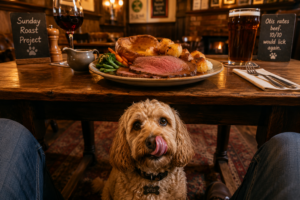
Lunch was in the estate’s own restaurant, and the Sunday Roast Project has been running long enough now that I have become difficult to impress. I had not expected the standings to be disturbed by a Sunday roast served on the premises of a vineyard, which is not usually where you go looking for one. But the beef came from Adsdean Farm, essentially up the road at Funtington — the same family have farmed it for sixty-odd years and have had a butchery on the premises since 1970 — and it had been hung for the better part of a month before anyone went near it with a knife.
You can taste that. Hanging is time, and time costs money, and the reason most supermarket beef is not hung properly is that a carcass sitting in a chiller for four weeks is a carcass earning nothing. What you get for the wait is beef that tastes of something on its own, rather than beef that only tastes of whatever you pour over it.
It was possibly the best beef I have eaten.
I am not going to hand over the number one spot on the strength of one lunch, a good mood and the better part of a bottle of the estate’s Pinot Noir, because that way lies a ranking nobody can trust. But it is a serious contender, and I have been thinking about it for five days, which in my experience is the real test. Anything genuinely good keeps turning up in your head afterwards, uninvited, usually around four in the afternoon.
The walk
We walked it off in the evening, when the heat had come off the day but not yet out of the ground.
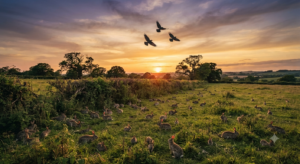
There is woodland running round the vineyard, and going into it from the open rows was like stepping into a different building. Cool, green, quiet, the light coming down in pieces. Otis, who had spent the entire afternoon horizontal, remembered that he was a dog.
The wood has nothing to do with the wine. It is simply there, and it means you can walk the whole way round the vineyard in the shade on a day when the rows themselves are unwalkable. Nobody puts that on the booking page. It was, by a distance, Otis’s favourite hour of the day.
The cabin, and the hamper
The kitchen closes after lunch on a Sunday, so there is no dinner to be had on the estate that evening. After the roast we had eaten, this was academic. Neither of us could have looked a menu in the eye.
The cabin sits among trees, with a deck angled so that you cannot see another guest and no other guest can see you, which is harder to arrange than it sounds. Inside there is a large and genuinely comfortable bed, a roll-top bath, and a shower with real pressure behind it. The room was warm, but it was the middle of a heatwave and I am not going to hold that against anybody.
There is a good selection of teas and coffee, and a fridge stocked with the estate’s own wines, so you can carry on forming opinions about them long after the tasting has finished. We did.
Feral rabbits were hopping about under the trees. Rabbits seem to follow me everywhere.
Just beyond the boundary fence there is a lake. You cannot quite see it, only pieces of it through the trees on the far side of the fence, but as the evening cooled we got the smell of it coming across. Not a bad smell at all. Anyone who has stood near still water on a summer evening will know the one I mean.
The restaurant does not do breakfast on a Monday either. A hamper turns up at the cabin instead, and there is plenty in it for two: cold meats and bread, granola and yoghurt, juice and fruit. We worked through it slowly, which was better than sitting in a dining room would have been. The cabin is a good size — room enough to spread out, drink a second coffee and be in no hurry about the morning.
Nearly the Cape
The South Africa feeling stayed with me all day and into that walk. Sun, vines, a long lunch, wine made from the field we were sitting by and beef from a farm close enough to walk to. If you had shown me a photograph of that table with no caption I would have guessed at somewhere considerably further south and been perfectly confident about it.
I spent years chasing the good weather overseas. Now I have retired, and the good weather appears to be chasing me.
It is a line that felt funny when I wrote it. I am not going to pretend the afternoon was filled with thoughts of climate change, or that my enjoyment of it was in any way lessened. It was not, and I enjoyed it immensely. But retirement has given me the space to think about things a second time, which is not always a favour.
The vines at Ashling Park are in the ground because the summers here changed, and the same change arrives elsewhere as drought, as fire, as storms that take the roof off. Both are true at once. The same weather, landing very differently depending on where you happen to live.
Everything here moves, and always has. The chalk was laid down under a sea and is now a hill in Sussex. A county that could not reliably ripen a grape is selling sparkling wine to the French. The warmth moved north and the vines came after it, and if it keeps going then people will come after it as well, because that is what people have always done and it is certainly what I would do in their place. I have no policy to offer and would not trust myself to write one. But understanding why they are moving will turn out to be a good deal less optional than it currently sounds.
Otis, for the record, was untroubled by any of it. He had arrived with a strategy, executed it faultlessly, and was asleep in the shade by four. His policy on strangers has never varied: everyone is a friend, and anyone carrying food is a very close friend indeed.
Ashling Park Estate, West Ashling, near Chichester. Tours and tastings run Thursday to Sunday, dogs are welcome, and the Sunday roast is served in the estate restaurant. There is no dinner on a Sunday night and no breakfast served on a Monday, when staying guests get a hamper instead; check current opening times before you book. The beef comes from Adsdean Farm at Funtington. Other entries in the Sunday Roast Project are here.