The Best Seat in the House
On magnificent views, the movie metaphor, and what you can only find at ground level.
For thirty years, I had one of the finest views available to anyone.
Not the view the passengers had — the oval window, the wing tip, the occasional cloud formation if you happened to be on the right side. I mean the flight deck view. The full panorama. The world spread out in every direction, from horizon to horizon, from the edge of the stratosphere down to the surface of the earth, unobstructed and enormous and, on the right night on the right route, genuinely breathtaking. Unless it was cloudy.
What you see
Cumulonimbus clouds building to fifty or sixty thousand feet, towering above the aircraft and lit from within by lightning firing continuously through the cell, leaving no doubt — if doubt there ever was — that you are outmatched here. Stay away. You route around them, and as you do, you watch the lightning move through them, chasing from spire to spire. Vast, indifferent, and entirely magnificent.
You drink your coffee and watch, from at least 20 nautical miles away, a force of nature perform for no audience but you and whoever is sitting in the other seat.
The Aurora Borealis over northern Canada and Greenland is one that stays with pilots — even those who fly high latitudes regularly and may see it several times a year. Green curtains that seem to be still till you look away, and then on the next glance have shifted entirely into new waves, moving across the sky above you. Sometimes seeming to extend below you in the distance but invariably, when you are there, still above you — tantalising but out of reach. The colour always pale green, unless you take a photo, when the hidden colours are then revealed.
And Greenland itself — the glacier-filled valleys, the ice-locked mountains which in winter are covered by such thick ice and snow as to appear as peaks poking out of a cloud. A silent land, indifferent to the aircraft passing over it. Entirely itself.
Even the night sky becomes special. Dim the cockpit lights and allow your eyes to adjust for a few minutes. Above the cloud layer, above the light pollution, above the atmospheric interference that robs the ground of what our ancestors saw every cloudless night — the Milky Way is simply there. All of it. The full arm of the galaxy spread across the dark, in a clarity that most people alive today just never get to see. It is the sky as it was before the industrial age, now available only to those above it.
You are probably thinking this has sounded uncharacteristically lyrical. Perhaps even as if I was trying to describe a scene in a movie.
It’s true, here’s why.
The movie
Here is the thing I fully appreciated once I was no longer up there.
All of it — the thunderstorms, the aurora, the night sky, the glaciers — was something I was watching. Through reinforced glass, in a pressurised and temperature-controlled environment, from a safe and entirely comfortable distance. The cumulonimbus over the Bay of Bengal could not touch me, which in the circumstance was rather the aim of the mission. The Milky Way was up there, remote, and I was in here, warm, with the autopilot engaged and the second cup of tea in hand.
I was the audience. The world was performing. And there is a significant difference between watching the world and being inside it.
The noises. The smells. The feel of weather against your skin. The heavy weight of humid air before a tropical storm. The sound of the waves and the chirp of tropical night insects on an empty beach on a clear night. These things do not exist at 38,000 feet. They exist down here, where the world is loud and immediate and occasionally soaking wet and very real.
The verandah in Sri Lanka
I have a particular relationship with tropical thunderstorms that I trace back to a childhood memory from Sri Lanka — the country of my birth, and one whose seasons are dominated by monsoons.
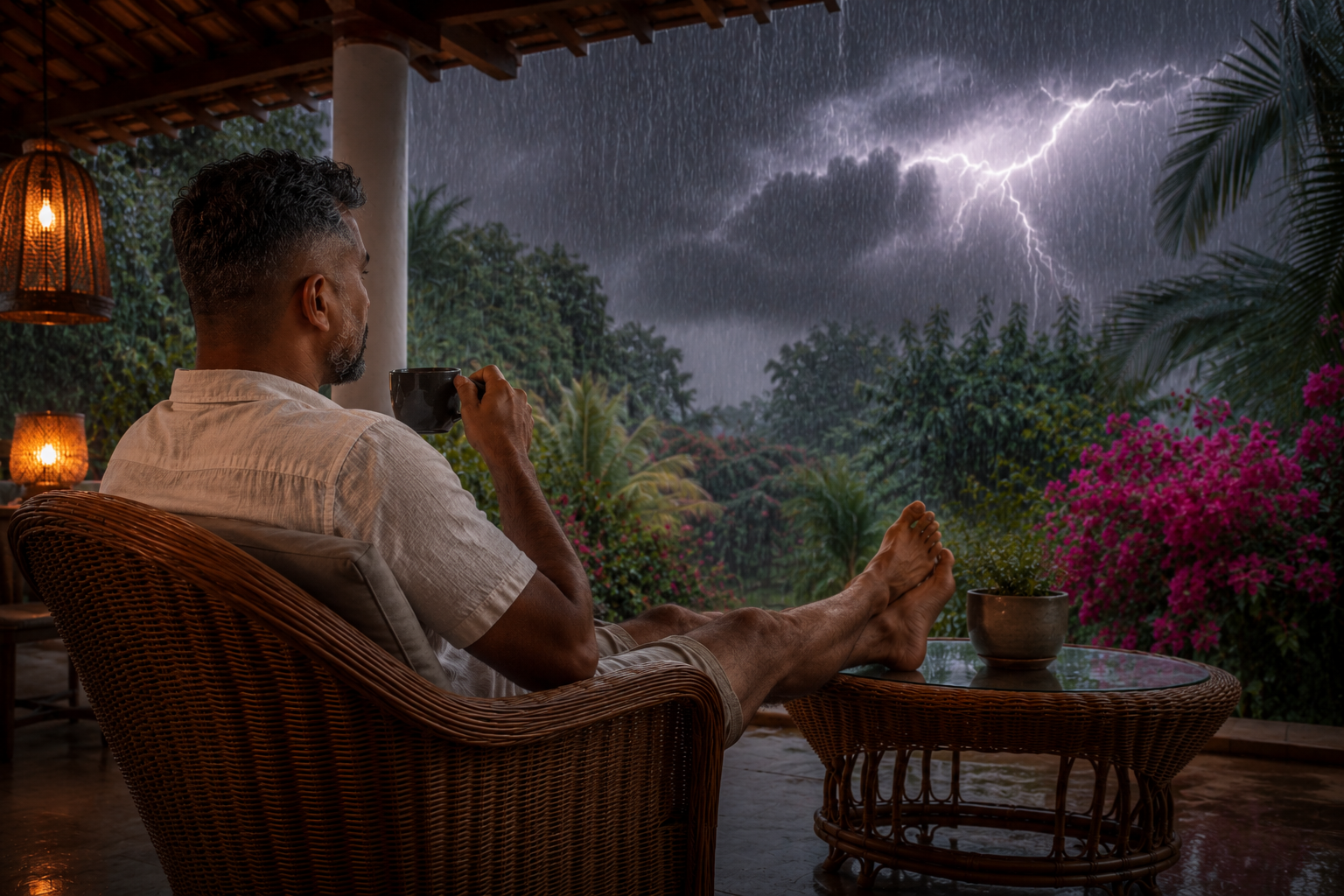
The experience I return to, whenever I can, is this: a verandah, a tropical thunderstorm, and nowhere to be.
I don’t seek out the storm. I seek out the verandah.
The storm is around you and loud. The rain comes down in the particular way tropical rain comes down — aggressively — a fully committed downpour that bounces off the ground and fills the air with a smell that is equal parts earth, heat, and relief. The air is humid and heavy and turns slightly cooler than it was before.
You are dry. You are safe. You are, however, experiencing it.
Not above it. Not routing twenty nautical miles around it. Not watching it through glass whilst busy planning the course around the next one coming up ahead. You are on the ground, under a roof, with a mug of tea and the luxury of a storm that is performing entirely for your benefit and asking nothing of you except your full attention.
I have watched bigger storms from the flight deck. I have never watched one as well.
The beach in Mauritius
On a deserted night beach in Mauritius, my wife saw her first moonbow.
A moonbow is what happens when moonlight refracts through water droplets in the air — the same physics as a rainbow, but at night, and pale, quiet, and something most people never get to see. I had seen one before. From the flight deck, on a night sector, noted and logged somewhere in the accumulated observations of a long career.
It is a different thing entirely when you are sitting on a beach in the dark, in the warm, and the person next to you sees it for the first time.
We had been watching the sky — occasional shooting stars, trying to work out the constellations, wondering whether it was a satellite or a plane. And then the moonbow.
I watched her see it. Her astonishment, Her excitement. A check on google to see if a moonbow was even a thing
I had seen a moonbow before but I had never experienced one. The distinction was the person next to me, and her wonder at a thing I had previously only observed as a technical curiosity, too busy with the job to pause and wonder.
That is what the ground offers that 38,000 feet cannot. Not a better view. Not a cleaner sky or a bigger storm. The presence of another person whose first encounter with the world gives you a second one.
What living below 38,000 feet actually means
I do not miss the altitude. I do miss some of the views. Occasionally.
But the world experienced from the ground is a different level of experience from the world observed from above it. Louder. Sometimes wet. Occasionally inconvenient. But full of other people having their first encounters with things I may have already seen, and offering me a chance to share the wonder anew.
The seat was excellent. The view was extraordinary.
I enjoyed the movie but prefer being in the play.
If you’ve had your own ground-level moment — a storm, a night sky, a moonbow or some other magic — I’d love to hear about it in the comments.