The Murder Next Door
Dark deeds in Hampshire, and an uncomfortable question about where our meat comes from
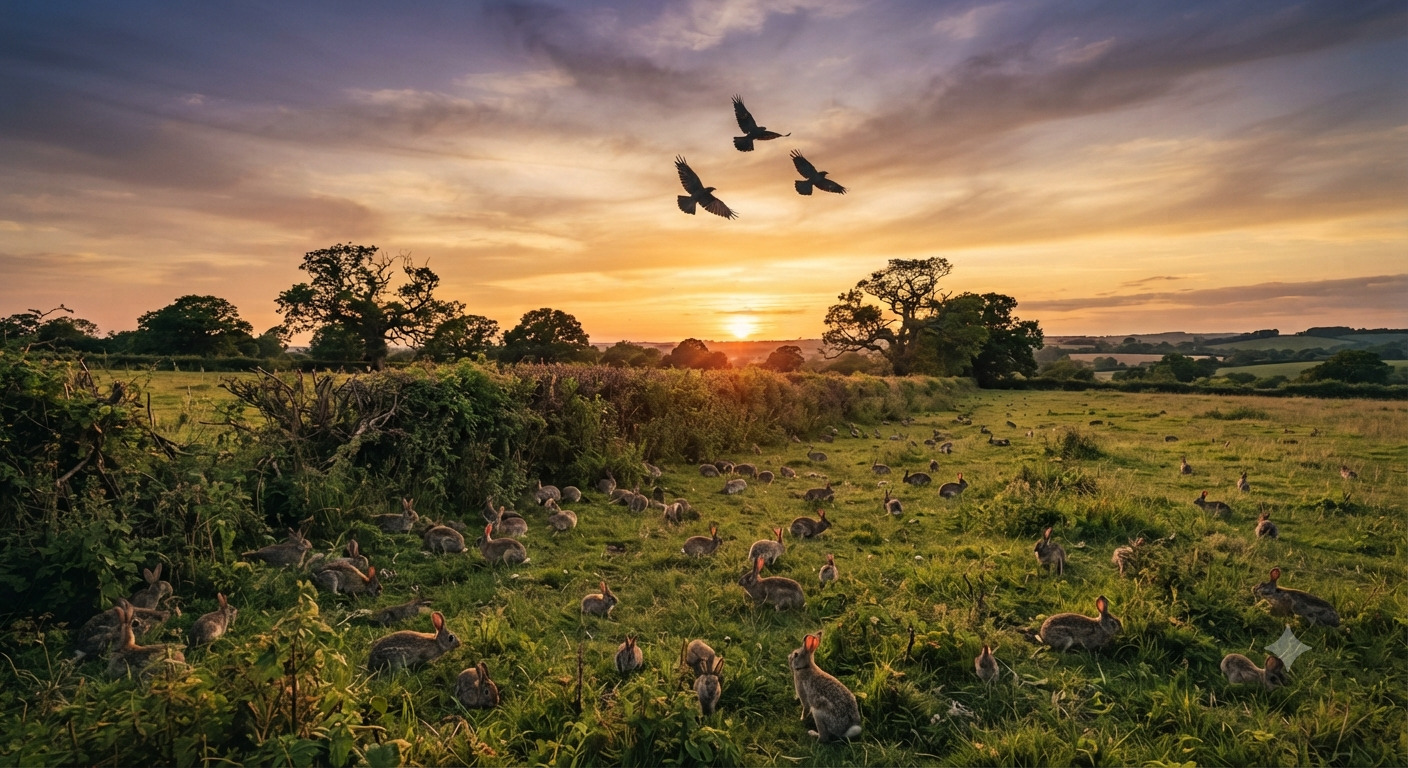
There was a murder in the field next to my house yesterday. Unfortunately, it has started to become something of a regular event. It’s true the screaming and shouting used to bother us, but we’re starting to get used to it now. I should probably clarify that I’m talking about the collective noun for crows here, before anyone rings the authorities — a play on words I have been waiting most of my life to deploy, and this blog has unexpectedly given me the opportunity. Serendipity.
They nest in the trees just over the hedge, returning en masse from whatever it is that crows do for a living, and they tell each other their daily news at the top of their voices, overwhelming the evening birdsong until their squabbling has quietened.
And occasionally, their work leaves evidence.
This morning, Otis and I found a patch of rabbit fur on the grass. A lot of fur. No rabbit. I have been considering the evidence and I can report that the suspect list is short: the crows, who have the numbers and the attitude; one of the red kites that patrols overhead; or the fox, who has form — and unfortunately was the reason for the end of our chicken-rearing experiment.
I’ll never know. But it has got me thinking about nature’s ways again.
David Attenborough beat me to it
When I was young I loved watching the nature documentaries. I absorbed the information effortlessly. For as long as I can remember, my two ambitions in childhood were to be an airline pilot or to be David Attenborough. Unfortunately the man himself had already taken that role, and questionable decision making led me more towards the physics and chemistry side of the sciences — and so began a slow move away from my fascination with the natural world. I feel very fortunate that decades later I now have my own wildlife documentary running right next door, no subscription required.
The rabbits — as a population rather than that individual — are thriving. This morning’s discovery has not discouraged the others in the slightest. They are out there every day, hanging about in the field or enthusiastically excavating the lawn, and undoubtedly increasing in numbers.
A confession about rabbit
Here is where it gets a little awkward. I have mixed feelings about rabbits. Watching tiny kits follow their mother around the field is one of the pleasures of living here. Watching their parents excavate the lawn is rather less enchanting. That’s usually the point where I start hoping a red kite, or perhaps that fox, might pay another visit.
I love rabbit. Lean, healthy, free-range in the most literal sense, and delicious. But it is a rarity in my life — restaurant-only, never at home.
I blame my brother-in-law. My wife’s brother, as a boy, shot a rabbit, and it duly appeared at dinner. My wife was halfway through the meal before anyone mentioned what it was. That was the end of rabbit for her, permanently. Some doors close quietly. That one slammed.
So the garden is full of rabbit, the kitchen never is, and I find myself in the odd position of watching one of my favourite dinners hop about the lawn every evening, entirely safe from me — and that’s not only because of my wife’s opinions.
Because here is the second confession: I wouldn’t shoot one. I have nothing against hunting for food — done properly it is more honest than most of what happens to meat — but I know I don’t want to be the one who takes the life. The rabbits are becoming a nuisance. The cost of buying repellent adds up. I want the rabbit; I just want someone else to have done the difficult bit first..
The difficult bit
Which brings the whole thing uncomfortably into focus. Perhaps hypocrisy is part of it. But perhaps it is also the operating model of the modern West.
Somewhere else, still, a family kills what it eats and knows precisely what that costs. For most of us, someone else performs the difficult part long before we reach the supermarket, where meat arrives plastic-wrapped with a use-by date, looking as though it was manufactured rather than once alive. Walk along the meat aisle in any supermarket and it’s surprisingly easy to forget those neatly wrapped cuts were once living animals. Somewhere between field and fridge, the connection has been carefully tidied away. A life becomes a food item, with more thought given to the marbling than to where it came from. I wrestled with this many years ago. I found a somewhat uneasy peace after reading Hugh Fearnley-Whittingstall’s essay in The River Cottage Meat Book.
I doubt the crows have this problem. Whoever took that rabbit knew exactly what it was doing and paid full attention while doing it. There is something honest about that — an honesty that I, with my sausage sandwich, cup of tea and strong opinions on the appropriate amount of ketchup, cannot quite claim. These days I choose high-welfare meat where I can. At the least, a food animal deserves the best possible life, but it doesn’t change the fact that someone else still performs the difficult part.
The murder next door will be back this evening, their hoarse calls harsh, repetitive, and utterly indifferent to the evening bird chorus they are drowning out with their chatter.
But, unlike most of us, they know exactly where their food comes from.
Further reading
The River Cottage Meat Book by Hugh Fearnley-Whittingstall — the essay on the ethics of eating meat mentioned above, and the book that helped me find my uneasy peace.
The Omnivore’s Dilemma by Michael Pollan — follows four meals back to their sources, and asks the same question this post does at much greater length.
Crow Country by Mark Cocker — a whole book about watching corvids in the British countryside, for anyone whose interest in the murder next door outlasts this post.
English Pastoral by James Rebanks — a farmer’s account of the link between land, animals and food, written by someone who has never lost it.