Thirty Years of Fatigue Management and I’m Still Looking for the Operator’s Manual
An honest investigation into sleep, sleep debt, and the small domestic frontier of the Kindle light.
I am currently wearing a Garmin watch on my wrist and an Oura ring on my finger.
Between them, they monitor my sleep stages, heart rate variability, resting heart rate, overnight oxygen saturation, body temperature, respiratory rate, and something called readiness — which is the Oura ring’s daily verdict on how prepared I am for the day ahead. All of which, it occurs to me, relates to processes I should theoretically be capable of performing unassisted.
In thirty years of professional aviation, I was never short of instruments. Retirement has not changed that.
The irony is not lost on me. I spent three decades during which the study of fatigue management — understanding the science of sleep, the effects of disruption, the physiology of a body operating across time zones at irregular hours — was an integral part of keeping ourselves and our passengers safe. I knew, in considerable professional detail, what sleep deprivation does to reaction time, decision-making, and cognitive function.
And yet here I am, wearing two devices on my body to monitor whether I’m actually sleeping properly, because it turns out that knowing the science and living inside it are entirely different things.
What shift work does
A career in long-haul aviation has a particular relationship with sleep, and it is worth describing plainly because it shapes a lot of what comes after.
The roster does not consult your circadian rhythm — though the industry has, in fairness, given more thought to fatigue-aware roster construction in recent years. It simply tells you where to be and when, and your body does its best to comply, accumulating a kind of deficit that the next break partially addresses and the next trip partially undoes.
Sleep, in that world, becomes something you manage rather than something you do. You learn to sleep when the schedule permits — in hotel rooms with blackout blinds, in crew rest facilities at altitude, in the gaps between legs. You become efficient at it, in the way professionals become efficient at the things their work demands. You do not, however, become good at it in the way that matters: the deep, regular, unhurried kind the body was actually designed for.
The cumulative effect is not dramatic. Usually. It builds quietly, the way small navigational errors do over distance — invisible in the short term, significant over thirty years.
My last flight was in mid-November. Months later, my Oura ring still tells me I’m carrying sleep debt.
I believe it.
What retirement revealed
The body, it turns out, keeps records. Mine appears to have spent thirty years quietly tallying everything I have put it through and has recently decided it would like to discuss the outstanding balance.
In the early weeks after I stopped flying, I had a strange, buoyant energy. Then, once the new reality settled, the tiredness arrived. Deep, genuine tiredness — the kind that suggests the body has been waiting for permission to acknowledge it for quite some time.
My response was instinctive rather than prescribed: I started going to bed at nine o’clock.
Not because anyone told me to. Because it felt right. The body seemed to be asking for something, and nine o’clock was the nearest thing to an answer.
I stayed with it for weeks, getting more sleep than I had in years, and slowly the quality began to shift. The deep sleep proportions were the last to improve, but they slowly did. The readiness scores climbed. The recovery data moved in the right direction.
The sleep debt has not been fully repaid. Months of retirement, some genuinely good nights, and a more reasonable bedtime have not erased decades of shift work. Partly that is because retirement has introduced its own disruptions: late evenings, new projects, the general busyness of a life being rebuilt from different components. The debt from the career and the habits of freedom are still negotiating with each other, and the outcome is not yet settled.
I am, as ever, still searching.
Why sleep matters — down the rabbit hole
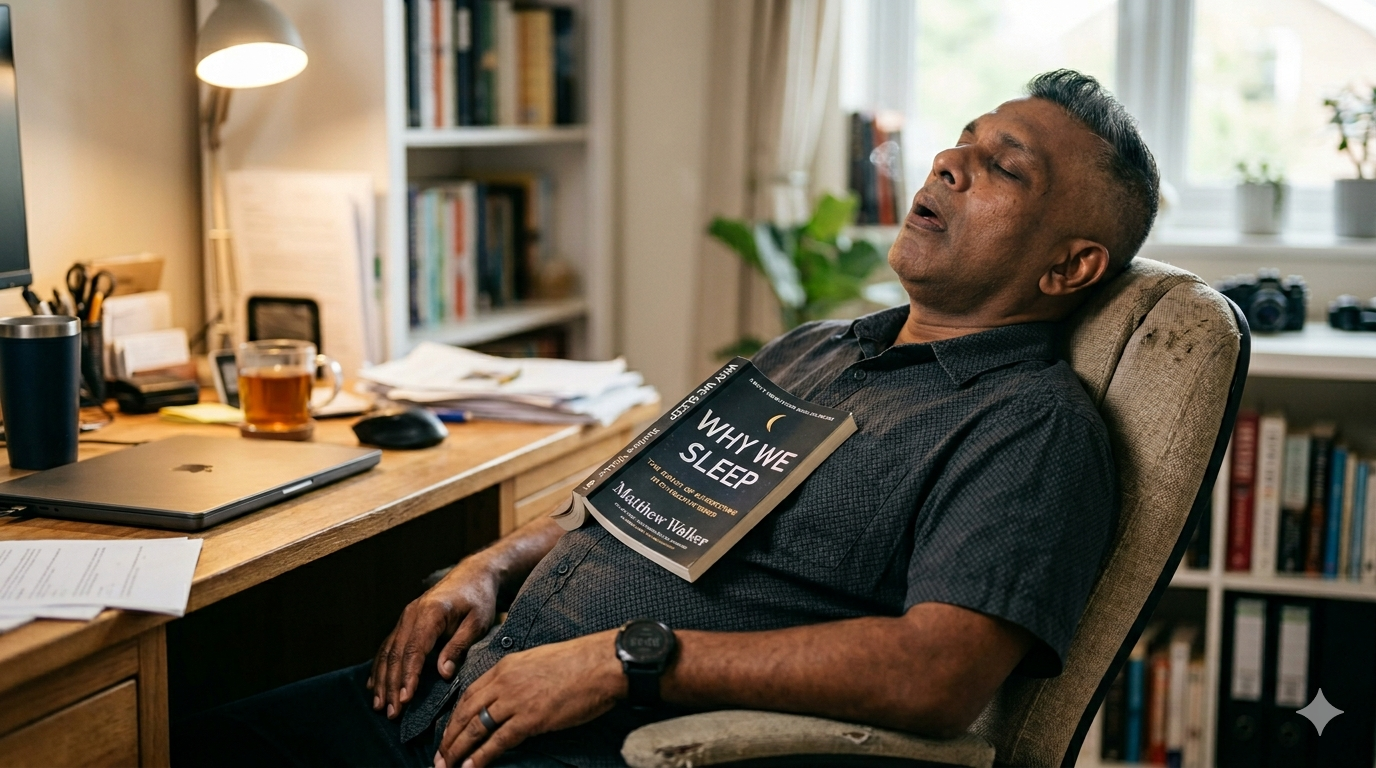
I started, as many people do, with Matthew Walker’s Why We Sleep. It was mentioned during some training day or other.
I was told that it is a compelling book. I wasn’t told that it is also a slightly alarming one — though apparently some of its more specific statistics have been disputed by researchers since publication. But the broader argument is compelling enough to deserve further reading. What follows is the possibly entirely inaccurate picture that I have built.
The cardiovascular research was sobering. I had a rough idea that poor sleep was bad for you in the vague, general way that most things are bad for you. What I hadn’t understood was the specificity of the association. Consistently sleeping under six hours — which, for significant stretches of a long-haul career, describes me very accurately — is associated with significantly elevated cardiovascular risk. A study in the European Heart Journal put a number on it: a 20% higher risk of heart attack for those sleeping six hours or less compared to those sleeping seven to nine.¹
Then there is the dementia research. Sleep, apparently, is when the brain clears certain waste products — including amyloid beta, the protein associated with Alzheimer’s disease. Disrupt the sleep consistently, and the clearance is impaired. A study in Nature Communications found that sleeping six hours or less at age 50 was associated with a 30% increased risk of dementia in later life.²
I wasn’t really surprised about the immune system findings — I think everyone has noticed that disrupted sleep correlates with picking up whatever is circulating at work or what the kids bring back from school — but the research confirmed it quite definitively. Sleep deprivation measurably reduces the immune response to vaccination.³
The mental health relationship I had already observed personally, in the way that most people who have worked shifts observe it — poor sleep makes everything harder to manage, and everything harder to manage makes sleep worse. If you are in the middle of a major life transition, it is worth knowing that the loop exists and that it can be interrupted.
The picture is completed by the metabolic findings. Sleep deprivation disrupts ghrelin and leptin — the hormones that regulate hunger and satiety — in ways that increase appetite and skew preference toward high-calorie foods. The association between chronic short sleep and type 2 diabetes is well-established.⁴
This sort of information has certainly been enough for me to reassess the importance of sleep. I always knew it was important. I just didn’t understand quite how much. That is the sort of information best served with a cup of tea.
This isn’t pretending to be a complete account of the sleep science — I am not qualified to offer one. But it is enough to show that this is a considerably larger subject than it first appears. The investigation, which began as a personal curiosity about why I was still tired months after retiring, has become something more serious.
Sleep is not a passive state between the things that matter. It is one of the things that matters most.
What I’m doing now
Here is where things stand, reported without the benefit of having solved them.
Light management. The research on light and sleep is clear: evening blue light suppresses melatonin and delays sleep onset. The bedroom is kept as dark as possible. The phone goes face-down. Screens are avoided in the hour before sleep where possible, or so the plan goes.
There is, however, a frontier in this endeavour. My wife reads her Kindle in bed. The Kindle emits quite a bit of light. This is a matter of ongoing domestic diplomacy. The dark mode setting has been raised and is under consideration. I remain cautiously optimistic.
Bedtime. Currently around ten o’clock in the evening, which is both progress from the nine o’clock recovery period and a reasonable target for the longer term.
Wake time. The next phase of the investigation involves establishing a consistent wake time. Sleep research consistently identifies this as one of the most effective levers for regulating the circadian rhythm. The plan is to move gradually towards six o’clock in the morning — not as an act of discipline for its own sake, but because the early morning hours have a quiet, unhurried quality I have been missing.
If six feels comfortable and sustainable, the experiment may eventually extend to five. But full sleep takes priority over early rising. There is no point in waking at five o’clock if it means shortchanging the night.
The instruments. The Oura ring and the Garmin between them provide more sleep data than I know what to do with: deep sleep percentages, REM cycles, heart rate variability, sleep efficiency scores. I find it both useful and occasionally alarming — which is also how I felt the first time I read Why We Sleep.
The data is most useful as direction. Trending better or worse. Responding to changes or not. The instruments don’t sleep for me. But they do tell me whether what I’m doing is working.
What I haven’t done yet
The routine.
I know it matters. The research says so — consistent timing, a wind-down period, dimming the environment, removing stimulation. These things work. I know they work.
I have not yet built the routine.
This is, it should be said, entirely consistent with the general theme of this section of the blog. Knowing what to do and actually doing it are different skills, and the reason for that gap — personally, for me — is what I’m trying to explore.
The routine is coming. The investigation continues.
The Kindle negotiation remains open.
Further reading
If the sleep debt question has opened a rabbit hole, these are worth going down.
Why We Sleep by Matthew Walker — the obvious starting point and the one most likely to make you put the phone down and turn the lights off. Compelling, occasionally alarming, but readable. Some of the more specific statistics have been queried by other researchers since publication, but the broader argument is convincing enough to take seriously. — Available here
The Sleep Solution by W. Chris Winter — if Walker tells you why sleep matters, Winter tells you what to do about it. A sleep specialist writing for people who actually need practical help rather than another reason to feel guilty. Less alarming, more actionable. — Available here
The Sleep Foundation — sleepfoundation.org — well-maintained, evidence-based, and free. Useful for looking up specific questions without committing to a book.
¹ Daghlas et al., European Heart Journal, 2019
² Sabia et al., Nature Communications, 2021
³ Prather et al., Sleep, 2015
⁴ Spiegel et al., The Lancet, 1999