Fire, Meat, Smoke, and Optimism
Discovering that wood fire cooking is wonderful, and occasionally on fire.
Last year, I became a person who owns a smoker. Not one of those small ones from the garden centre — I had one of those before. I mean a proper heavy duty Corten steel one that can cook far more food in one go than I could ever need. I have plans about that.
This wasn’t a carefully considered decision so much as an enthusiastic one. There is a difference. Carefully considered decisions involve comparative research, assessing the value, and a sober assessment of whether you actually need the thing in the first place. Enthusiastic decisions involve looking at something large and made of metal and thinking: yes. That. Obviously.
The smoker arrived on a Monday. It was enormous, very heavy, and delivered to the front of my house, which left me with the problem of how to get it round to the back over a soft soggy lawn without it getting stuck. Luckily a friend was on hand to come up with the solution of laying planks repeatedly in front of it like a self-refreshing track, and also providing the muscle to help move this beast.
It was also, the instructions made clear, a device of considerable complexity, capable of producing results of extraordinary quality, provided you understood airflow management, fuel load dynamics, target temperatures, stall phases, and how the internal water reservoir provides a thermal mass.
I understood none of these things.
I lit it anyway.
The optimism of a beginner
Here is what I knew about smoking meat before I owned my first smoker: it involved smoke and meat, and the results looked wonderful in photographs. This turned out to be roughly the right level of knowledge to begin. Not enough to be competent, but enough to be enthusiastic, which in the early stages is probably more useful.
The first attempts produced something that was, technically, edible but perhaps not quite as delicious as recipe pictures and YouTube videos suggested it could be.
By the third or fourth attempt, I had developed opinions — about wood, about temperature, about the injustice of a stall that arrives four hours in and simply refuses to move when the guests will be arriving soon. I had become, without meaning to, someone who talks about brisket the way other people talk about wine.
My family have taken this with considerable grace.
The grill – a different matter entirely
The smoker, for all its occasional drama, is fundamentally a waiting game. You light it, you set it, you check it approximately four hundred times more often than is either necessary or helpful, and eventually something magnificent emerges. The grill is an entirely different proposition.
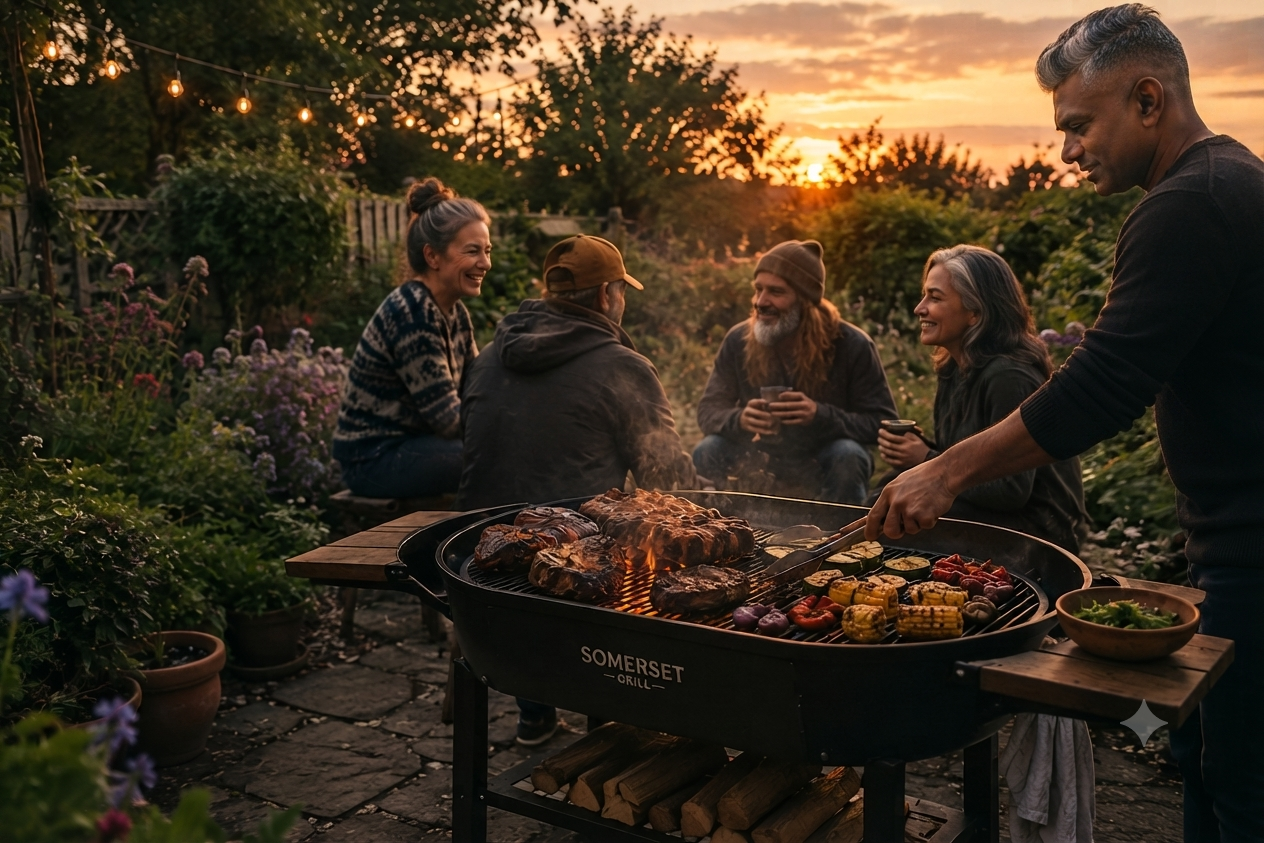
The grill is immediate. The grill is live fire — proper fire, the kind that has opinions and communicates them enthusiastically, usually in the direction of your eyebrows. Cooking over live fire is part craft, part instinct, and part negotiation in which the two parties have incompatible ideas about how the afternoon should proceed.
The fire’s idea of how the afternoon should proceed is, generally, hotter than mine.
This is where the choice of wood comes in. I’ve discovered Sekelbos — a South African hardwood that burns with the sort of reliable, even-tempered consistency that makes you feel, briefly, like you know what you are doing. This feeling is useful. It is also, on occasion, somewhat misleading.
I have learned a great deal from the grill, especially when hoping to entertain friends. Most of it from things going wrong in ways that were both instructive and, in retrospect, quite funny.
There was the incident with the lamb, a pristine white dress and a carpet which resulted in that dish being forever be known as Axminster Lamb. Always cook two.
There was the evening when a door left accidentally open and an unfortunate wind direction meant the downstairs hallway became smoke-filled, causing a few minutes of waving frantically at the smoke alarm with a tea towel.
There was the time I forgot to get honey, which led to the happy discovery that maple syrup is, unexpectedly, actually rather good on barbecued halloumi.
What nobody tells you
Nobody tells you, when you begin cooking over fire, that you will develop feelings about charcoal.
Strong feelings. Considered feelings. The kind of feelings that lead you to stand in a garden centre for twenty minutes weighing the relative merits of two bags of fuel while a member of staff waits nearby with the patient expression of someone who has seen this before.
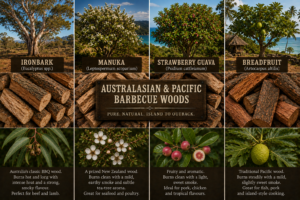
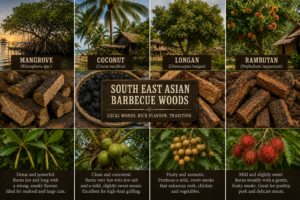
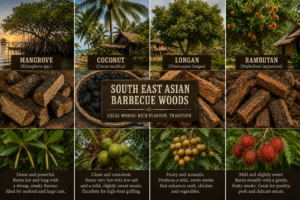
Nobody tells you that you will become interested in wood. Not just any wood — specific wood. The wood matters, it turns out, in the way that apparently everything matters once you start paying attention to it. Different woods produce different smoke. Different smoke produces different flavour. This is the kind of thing that sounds insufferable in the abstract and completely obvious once you’ve tasted the difference.
What surprised me most, however, was that a large portion of the experience is simply standing near a fire with a drink in hand and some friends by your side, watching something cook slowly, having what I can only describe as a very good time for reasons that are difficult to articulate but require no further justification.
This last part is, I think, what it is actually all about..
The right moment
I came to love fire cooking at the right moment, which is to say: when I finally had the time to do it properly. I have always enjoyed it, but turning it from an occasional pleasure into a genuine hobby requires something the earlier version of my life didn’t always provide: time. Time to read. Time to experiment. Time to chat to the butcher. Time to get it wrong often enough to start getting it right.
Smoking a brisket is not a lunchtime activity. It is an all-day, all-night commitment, a project, a thing that requires you to be around and available and willing to check a temperature gauge at intervals that others will describe as obsessive and you will describe as diligent. These are the same behaviour, viewed from different distances.
The grill requires an afternoon. The smoker requires rather more.
Both require the particular quality that the previous chapter of life — the rosters, the schedules, the being somewhere specific at a time that was decided in advance — didn’t especially reward: the willingness to let something take as long as it takes, and to enjoy the entirety of the time it’s taking rather than trying to get to the end of it.
I find I am quite good at this, which has come as something of a pleasant surprise.
The fire helps. There is something about tending a fire — building it, reading it, keeping it controlled — that makes the waiting feel purposeful rather than passive. Something is happening. You are part of it. The afternoon is not being spent; it is being used.
And at the end of it, there is food that tastes of time and wood and the particular satisfaction of a thing done at its own pace, by someone who had nowhere else to be.
Which is, as far as I can tell, an excellent way to spend any day.
Even when it occasionally tastes like charcoal.