Letting the Dog Out
On roe deer, ringed fruit trees, and the garden’s other residents.
Most mornings begin the same way, more or less. Whoever wakes first lets Otis out and gets the coffee going — an arrangement that evolved rather than was planned, the way these things tend to happen. There’s no ceremony to it. We walk him down to the bottom of the garden and into what we loosely call the field. He does what he needs to do, and trots back in with the look that can only mean right, what’s for breakfast?
One morning, it was my turn.
One morning, he didn’t crack on with his usual enthusiasm.
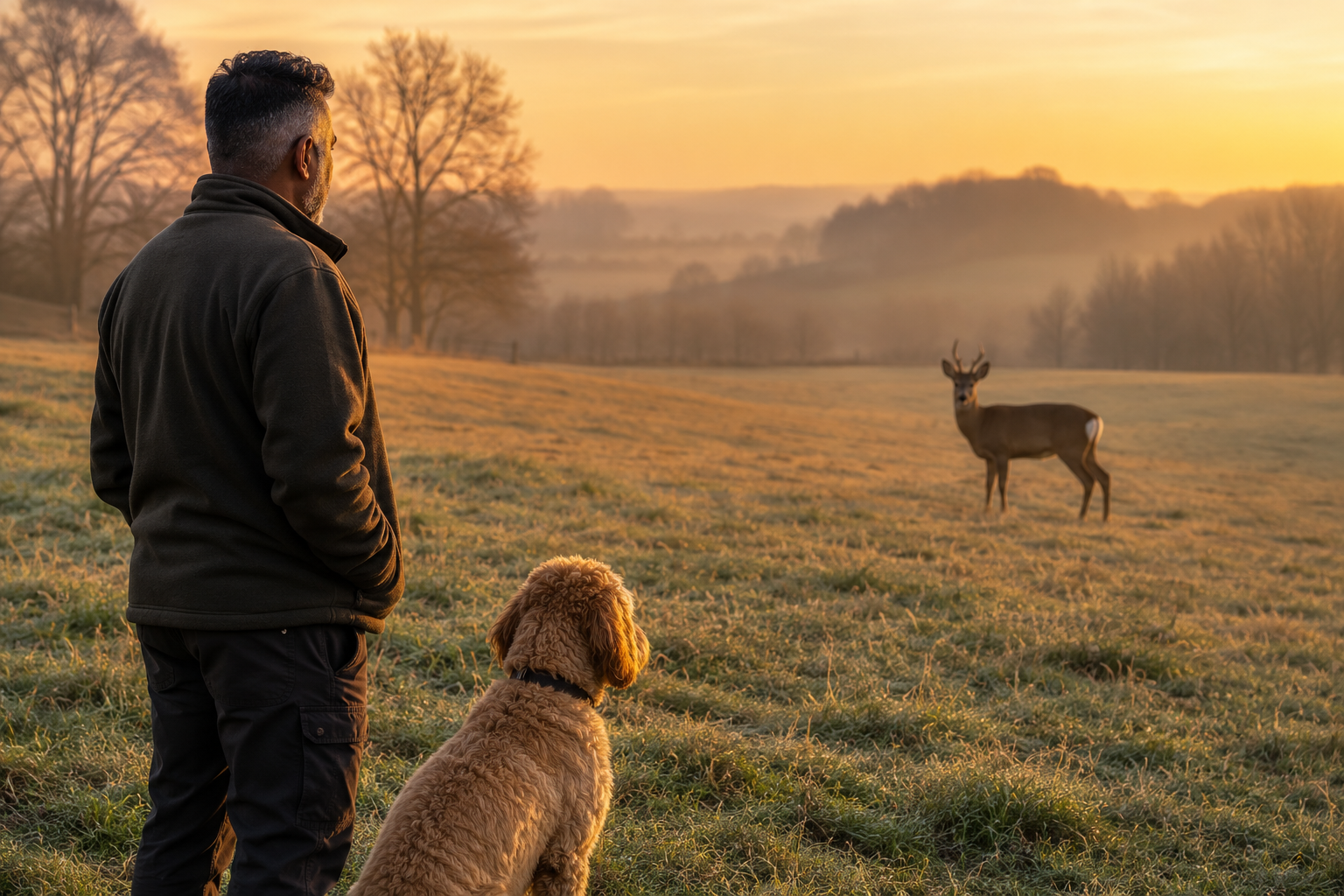
He’d spotted something. At the bottom of the field, a roe deer was standing, quite calmly, having what I assume was its own version of an entirely ordinary morning.
The approach
Otis went rigid. Ears up, every muscle aimed at the deer, the doggy equivalent of someone spotting a celebrity across a restaurant and trying very hard to look like they haven’t. Without the inevitable selfies.
A deer coming to visit is a rare event, even in Hampshire, so I was absolutely going to try to get a closer look. I crept closer. Otis crept closer with me, matching my pace exactly — though “matching” is doing some work there. It took a constant, murmured back-and-forth: Otis, sit. Otis, stay. Otis, come. Otis, sit. Repeated, for the whole slow stalk across the field, with Otis treating each one as a fresh and exciting instruction rather than the same three he’d already had several times. His tail thumped harder and harder against the ground as each sit brought him a little closer to our guest. Normally his pace and mine have very little in common, so for a while I genuinely believed I’d cracked dog training.
The deer carried on doing whatever it is deer do while standing in a field at dawn, which appears to be mostly just standing. It regarded me with what I can only describe as mild curiosity — the kind of look that might have been translated as you’re up early. Normally it’s your wife.
Twenty metres. Fifteen. This was going rather well.
It did not continue going well.
At some point — I couldn’t tell you exactly when, because it happened too fast — Otis, sit, stay and come simply stopped working. My voice had been downgraded to ambient noise. Otis reached the limit of excitement he could be reasonably expected to contain, and went from rigid to absent in half a second, barking the specific bark that probably translates as hello, hello, hello, HELLO.
The deer, which had been watching all this with what I can only describe as mild composure, reassessed the situation, took offence, and left. Not hurriedly. Just very determinedly. The way you’d leave a conversation with someone who’d suddenly started shouting.
What happened just before that
For the length of time it took to creep slowly across the field, before Otis registered his disagreement with how the morning was going, neither of us said anything to the deer, and the deer didn’t say anything to us.
It was just there. Getting on with being a deer, in a field, at an hour when it presumably assumed — not unreasonably — that nothing with interest in its presence would be awake yet.
I thought about that space of time more than I expected. Nothing happened in it. That was the point. We were part of the scene — at least until Otis went to introduce himself. The deer wasn’t in my world, we were in his.
In Otis’s defence
Otis isn’t a ferocious dog. He’s a friendly soul whose expertise in convincing you to share your dinner compensates for the lack of anything resembling a hunting instinct.
His approach to any new arrival — human, canine, or apparently cervine — is roughly: hello, I’m Otis, what’s your name? And if a plate of food is involved, can I have some of that?
The rabbits know this. We have a fair number of them invading our garden, and most days they regard Otis with the specific indifference of someone who has seen this dog before and isn’t going to let it interrupt their digging up the lawn. Oh, it’s only Otis.
Even on the rare occasions he decides to give chase, it’s a half-hearted affair on both sides. Otis, because he wouldn’t have the faintest idea what to do if he ever actually caught one. The rabbit, I suspect, having reached more or less the same conclusion about him.
The regulars
Otis and I see quite a lot of this, especially since I started paying attention — usually with rather less barking, though I wouldn’t want to overstate his self-control.
Roe deer occasionally, generally at a respectful distance, regarding us the way you might regard someone who’s wandered into the wrong meeting. Muntjac most often — smaller, somehow always slightly more startled-looking, as though they’re still surprised to be roaming wild in Britain when their natural home is South Asia. Rabbits constantly, in numbers that suggest dedication. And overhead, on the better mornings, a red kite or a buzzard, doing slow circles with the unhurried confidence of something that knows exactly where breakfast is and isn’t in any rush about it.
It’s a genuinely remarkable thing to have on your doorstep. I don’t think I’ve fully got used to it. I hope I don’t.
The bit that isn’t charming
To my amazement, I have discovered that trees and nature don’t always mix. At least not in the way I’d prefer.
We had a hard winter (for Hampshire) — proper snow, the kind that sits for days rather than hours, burying most of what a deer or a rabbit would normally find to eat. At some point during it, five of the fruit trees in the garden got ringed: the bark eaten away in a complete circle round the trunk, from ground level to roughly the height a deer could reach, or a rabbit standing on a drift.
Ringing, I have learned, is about as bad as it gets for the tree. The bark carries the layer just beneath it that moves water and nutrients between roots and branches, and once that’s gone all the way round, the tree is effectively cut off from itself. It doesn’t matter how healthy the roots are, or how green the leaves still look that spring. The supply line is gone, and there’s no reconnecting it.
By spring it was obvious they weren’t coming back. Five trees. Several years of growing, in some cases. Gone.
It wasn’t malice. I think it was a hard winter, not much else on the menu, and bark turning out to be food if you’re hungry enough. We almost got snowed in. The deer and the rabbits seem to have had a difficult few weeks too.
The bit that’s actually the point
That morning, with Otis, the snow was long gone. The field was just a field again, and the deer at the bottom of it was just standing there, entirely unbothered, having what looked like a perfectly comfortable morning.
This might well have been the same deer — or near enough — that had spent part of the winter working its way round my apple trees, because the snow had taken everything else off the list.
I’d assumed, when we bought the property, that the garden was mine — that I plant things, the things grow, and that’s the arrangement. The deer never agreed to that arrangement. And in a winter hard enough, I suspect I wouldn’t either, if bark were what there was.
Nature, it seems, doesn’t really do orderly arrangements. It doesn’t wait for invitations and it doesn’t issue apologies. Some mornings what it has to say is a deer, standing quietly, completely unbothered by your presence. Other mornings, in the snow, what it was saying was sorry about this — it’s been a difficult winter, and your tree is what there is. But thanks for the snacks.
What I’m doing about the trees
Buying tree guards, mostly — the plastic kind, wrapped right up as high as I can get it, because apparently deer can reach further than you’d think. And accepting — slowly, and with the occasional muttered word about the price of tree guards — that this was always going to be a shared arrangement, and that the bits I don’t enjoy are the price of admission for the bits I do. Even when those bits get gate-crashed by Otis before I’ve had a proper look.
I don’t know what tomorrow’s five minutes will involve. Most days, nothing. Some days, a deer. The trees, increasingly, are wearing little plastic sleeves, which doesn’t feel like much of a peace treaty, but it’s the one I’ve got.
In Hampshire, apart from the occasional badger or a fox with an eye on someone’s chickens, what visits is usually fairly placid. I’d love to know if you have more challenging visitors, and how you’ve found the equilibrium in your own arrangement.