Regional Wood Fired Cooking: From the Texas Pit to the Pacific Earth Oven
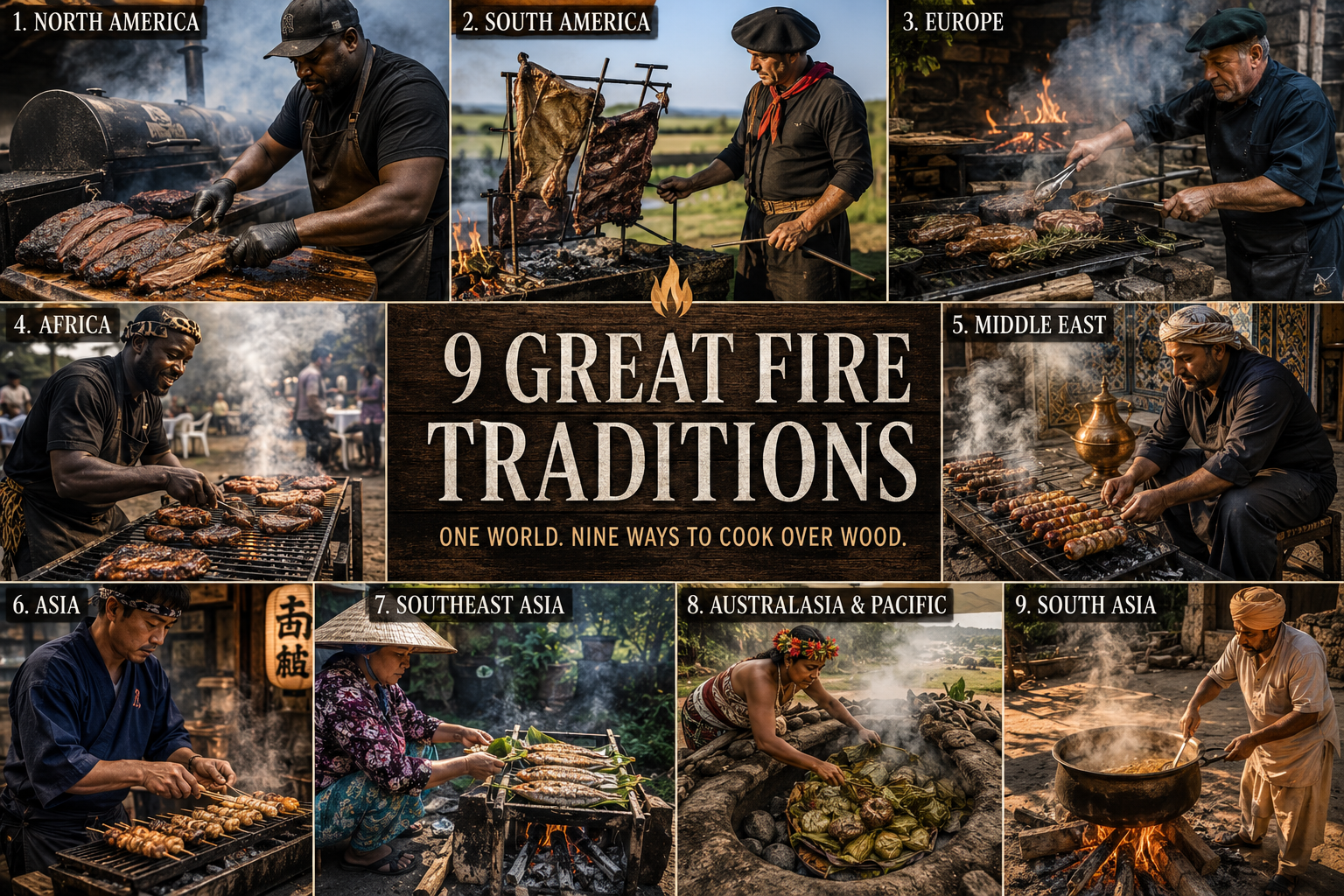
A fire is the oldest kitchen there is, and every culture has, over time, worked out its own way of cooking over it. This is a tour of wood-fired cooking around the world — the traditions, the specialities and the wood that make them — a light touch here, but if you want more there are in-depth guides to each region linked along the way.
When I was a child, I watched a man cook a biryani over a wood fire in a garden in Sri Lanka. He had been hired for that alone — a specialist, brought in for a wedding feast because it needed to be done properly, and for such an important occasion, it was something you did not simply attempt yourself. The memory has stayed with me for the better part of a lifetime: the primal, basic nature of cooking over a fire built on the ground contrasting with the deliberateness of it, a whole afternoon surrendered to one pot and one fire, and a man who knew exactly how that fire should behave and was in no hurry to rush it. It was only much later in life that I started to understand the skill, and that man’s art.
What I was watching, I see now, was a philosophy — a particular, inherited idea about how fire and food should meet. And the older I get, and the more time I spend at my own fire in the Hampshire evening with my dog Otis pretending not to watch, the more I’ve come to think that this is the real subject. Not the barbecue as a piece of equipment, and not even the wood exactly, but the fact that every corner of the world has looked at a pile of burning timber and arrived at a different, deeply held answer to the question of what to do with it.
So this is that tour.
In the vague hope that somebody other than my wife and my mother is reading this, I have looked at nine regions, having their own philosophies, the dishes each is proudest of, and — because the character of a fire really does live in what you feed it — the woods behind them.
Each region gets its sketch here and a full guide of its own, where the deep detail lives. You can read it straight through, or treat it as a map and drop into whichever fire you fancy — the asado, the braai, the tandoor, the Pacific pit.
The shared grammar of wood-fired cooking
Before the differences, the things everyone agrees on.
The first is patience. Almost nobody who cooks seriously over wood cooks over flames unless they are cooking in a pot; they cook over embers, having burned the wood down first and learned to read the grey ash-over-orange glow that says it’s ready. Flame chars and panics; embers give the steady radiant heat that actually cooks.
The second is that the wood must be properly seasoned — in the UK, that means dried a year or more — or it sulks, hisses and coats everything in an acrid, ashtray smoke. I wonder if half the people who say they dislike wood-smoked food have only ever suffered food cooked over wet wood.
Get those two right — embers, and dry wood you can trust — and you have the whole of the shared technique. Everything after that is just local accent.
Is cooking over wood defensible?
It is a fair question to ask before lighting anything, and one I have started asking myself, standing in the smoke while the news regularly reminds me that setting fire to things is a significant part of the problem.
The reassuring answer is that wood, sourced sensibly, is about as benign a fuel as an open fire allows. A tree spends its life pulling carbon out of the air, and burning it releases roughly what it took in, so well-managed firewood is close to carbon-neutral in a way gas certainly is not. The real villain of the barbecue world is anonymous lump charcoal, a good deal of which is made from tropical hardwood and mangrove of murky origin. So the best thing you can do for your conscience is simply to know what you are burning.
Better still, much of the finest cooking wood is somebody else’s rubbish. Apple and cherry come off orchard prunings, olive from grove offcuts, grapevine from what the vineyards would otherwise throw on the skip, macadamia from the nut farms. You are, in effect, cooking over the trimmings.
And in a few happy cases you are doing the landscape an active favour, because several of the woods on this tour are invasive species where they grow. Rooikrans, the South African braai favourite, is originally an Australian species so aggressive the law now requires landowners to clear it. Mesquite and its South American cousin algarrobo march across grassland the world over. Turning an invader into a bed of embers adds an extra level of satisfaction for a wood fire cook.
None of which makes a barbecue a carbon sink. Smoke is still smoke, and some slow-growing hardwoods — camel thorn, mopane — are sometimes over-cut. The conscientious position is simple: buy wood you can name, favour the by-products and the invaders, and give the mystery sack of charcoal a miss.
Now, the tour.
Britain and Europe
Since this is home, let me start here. The British barbecue is, before anything else, an act of optimism — a nation that fires up the grill at the first ambiguous patch of blue and then stands over it in the drizzle, tongs in one hand, insisting it’s brightening up. We came late to low and slow, and have taken to it with the zeal of the recently converted; and on the rare, perfect evening — for me, a Hampshire garden with the red kites wheeling overhead — I’m not sure there’s anywhere I would rather be.
But the older, prouder British contribution isn’t the grill at all — it’s the smokehouse: Craster kippers, Arbroath smokies, cold-smoked salmon, all fish, wood smoke and patience.
The Continent, meanwhile, grills with far more devotion than we do — Germany swinging meat over the coals on the chain-hung Schwenker, the Balkans turning out ćevapi from the roštilj, Portugal charring sardines and piri-piri chicken, and Basque chefs like Bittor Arginzoniz at Asador Etxebarri are building world-famous kitchens grilling over embers. The continent has its own great smokehouse heritage in the cured hams of Germany and the Alps.
The woods are the temperate hardwoods, and this is where they shine — oak and beech doing the main body of work, apple and cherry lending sweetness to pork and poultry, and, in the south, olive and grapevine prunings perfuming a quick fire. A word of caution though: a few common garden ornamentals and all the resinous conifers are best kept well away from food, and the region’s own guide sets out exactly which to avoid.
Full guide: the grill and the smokehouse of Britain and Europe →
North America
America takes that shared patience to a devotional extreme, then dresses it up as regional rivalry — low and slow, the faith that enough time and gentle smoke will turn the toughest, cheapest cut into something transcendent.
The ‘barbecue belt’ divides into fiercely defended schools: Texas worships beef and brisket, the Carolinas argue over pork and sauce, Memphis stakes its name on ribs, and Kansas City smokes everything and gave the world burnt ends. Outsiders take this for a matter of taste; locally it is closer to a matter of identity, and not a subject to be raised lightly with the locals.
But the tradition is bigger than its belt and older than the United States: the very word comes from the Taíno barbacoa by way of Spanish, and Mexico still cooks true pit barbacoa — lamb steamed underground in maguey leaves — while the First Nations of the Pacific Northwest have roasted salmon splayed on cedar beside the fire for centuries. The woods tell the same story of patience: post oak, mild and steady, is the backbone of Texas brisket; hickory the sweet, bacon-like partner to pork; mesquite fierce and best kept for quick grilling. The one to be wary of on the coals is black walnut, which turns everything bitter.
Full guide: the schools, the pitmasters and the woods of North American barbecue →
South America
If North America worships time, South America worships the fire itself, and the person tending it. The asado is less a meal than a slow social occasion built around embers, and the asador who runs the fire holds a genuine position of honour — to be handed the tongs is a true mark of trust and respect, a sign you have been made master of ceremonies, at least for the important part. Nobody hurries, because not hurrying, and spending the time with other people, is the main point.
An Argentine parrilla is a whole afternoon’s parade — sausages and offal to begin, then the beef, short ribs and flank and skirt, all cut with sharp green chimichurri. Uruguay makes the same claims for its own grill and out-eats everyone; southern Brazil turns it into skewered churrasco and its prized picanha. The fire runs the length of the continent, from a whole Patagonian lamb splayed on an iron cross a la cruz to the Andean pachamanca, buried to steam over hot stones.
The fuel matches the patience: dense, ferocious hardwood burned down to coals that last. Above all is quebracho — the “axe-breaker”, so hard it blunts the tools used to fell it — with its aromatic cousin algarrobo, a relative of mesquite. Keep the fire to honest timber; as elsewhere, the pretty flowering shrubs of a warm-climate garden are there to be admired, not cooked over.
Full guide: the parrilla, the cross and the fires of the South American asado →
Africa
In much of Africa the fire is the gathering. South Africa’s braai is practically a civic institution — ‘we’re having a braai’ is an invitation to a whole afternoon, not just a plate of food — and the philosophy is generous and communal rather than competitive.
A South African braai runs to boerewors — a fat beef sausage coiled like a garden hose — with sosaties, lamb chops, Cape snoek and a cast-iron potjie stew beside the coals. In the townships the same communal spirit becomes shisa nyama, meat bought and grilled on the spot. The fire changes character as you travel: West Africa’s peanut-spiced suya skewers, the slow goat nyama choma of East Africa, and, across the Sahara, the whole roasted lamb of a Moroccan mechoui.
Southern Africa also grows some of the finest cooking wood anywhere, slow-grown in dry country and ferociously reluctant to give up its heat. Rooikrans is the everyday favourite — and, being an invasive Australian import the law requires landowners to clear, it is one you burn with a clear conscience. Dense camel thorn and mopane hold heat for hours; yellow-wooded sekelbos lends a distinctive bushveld aroma. The name to fear is tamboti: a handsome hardwood that is genuinely toxic and has laid entire gatherings low.
Full guide: the braai, the suya and the fires of Africa →
The Middle East
The Middle East has perfected the charcoal grill and the shared table at the same time. At the centre sits the mangal, the open charcoal grill handed down from Bedouin tradition to the whole region, and around it a culture of mezze and hospitality in which the grilling is only half the point.
The kebab alone could fill a book. Persia treats chelo kabab almost as a national emblem — skewers of saffron-stained koobideh, barg or jujeh chicken, fanned over charcoal and laid over rice. The Levant grills shish taouk, lamb and koftaover the mashawi and shaves meat off the vertical spit for shawarma; Turkey turns the same instinct into the ocakbaşıgrill-table, the Adana and Urfa kebabs and the döner that has colonised half of Britain’s high streets. And in Iraq there is masgouf — a whole carp splayed open and stood upright beside a blazing wood fire to roast slowly for an hour, a ritual of the Tigris banks about as old as cooking gets.
Because so much of this is quick grilling work, the fuel is mostly clean charcoal — but wood takes over where it matters, in the open fire beside the masgouf and in the tannour, the clay oven whose wood heat bakes the flatbread and, in the Gulf, wood slow-roasts the lamb and rice of a mandi. Keep well clear of the poisonous oleander that turns up in warm gardens the world over.
Full guide: the mangal, the kebab and the fires of the Middle East →
The Indian Subcontinent
No dish captures the subcontinent’s devotion to fire better than the one that heads every Indian restaurant menu: tandoori. A tandoor is a clay well fired by charcoal or wood to a savage heat, its walls searing naan while chicken, tikka and seekh kebabs cook on skewers plunged into the glow. It does in minutes, with smoke and char, what the sealed-pot dum of a biryani does slowly over gentle coals: the chefs both showing the skill of cooking with fire, but at opposite speeds. Between the two sit the great charcoal kebabs of the north — the melting galouti and seekh of Lucknow, the blistered tikkas of the Punjab — cooked on the sigri, a humble coal brazier that is the subcontinent’s answer to the grill.
But the subcontinent runs far wider than the tandoor. Balochistan roasts a whole sajji upright beside an open fire, cousin to the Argentine cross; Sri Lanka keeps its fire indoors under a clay pot and smokes its tuna months ahead; Nepal skewers sekuwa over hill-wood coals; and everywhere you’ll find the dhungar trick — a lump of glowing charcoal and a spoon of ghee sealed into the pot — lending a curry the aroma of the grill. The everyday fuel is charcoal, from dense babool in the north to coconut shell down the coasts, with mango and tamarind burned when the smoke itself is wanted.
Full guide: the tandoor, the kebab and the fires of the Indian subcontinent →
Southeast Asia
Southeast Asia grills at street level, hot and fast and constant — the brazier lit since mid-afternoon and worked with a hand fan, the food cut small and sold cheap. Satay — skewered, marinated meat over charcoal, traditionally the coconut-shell kind that burns hot and fragrant — spread out of Java across the whole region. Thailand and Laos have their lemongrass-scented gai yang chicken and moo ping pork skewers; Vietnam its charcoal-grilled bún chả; Cambodia and Myanmar their roadside skewers; and the Philippines its chicken inasal and, on a grander scale, lechon, a whole pig turned slowly over embers.
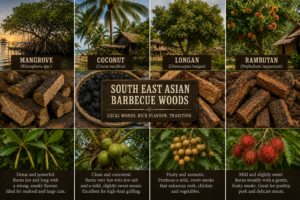
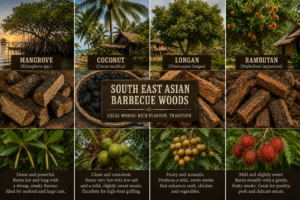
The signature fuel here isn’t wood at all but coconut-shell charcoal — a by-product of the harvest that burns hot, clean and faintly sweet — with the banana leaf doing double duty as wrapper and plate. Keep bamboo off the fire, though: for all its uses as skewer and steamer, it is a grass, not a wood, and burns fast, dirty and is spark-happy.
Full guide: satay, street grills and the fires of Southeast Asia →
The Far East
The Far East splits into four quite separate traditions, united mainly by a preference for clean charcoal over smoke. China alone spans several — the lacquered Cantonese roast meats and char siu, Peking duck crisped in a brick oven over fragrant jujube or pear wood, the cumin-dusted lamb skewers of the Muslim northwest, and the delicate craft of tea-smoking.
Japan sets the global standard for restraint, cooking yakitori and robata over binchotan, a near-smokeless white charcoal so clean and hot that a skewer tastes only of the chicken, with smoke having no part.
Korea turns the meal into a shared performance, grilling bulgogi, galbi and samgyeopsal at the table over oak sutcharcoal.
And Mongolia — whose citizens would not recognise the stir-fry that has borrowed its name — does something older still: khorkhog and boodog, in which the meat is cooked not over the fire but by fire-heated stones packed against it, inside a sealed churn or even the animal’s own skin.
In the Far East, where smoke is wanted it is used sparingly, drawn from fragrant fruit and blossom woods — jujube, pear, sakura cherry — or a mere whiff of a cypress like hinoki. Where clean heat matters most, it comes from binchotan or oak charcoal. As in Southeast Asia, the one to avoid as fuel is bamboo — ubiquitous and endlessly useful, but a grass full of silica that spits sparks and gives nothing good to the food.
Full guide: char siu, yakitori and the fires of the Far East →
Australasia and the Pacific
Australasia and the Pacific treat the fire as the great social leveller. The Aussie barbie is deliberately unpretentious — snags and onions, prawns, lamb, whatever’s fresh — and comes with its own etiquette of ‘bringing a plate’, even as a serious American-style low-and-slow scene has grown up alongside it. The distinctive part is the larder: fat prawns and other seafood straight onto the grill, lamb in every form, and increasingly native ingredients like kangaroo.
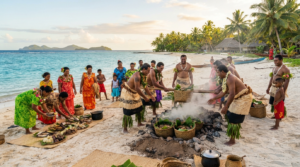
Strike out into the islands, though, and the fire gets lit in underground pits. The great shared tradition of the Pacific is the earth oven — New Zealand’s hāngī, Sāmoa’s umu, Fiji’s lovo, Hawaiʻi’s imu — in which a pit or mound of volcanic stones is heated in a fire for hours, the food laid on top wrapped in banana leaves or coconut fronds, and the whole thing sealed to steam-roast a feast for a whole village. It is the oldest fire-cooking on this tour, and still at the heart of a Māori hui or a Hawaiian lūʻau, where the imu turns out kālua pig, smoky and falling off the bone.
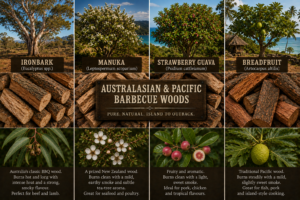
Where the Pacific grills rather than buries, it burns its own timber. Hawaii’s favourite is kiawe, which is simply mesquite run wild across the islands from a single 1828 seedling — an invasive pest that makes superb, sweetly smoky charcoal for huli-huli chicken. Australia’s cooking gum trees — dense ironbark, bold red gum, heavy jarrah — are nothing like the oily ornamental ones, and New Zealand smokes lamb and fish over its native mānuka. Steer clear of those oil-rich garden gums, whose medicinal smoke does no favours to good meat.
Full guide: the barbie and the earth ovens of Australasia and the Pacific →
Back at the fire
Some friends still call me Captain, and my wife once handed me, with a straight face and a great deal of love, a brown leather apron with “Captain of the Barbecue” stamped across the front. I wear it without irony. It is, if anything, a promotion — a command where I still get to decide exactly when we’re ready to go.
I never did learn how that biryani was made. But I think I finally understand: what I was learning was not a recipe, but an attitude to fire that someone had carried, carefully, and set down for an afternoon in a Sri Lankan garden. Every region on this tour is doing the same thing in its own way — the asador at his cross, the pitmaster at his brisket, the yakitori cook at his glowing binchotan. Different answers to the same old question of what to do with a pile of burning wood.
I’ve a great deal of it still to try — fires half-planned for the rest of the summer and into next year, and my wife is all for me learning as many of those techniques as I want. Almost — I expect a discussion about digging a pit in our garden for a village-sized lūʻau may be a very short one indeed. The variety strikes me as good news rather than bad. Retirement is not running out of things to do; it is finally having the time to do them slowly, and on purpose. Every one of these fires has been trying to teach me the same thing, and I have only just stopped rushing long enough to listen.
It is about time.