Australasian and Pacific Barbecue: The Barbie and the Earth Oven
Australasian and Pacific barbecue runs above ground and below it — the barbie, the earth oven, and the buried feast beneath. Part of a world tour of wood-fired cooking.
Somewhere in the Pacific this morning, well before it was properly light, a group of people dug a hole. They lined it with stones — volcanic, for preference, because volcanic rock will swallow an enormous amount of heat without splitting — stacked hardwood over the top and set it going, then left it to burn down for three or four hours while the stones went from cold grey to dull glowing red under a deepening bed of ash.
And then they raked the fire out.
In Texas the fire would still be going fourteen hours later. On an Argentine parrilla the coals get shovelled and shifted right up to the last minute. Here the fire’s whole job is to heat a pile of stones and then get out of the way, and by the time the food goes in there is no flame anywhere near it. The wood-fired tour ends here, in a hole in the ground, with a fire that finishes its work before the cooking starts.
Cooking After the Fire Has Gone Out
An earth oven works on the same principle as a bread oven. The baker lights a fire inside the oven itself, lets it burn down, sweeps out the ash and sets the loaves straight onto the hot floor — what bakes them is heat the brickwork has already taken in. Do the same in a hole in the ground, with volcanic rock in place of brick and wet leaves to turn dry heat into steam, and you have a hāngī. The wood heats the stones; the stones cook the dinner; the earth piled over the top keeps the lot in for the next several hours. Nobody tends it. Nobody can — it is sealed under a foot of soil, and lifting the lid for a look would cost you the meal.
Which makes it a close cousin of the stone-cooked feasts of the Mongolian steppes and a long way from anything you would call grilling. What comes out is not smoky in the barbecue sense so much as steamed through — meat that falls off the bone, root vegetables saturated with fat and juice, everything tasting faintly of earth and of the leaves it was wrapped in.
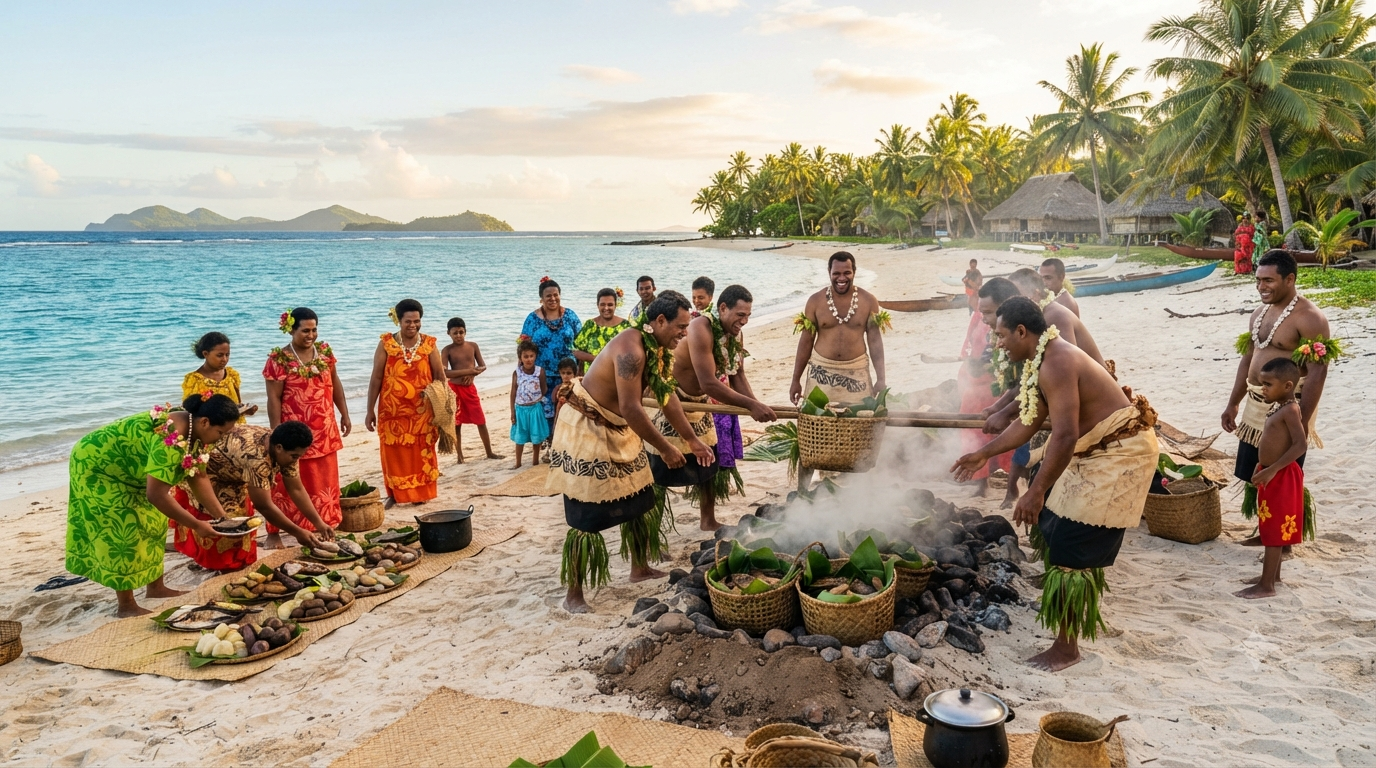
The earth oven, roughly: dig a pit (or, in Sāmoa, build the whole thing on the surface). Fill it with volcanic stones and burn hardwood over them for three to four hours until the stones are glowing. Rake off the embers and any charred wood, level the stones, and lay wet sacking, banana leaves or coconut fronds over them. Food goes on wrapped — pork, chicken, fish, taro, kūmara, breadfruit — then more leaves, wet cloth, and earth heaped over everything to seal it. Then you wait: three hours for a modest one, most of a day for a whole pig. Opening it early is not an option, which is a large part of why it is a group undertaking rather than a solo one.
Nothing else on this tour comes close for age. The technique appears to have begun in New Guinea and travelled outward with the Lapita people, the seafaring ancestors of the Polynesians, who went out across an empty ocean in canoes carrying pigs, taro, and the knowledge of how to cook in a hole. Their distinctive pottery shows their spread as far as Tonga and Sāmoa around three thousand years ago.
You can still hear it in the names. Sāmoa’s umu, Tonga’s ʻumu and Hawaiʻi’s imu preserve the same Proto-Polynesian root, while Aotearoa’s hāngī, Fiji’s lovo and Tahiti’s ahimaʻa became local names for the same ancient technique.
The hāngī is the youngest branch of that very old tree, carried down from eastern Polynesia somewhere around 1250 to 1300 AD by the ancestors of Māori, to the country they named Aotearoa and the maps call New Zealand. Recent only by Pacific standards. Several centuries before anyone in Texas gave brisket a second thought.
Australia has been at it far longer, and arrived from another direction. Aboriginal peoples have cooked in ground ovens right across the continent, and along the Murray River, in the south-east, the evidence is underfoot: low earth mounds made of nothing but the ash, charcoal and burnt clay heat-retainers of ovens dug on the same spot, over and over, for four thousand years. A mound of old dinners.
In the Torres Strait the kup murri is what a family still builds a wedding, a funeral or a tombstone unveiling around — pit dug, stones heated, dugong and turtle and pork and yam going down under leaves and earth, and then everybody waiting.
The barbie sits on top of all that. A twentieth-century suburban arrival, roughly a hundred years old, on ground that has been cooking this way since before Stonehenge.
The Barbie and the Buried Feast
Start above ground, in the back garden. Snags and onions, prawns, lamb chops, whatever the fishmonger had — cooked without ceremony and eaten off a paper plate standing up. Guests bring a plate, meaning a dish for the table rather than an empty one, so the food arrives from all directions and no single host carries the burden of the whole afternoon. It is about as far from the Argentine asador’s place of honour as you can get. The fire belongs to nobody in particular and is not there to impress anyone.
Which was roughly the arrangement at Phillip’s Foote in Sydney, down in The Rocks under the Harbour Bridge, where I ate before it closed: you bought your steak raw at the counter, carried it out to the courtyard and cooked it yourself over a communal grill among the picnic tables, surrounded by suggestions and banter from people you had never met. You were, in effect, paying for the privilege of doing the cooking. Nobody there was the pitmaster, and nobody was pretending to be. A commercial barbie, and none the worse for it.
Australians shorten everything. Breakfast becomes brekkie, afternoon becomes arvo, the service station becomes the servo, and barbecue becomes the barbie. The point isn’t brevity, it’s familiarity — the ceremony comes out of the word exactly the way it comes out of the cooking.
The most famous sentence ever spoken about the barbie was not written for Australians. Paul Hogan’s “I’ll slip an extra shrimp on the barbie for you” went out on American television from January 1984, part of a tourism campaign whose real slogan was “Come and say G’day”. Australians say prawns, not shrimp.
A serious streak runs alongside all that. American low-and-slow arrived and was adopted with enthusiasm, and there’s a proper smoking scene now — Bluebonnet Barbecue in Brunswick East doing Texas-style beef ribs and lamb ribs, Fancy Hank’s smoking brisket on a Melbourne rooftop.
And then there’s Firedoor, in Sydney, which has no gas in the building at all. Lennox Hastie cooks everything over hearth, grill or wood-fired oven, and picks the timber to suit the ingredient the way most cooks pick an oil. He spent six years at Asador Etxebarri in the Basque hills first, which explains a good deal.
But the distinctive thing about Australian cooking over fire is not the method, other than the enthusiasm. It is the larder. Superb seafood straight onto the bars — fat prawns above all, but also whole fish, squid, scallops in the shell. Lamb in every form the animal offers. And, increasingly, native ingredients: kangaroo is very lean red meat that wants a fierce fire and a short time on it, and turns to shoe leather if you treat it like beef, but is delicious if you get it right.
Then strike out into the islands, and the fire goes under the ground.
| Where | The oven | What tends to come out of it |
|---|---|---|
| Aotearoa New Zealand | hāngī | pork, lamb, chicken, kūmara (sweet potato), potato, pumpkin, stuffing |
| Sāmoa | umu (built above ground, on heaped stones) | whole pig, taro, breadfruit, palusami (taro leaves in coconut cream) |
| Fiji | lovo | pork, fish, dalo (taro), cassava |
| Tonga | ʻumu | suckling pig, lu (taro leaf parcels), root crops |
| Tahiti | ahimaʻa | pig, fish, fei (mountain banana), uru (breadfruit) |
| Hawaiʻi | imu | kālua puaʻa — whole pig, salted and smoke-scented |
| Papua New Guinea | mumu | pork, sweet potato, greens |
| Torres Strait | kup murri | dugong, turtle, pork, yam, cassava |
The names change; the method barely does. The hāngī still feeds a hui — a gathering on the marae, the meeting ground at the heart of a Māori community. When the covering comes off and the smell lifts, the formal part of the day is done. In Rotorua they have a shortcut nowhere else can copy: the geothermal field does the work of the fire, and households at Whakarewarewa cook in steam boxes sunk into the ground over natural vents, with sweetcorn boiled in the mineral pools. Same principle, no woodpile.
In Hawaiʻi the imu still turns out kālua pig for a lūʻau — hot stones packed inside the carcass as well as under it, banana trunk and leaf laid over to raise the steam, wet sacking and earth on top, and the whole thing left overnight. What comes out is salted, smoky, and pulls apart under a fork. The wood used to heat the stones is usually kiawe, sometimes ʻōhiʻa — the native Hawaiian myrtle — or guava.
The Invader, the Gums and the Honey Tree
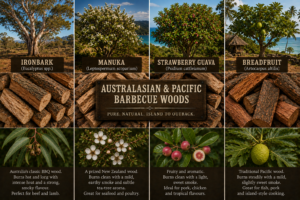
When the Pacific grills rather than buries, it burns its own timber, and the tour’s environmental thread loops shut. Hawaii’s favourite is kiawe — mesquite run wild across the islands from a single 1828 seedling, an invasive pest that makes superb, sweetly smoky charcoal for huli-huli chicken. Australia’s cooking gums are the surprise: dense, clean-burning ironbark and gidgee are a world away from the oily ornamental blue gums that give eucalyptus its bad name; and New Zealand smokes fish over its native mānuka. The real hazard down here isn’t botanical at all — it’s CCA-treated pine, the green-tinged decking offcut that concentrates arsenic in the ash.
For the full account — the mallee root, the eucalyptus myth corrected in full, and the treated-timber warning — see Australian and Pacific Barbecue Wood.
Digging One at Home
An earth oven asks for very little — soil, stones, hardwood, time, and enough people to make the digging worthwhile — and none of it is hard to come by in Hampshire.
What travels:
- Stored heat, not live fire. The wood’s job is finished once the stones are hot, and it comes out before the food goes in.
- Steam under a seal. Wet wrapping and a covering of earth turn dry stone heat into something closer to a very slow braise.
- No lid-lifting. Once it’s sealed you have committed. That is the whole discipline of it.
- A group, and an afternoon. Digging, gathering stones, tending the burn, unearthing it — it is designed around several pairs of hands.
In practice, in a Hampshire garden:
Before anything else: the stones. This is the one part of an earth oven that can actually hurt someone, and it is worth being blunt about it. Porous or water-bearing rock heated to the temperatures inside a burn-down does not crack quietly — the trapped water flashes to steam with nowhere to go and the stone bursts, throwing fragments hard enough to break bone and blind. It can happen an hour into the fire, when you have relaxed and wandered over to look. River cobbles, flint, sandstone, slate, limestone, concrete, breeze block and anything scavenged from a wet ditch are all out. Use dry, dense igneous rock — granite, basalt, gabbro — sourced dry and stored dry, ideally for weeks. Test-fire new stones on their own in an open fire before you ever build an oven on them, from a good distance, and discard any that spit, crack or ring. Keep everyone well back while the fire is burning down, and never lean over the pit to look in.
- Dig the pit. Somewhere around two feet deep and wide enough for the food with room to spare around it.
- Burn hardwood over the stones for three or four hours. Oak, ash, beech — anything that holds a long steady heat. You want the stones properly heat-soaked, not just hot on top. Choose it for heat and not for flavour: every bit of smoke this fire makes will have gone up the garden long before the food goes anywhere near it. Save the apple and the expensive imported chips for the grill.
- Rake out every ember and lay your wrapping. Wet hessian, cabbage or vine leaves, foil if you must. Food in — a pork shoulder, a lamb shoulder, potatoes, whole onions, squash — then more wet layers, then earth heaped over until no steam is escaping anywhere.
- Leave it alone for the afternoon. Three hours for a shoulder, longer for anything bigger. Go for a walk. There is nothing to tend, which takes some getting used to.
- On the grill rather than in the pit, match the fire to the meat. Kangaroo, tri-tip and prawns want a hot fire and a short time. Lamb shoulder wants the long, patient one. Oak or apple underneath anything staying on for hours, and a handful of mānuka over fish — it reaches Britain as imported smoking chips rather than firewood, which is all you want it for anyway.
What’s Left in the Ground
An earth oven strips cooking with fire back to the parts you cannot do without: fire, stone, leaf, earth, time and company. No grill. No fuel debate. No argument about sauce. The wood matters enormously and then, halfway through the afternoon, stops mattering at all, which is not something you can say about any other fire in this series.
And there is a tidy closing of the circle in the woodpile. The kiawe smoking under a Hawaiian imu is the same mesquite that opened the tour in the Americas, carried across an ocean as a single seed by a single priest, gone spectacularly wild, and ending up as a bed of embers under someone’s dinner. Different answers to the same old question of what to do with a pile of burning wood — and occasionally, it turns out, the identical wood, cooking on the far side of the world.
What draws me to the earth oven, more than the food that comes out of it, is that it requires you to stop interfering. I have spent plenty of evenings turning skewers and shifting steaks about and there is real pleasure in that, but sealing dinner under a foot of earth and then walking away from it feels faintly rebellious.
There are still a great many of these fires I haven’t cooked over, which strikes me as good news rather than bad. Retirement is not running out of things to do. It is finally having enough time to do them properly.
Though, regrettably, probably not the pit. Digging up the lawn is the preserve of the feral rabbits round here, and altering that arrangement would mean a conversation with my wife that I am not confident of winning. A South African friend once talked his parents into letting him dig a pit in their garden for a hog roast. I should find out whether he gives lessons on negotiation.
Further reading
These guides are on their way — this section will grow as the series does.
- In depth look at Australian and Pacific woods
- How to build a hāngī or earth oven in a British garden
- The Aussie barbie, done properly: seafood, lamb and kangaroo
- A guide to Australasian and Pacific cooking woods
- Recipe: huli-huli chicken over kiawe (or mesquite)
Back to the main guide: Wood-Fired Cooking Around the World