Far Eastern Barbecue Wood: Ubame Oak, Lychee, Jujube
Far Eastern barbecue wood, from ubame oak and binchōtan charcoal to lychee, jujube, pear and sakura across Japan, China and Korea — and the one tree to keep off the fire. Part of a world tour of wood-fired cooking.
A lychee orchard is pruned every year of its working life, and Dalingshan, in Dongguan, has a great many lychee orchards. The town has spent something over six hundred years burning the offcuts down to charcoal and roasting geese over them. Nobody planted a lychee for firewood. The firewood is what was left over.
Almost every wood in this guide has a story of that shape. The Far East has the most exacting charcoal craft in the world, and it did not arrive at it through theory. Japan made white charcoal out of a scrubby coastal oak that was no use for building. Beijing roasts duck over jujube and pear because north China grows jujubes and pears. Korea burns oak because Korea has oak.
The fires themselves — the char siu oven, the Xinjiang trough, the yakitori counter, the Korean table, Mongolia’s hot stones — are covered in Far East Barbecue. This is the guide to what they burn.
Before the lists
None of this is authoritative. It is gathered largely from what is published online, alongside regional cooking traditions and general reading, and I am a cook rather than a botanist or a toxicologist. Common names cover several different trees, species get muddled between countries, and the same wood is often described in contradictory ways by people who all sound confident.
Use it as a basis for your own research rather than a reliable indication of what is safe to cook over. If you are not certain what a piece of wood is or what harm it might do to you, do not put food above it.
The four tiers
Great — worth going out of your way for. Burns clean, holds heat, and either adds a flavour you want or stays usefully out of the way.
Fine — sound fuel. It will cook your dinner and nobody will ask what you used.
Avoid — not harmful, but the food or the fire suffers: poor heat, foul smoke, or a flavour that fights what you are cooking.
Dangerous — the smoke, sap, dust or ash can genuinely injure. No technique makes these acceptable. The regional entry here is a tree the region has been cultivating deliberately for three thousand years.
A few entries are aromatics rather than fuels: burned by the handful for scent, never used to cook over. Those are marked in place.
The great woods
| Wood | Where | Smoke | Burn | Best with |
|---|---|---|---|---|
| Ubame oak — binchōtan (Quercus phillyraeoides) | Wakayama, Kōchi, Shikoku | None to speak of | Extremely long, very high radiant heat | Yakitori, unagi, anything grilled close and fast |
| Kunugi and konara oak (Quercus acutissima, Q. serrata) | Honshū, Kyūshū, Korea | Light, clean | Long, steady | Japanese black charcoal; also the wood for smoking katsuobushi |
| Mongolian oak (Quercus mongolica) | Korea, northeast China, Hokkaidō | Light, dry | Excellent coals | Chamsut — Korean oak charcoal, the fuel of Korean barbecue |
| Lychee (Litchi chinensis) | Guangdong, Guangxi, Fujian | Sweet, fragrant, distinct | Dense, slow, long | Cantonese roast goose and roast pork |
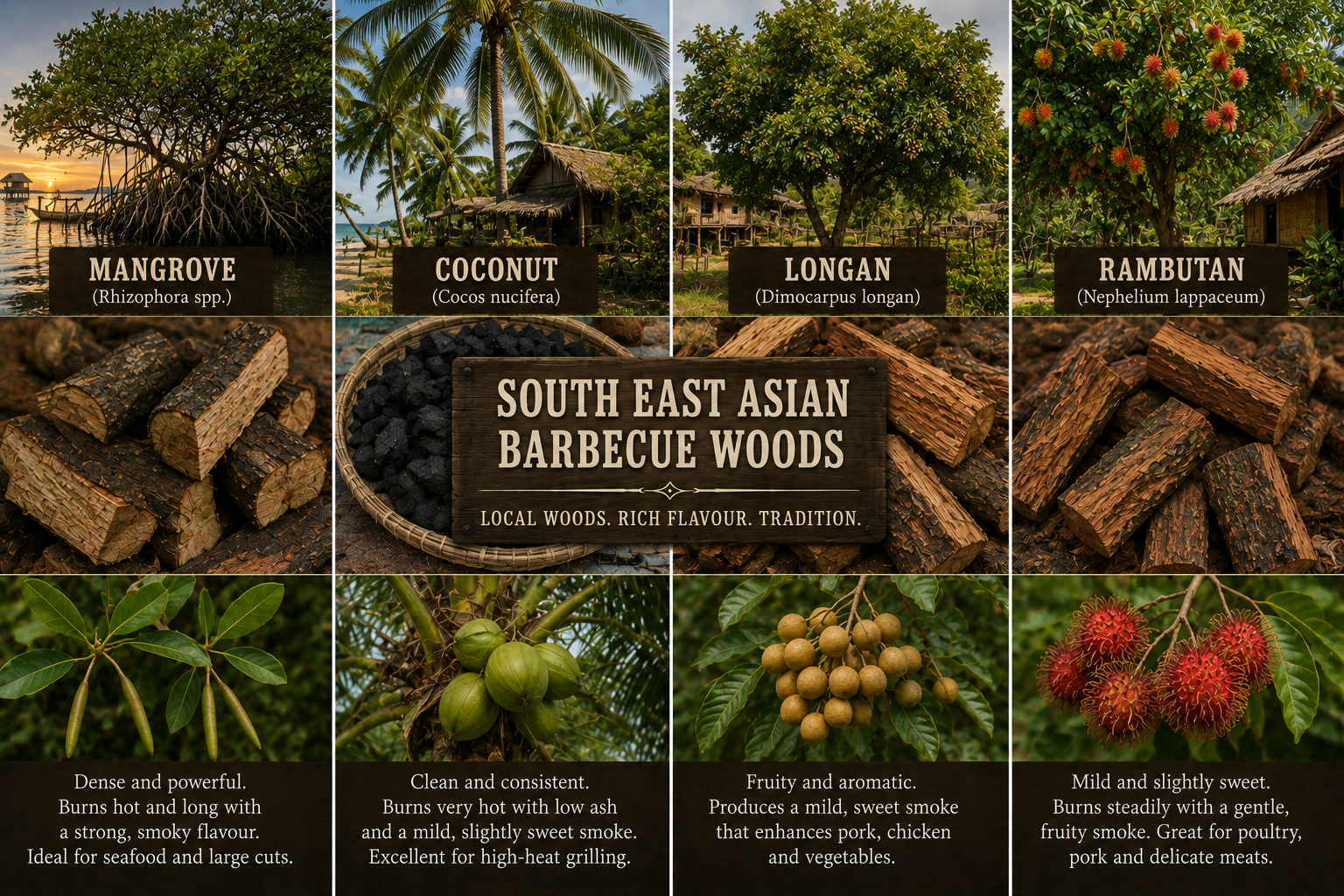
| Longan (Dimocarpus longan) | Guangdong, Fujian, Taiwan | Sweet, gentle | Dense, long | Taiwanese sausage, roast meats |
| Jujube / Chinese date (Ziziphus jujuba) | North China | Sweet, mild | Dense, good coals | Peking duck in the open guàlúoven |
| Pear (Pyrus spp.) | North China | Light, sweet | Moderate | Peking duck; the classic alternative to jujube |
| Peach and apricot (Prunus persica, P. armeniaca) | North and central China | Sweet, light | Moderate | Roasting and grilling |
| Cherry — sakura (Prunusspp.) | Japan | Sweet, distinctly floral | Moderate | Japanese smoked foods; the standard sakura smoking chip |
| Apple (Malus spp.) | Shandong, Hokkaidō, Korea | Sweet, gentle | Moderate | Poultry, pork |
| Camphor (Cinnamomum camphora) | Sichuan, southern China, Taiwan | Powerful, menthol-like | Aromatic, not a fuel | Zhangcha duck. See the note below |
| Sugarcane bagasse, rice, tea leaves, pine needles | Southern China, Sichuan, Hunan | Sweet, tannic, resinous depending | Smouldering material rather than fuel | Chinese hot-smoking; a whole technique of its own |
Four in detail
Binchōtan is the most refined fuel in this series and possibly in the world, and the part that belongs in a guide to trees is the species. Ubame oak is a scrubby, twisted coastal thing, too hard and too crooked to build with, growing on ground that suits little else. The entire tradition rests on somebody having found the one job it was extraordinary at. Carbonised at around 1,000°C and quenched with damp ash and sand, it comes out close to pure carbon — which is why it burns almost without flame or smoke, and why the pale surface gives white charcoal its name.
Lychee wood does the opposite job. Where binchōtan is prized for adding nothing, lychee charcoal is chosen for the fragrance it puts into the skin of a goose. Dongguan’s roast goose tradition is built on it, and Sham Tseng roast goose in Hong Kong is the same idea. The pruning cycle of a lychee orchard supplies the fuel; nothing is grown for the purpose.
Jujube, pear and peach are the north Chinese duck woods, and all three are orchard prunings rather than anything felled for the purpose. They matter because a Peking duck oven is one of the very few Chinese fires where the wood is chosen for its smoke rather than only its heat — a faint sweetness on the skin, and not much more than that.
Camphor (Cinnamomum camphora) is a seasoning here rather than a fuel — a small quantity of leaves and shavings, burned briefly under Sichuan tea-smoked duck, giving the menthol note that names the dish. Two things to be clear about. Natural camphor used that way is long-established and traditional. Synthetic camphor is toxic and must never be substituted for it.
Korea, Taiwan and the steppe
Korea grades its charcoal the way Japan does, which is worth knowing before you buy a bag. Geomtan is black charcoal — kiln-cooled, easy to light, burning fast and warm. Baektan is the white kind, taken to high temperature and quenched with ash, and it is the Korean equivalent of binchōtan. Both are usually Mongolian oak.
Taiwan built a considerable smoking tradition on longan, grown across the south of the island. Longan-smoked sausage and longan-dried fruit come out of the same orchards, and the wood is prized for the reason it is prized in Guangdong: sweet, dense and slow.
Mongolia and the Tibetan plateau have almost no wood at all. The fuel across the steppe is argal, dried dung, which burns slowly and evenly and produces a great deal of smoke. It earns a place here mainly as a reminder that a wood list is a luxury of places that have trees.
The fine woods
| Wood | Smoke | Notes |
|---|---|---|
| Chinese chestnut (Castanea mollissima) | Mild | Sound fuel; spits when it first catches |
| Mulberry (Morus alba) | Sweet | Sericulture pruning residue, widely available in China |
| Walnut (Juglans regia, J. mandshurica) | Heavy, can turn bitter alone | Blend with fruitwood |
| Birch (Betula spp.) | Light, faintly sweet | Northeast China, Hokkaidō, Korea. Fast burn |
| Japanese cherry birch, mizunaraand other oaks | Clean | Mizunara is a prized cask oak and rarely burned; the offcuts are excellent |
| Bamboo (dry, split) | Light, grassy | Fine split and dried; excellent as a vessel. Green and whole, it bursts |
| Argal — dried dung | Earthy | Mongolia and the Tibetan plateau, where wood is scarce. The standard hearth fuel across the steppe |
Woods to avoid
- Softwoods as barbecue fuel — sugi, hinoki, akamatsu, larch, Chinese fir. Resinous and sooty over a live fire. Sugi and hinoki do have a real place in the kitchen as planks, boxes and vessels, where the wood scents food without ever being burned — the same logic as North American cedar planking. And Hunan and Sichuan genuinely do smoke cured pork over cypress and pine branches, but that is a slow cold smoke and does not generalise to grilling.
- Green, unsplit bamboo. The sealed sections burst.
- Paulownia and poplar. Very light, very fast, almost no coals.
- Driftwood. Salt in the wood means chlorides in the smoke.
- Any wood not clearly identified after a garden or hedge clearance. See the next section, and particularly the lacquer tree.
- Treated and salvaged construction timber. Preservatives, adhesives, paint.
- Firewood and charcoal from restricted areas of northeastern Japan. After the Fukushima Daiichi accident, Japan set caesium limits for firewood and for charcoal, and some prefectural produce was restricted from distribution. The rules have changed several times since. If you are buying Japanese charcoal, this is worth a current check rather than an assumption.
Dangerous woods
The lacquer tree — urushi (Toxicodendron vernicifluum), and the wax tree — haze (T. succedaneum). This is the Far East’s principal hazard and it is culturally central: urushi sap is the lacquer that has coated Japanese, Chinese and Korean bowls, boxes and armour for three thousand years, and the trees are cultivated for it. The sap contains urushiol, the same compound as North American poison ivy. Contact causes severe dermatitis, and the smoke from burning the wood carries urushiol into the airways, where the reaction is dangerous rather than merely miserable. Haze is grown for wax and is just as reactive; its autumn colour makes it a popular ornamental, which is how it ends up in green waste.
Japanese yew — ichii (Taxus cuspidata). Grown as a hedge and topiary throughout Japan, Korea and northeast China. Taxine alkaloids, cardiotoxic, no antidote.
Oleander — kyōchikutō (Nerium oleander). Planted in enormous quantity across Japan along roads, railways and school grounds, because it tolerates pollution and drought. Every part contains cardiac glycosides. It should not be burned in any fire near people or food. There is a widely repeated Japanese story about a fatal poisoning caused by using oleander branches as barbecue skewers; the documented evidence for that specific incident is thin, and what is not in doubt is that the plant is toxic and burning it is a bad idea. If you repeat the skewer story, repeat it as a story.
Japanese star anise — shikimi (Illicium anisatum). Highly toxic, containing anisatin, and easily confused with the culinary star anise (I. verum). It is grown at temples and graves and its wood and bark are burned as incense. It is not a cooking wood and the confusion with the edible species is the reason to know it.
Chinese tallow tree (Triadica sebifera). A spurge — Euphorbiaceae, the milky-latex family — with the irritant sap that implies.
Rhus and sumac species generally. The genus is well represented across China, Korea and Japan and several members carry urushiol-family compounds.
Treated timber, sleepers and painted salvage. Creosote, preservatives, adhesives, and the strong likelihood that nobody now remembers what the paint was.
Buying it in Britain
Binchōtan is available here, imported from Japan and priced accordingly. Buy it once if you are curious, but understand it before you do: it needs a chimney starter and real patience to light, it burns almost invisibly, and it is designed for cooking small things very close to the coals. Used under a large joint on a kettle barbecue it is money burned in the most literal sense.
The practical substitute is Thai or Malaysian mangrove charcoal, which is dense, long-burning and a fraction of the price, or the better grades of Japanese-style white charcoal made in Vietnam and China and sold as “binchotan” without the geography. Both are covered in the Southeast Asia article.
Korean chamsut oak charcoal is worth looking for in Korean supermarkets in the larger British cities, though it is not something the mainstream barbecue merchants carry. Sakura chips are widely sold for smoking and give a distinctly floral note that suits pork and oily fish.
Lychee and longan wood are the hard ones. British cherry is the closest thing in character, and a goose cooked over cherry with the fat rendered off properly is not a poor consolation.
Next in this series: Australia and the Pacific. See also Britain and Europe for what is actually available naturally on this side of the Atlantic.