Far East Barbecue: Char Siu, Yakitori and the Cult of Clean Fire
Far East barbecue spent centuries designing the smoke out — char siu, yakitori over binchotan, Korean tabletop grills, and Mongolia’s hot stones. Part of a world tour of wood-fired cooking.
Here is a thing I have decided about the fire cooking of the Far East: the whole region has spent several centuries trying to get rid of the smoke.
That sounds like a complaint but it is meant as very nearly the reverse. Everywhere else on this tour, smoke is the prize — the thing the cook is chasing, the reason for the fourteen hours and the fussing over which wood. Come east and it turns into a problem to be engineered away. The prized Japanese charcoal is valued precisely for producing almost none of it. The Cantonese roast oven is sealed. Mongolia has dispensed with flame altogether. What is left, once the smoke is gone, is heat and the thing you are cooking, and bringing out its best becomes the goal.
This is the Far East leg of the wood-fired tour, and it is the leg that refused to settle into a single story, or rather, four traditions telling very different versions of the same story. China alone is a continent of fire. Japan has turned charcoal grilling into something close to a discipline. Korea has moved the fire into the middle of the table. And Mongolia barely uses flame at all.
I should say that “Far East” is a convenient umbrella and not much more. It is a phrase written from London, and what it covers here is four traditions with little in common beyond a continent and a preference for charcoal. I use it because the series is organised by rough geography rather than because anybody in Wakayama or Ulaanbaatar thinks of themselves as sharing a barbecue.
What Far East barbecue leaves out
Every one of these traditions has arrived at the same decision: choose your fuel for what it will not add. A Texan picks a wood for the flavour it lays down over a long cook. The cooks here pick a fuel for the heat it gives and the taste it keeps to itself, and then interfere as little as possible.
Where a Texas pitmaster’s art is patience — holding a modest glow for fourteen hours while smoke does the work — the Far Eastern art is mostly purity. Almost everything here is cooked over charcoal rather than wood, and charcoal is simply wood with the smoke already taken out of it: the volatile, sooty, resinous parts have been driven off in the kiln, so what reaches the food is heat and very little else. A brisket is supposed to taste of smoke. A skewer of yakitori chicken is supposed to taste of chicken. Both are considered positions; they just point in different directions.
Which is why the effort in this part of the world goes into the fuel and the fire rather than into rubs, sauces and long hours. The cook controls the distance from the coals, the angle of the skewer, and when to stop.
Hot and clean, in practice: where an American pit runs at 100–120°C for most of a day, a yakitori grill works at several hundred degrees and a skewer is done in minutes. Binchotan, the charcoal that makes it possible, is not cheap but it earns its price in the kiln: the wood is carbonised slowly at around 240°C for roughly five days, the kiln is then taken up to about 1,000°C, and the glowing charcoal is raked out and smothered in a damp mix of earth, sand and ash. That last step is what leaves it dense, pale, ferociously hot and almost silent in the fire.
The history is worth a brief moment, because the tidy modern picture — Chinese roast meats, Japanese grills, Korean tables — hides how much of it arrived from the edges rather than the centre. Char siu is old enough that the name is a fossil: it means “fork roast,” from the long forks the meat was once held on over an open fire in Guangdong, and the Cantonese charcoal oven is the evolution — that fire, walled in. Chuan’r, the cumin-heavy lamb skewer that half of China now eats at midnight, is not a Han dish at all but a Uyghur and Hui one from the far northwest, which only ventured east in the 1980s when economic reform made a street stall possible; even the cumin carries its own history, since the Mandarin ziran comes from the Persian zireh by way of the Uyghur zire, a small linguistic echo of the Silk Road. Korea’s tabletop grill has a long pedigree, and what persists through all of it is the marinade. It starts with maekjeok, marinated meat skewered over an open fire by the nomadic Maek people two thousand years ago. At the Joseon court that became neobiani — the same idea refined, beef sliced thin and grilled over charcoal, and a luxury for as long as beef was one. When cattle grew cheaper, neobiani became the bulgogi anyone can order. The skewer flattened into a grate, the court became a restaurant, and the marinade came through intact.
Even the other great Japanese grill, yakiniku, is a Korean import. It was built after the war by Korean residents of Japan, and built largely out of what nobody else wanted: in the food shortages that followed 1945 they took the beef and pork offal Japanese butchers were discarding, grilled it the way gogigui is grilled, and sold it from black-market stalls. The trade called it horumon, which in Kansai dialect means roughly the things you throw away. Anyone who has read the American leg of this tour will recognise the shape of that story exactly.
So the pattern repeats. The fire arrives with people living at the edge of somebody else’s country, and is claimed as national soon enough afterwards.
From char siu to hot stones
Four countries, and within China several countries’ worth. Here’s the overview at a glance before we dig in:
| Region | The meat | The fire |
|---|---|---|
| Cantonese siu mei | Pork, duck, goose | Charcoal ovens, hung |
| Beijing | Duck | Fruitwood — jujube, pear, apricot |
| Xinjiang | Lamb skewers | Open charcoal troughs |
| Sichuan | Duck | Camphor wood and tea, cold smoke |
| Japan | Chicken, fish, eel | Binchotan white charcoal |
| Korea | Beef, pork | Sut oak charcoal, in the table |
| Mongolia | Mutton, goat, marmot | Fire-heated stones, no flame |
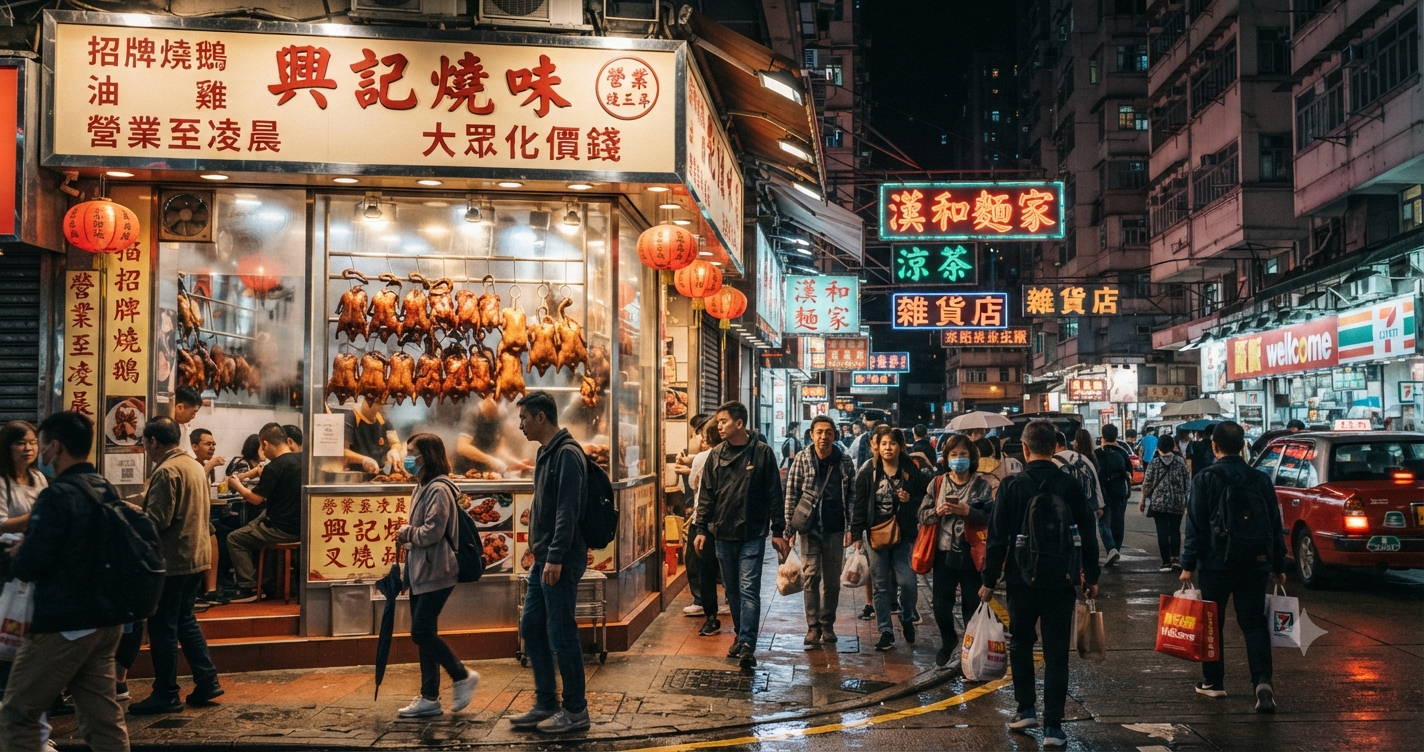
Cantonese siu mei is the roast-meat they put in the window you see in every Chinatown, and it is a proper craft rather than just a restaurant menu item: char siu, honey-lacquered pork; siu yuk, crackling-topped roast belly; and whole ducks and geese hung in tall ovens. The times, though, they are a-changin’. Hong Kong’s charcoal pits have been giving way for decades to the sealed metal ovens the trade nicknamed “Apollo,” after the space capsule they resemble, and by most accounts only a handful of true charcoal roasters are still working the old way in the city. What goes with them is not just sentiment: charcoal throws a fiercer radiant heat, and the fat that drips onto it sends a thin thread of smoke back up through the meat, which is what puts the blistered crackle on siu yuk and the caramelised, faintly smoky edge on good char siu. Gas is cleaner, steadier, far easier to run, and gives a flatter result. Here the old fire is losing and, for no logical reason, this seems a little sad.
Beijing gives us the most famous roast in Asia — Peking duck — and the two prominent houses that make it are the embodiment of the smoke-or-no-smoke question. Bianyifang, trading since 1416, roasts by the menlu or closed-oven method: the oven is heated, the fire is put out, and the duck cooks in stored heat with no flame anywhere near it. Quanjude, founded in 1864, does the opposite — the gualu, or hung oven, open-fronted, the birds turned over a live fire of fruitwood, jujube or pear or apricot, until the skin goes to lacquer and takes a faint sweet smokiness. Six hundred years of doing without smoke, against a hundred and sixty of letting a very little of it back in, and it is the second one that won: when anyone says Peking duck now, they mean Quanjude’s. What this suggests is that maybe the rule here was not no smoke. It was never letting the smoke be dominant. The bird itself is prepared for the fire long before it meets it, too: air pumped under the skin to lift it away from the fat, a scald, a coat of maltose syrup, and then a day hanging in a draught so that what goes into the oven is already dry to the touch. The fire’s contribution is the last hour of a two-day process.
Xinjiang is the night-market take on things: chuan’r, lamb threaded on skewers and laid across a long, narrow charcoal trough, dusted hard with cumin, chilli and salt. The skewers are flat rather than round, so the meat cannot spin as it is turned, and lean meat is threaded alternately with cubes of fat that render down over everything below them. The trough is the clever part — it puts fierce heat directly under the meat and nothing under the cook’s hands. I say this having spent the best part of an afternoon in heat-resistant gloves, turning metal skewers of shish tawook over a grill that had no such consideration for me. There is a strong health and safety case for acquiring a hibachi grill. There is a stronger health and safety case for not raising it with my wife, given what I’ve already bought for the barbecue shelter.
Sichuan shows the folly of trying to put the wood-fired cooking of this area into one box. Counter to my opening paragraph, it smokes. Tea-smoked duck, zhangcha, is cold-smoked over camphor wood and jasmine tea leaves before being steamed and fried, and it is one of the most distinctive uses of aromatic smoke anywhere in the world. Note the order, though. The smoke goes on first, as a seasoning, and the cooking happens afterwards.
Japan approaches the grill the way it approaches most things, by paring back until only the essential remains. Yakitori — skewered chicken, every part of it — and the wider robatayaki, “fireside cooking,” rest almost entirely on one fuel. Binchotan is white charcoal made from ubame oak, fired so hard it rings like metal when two pieces meet. It burns intensely hot, remarkably steady and very nearly without smoke, which is exactly what they value: over binchotan a skewer of chicken, a fillet of fish, or the glazed eel of kabayaki tastes of itself and of clean fire and of almost nothing else.
It is named after a person — Bichūya Chōzaemon, who began making it in Tanabe in the seventeenth century — and the ubame oak it comes from is now the official tree of Wakayama. The little town of Minabe still produces more of it than anywhere in Japan. A charcoal with a hometown and a founder’s name on it shows how seriously this is taken.
Sit at a yakitori counter and the contrast with a smoky street stall could not be sharper. The coals glow a steady, almost smokeless orange. The cook works in near silence, fanning gently, turning each skewer a few degrees at a time, judging by sound and colour rather than by the clock. The only drama is the brief flare as fat meets coal, and the moment a single perfectly charred skewer is set down in front of you.
Korea did something no one else quite has: it moved the fire into the middle of the table and made the meal a shared performance. Gogigui hands the cooking to the diners, who grill their own bulgogi, galbi and samgyeopsal on a grate set into the tabletop. At its best the heat comes from sut, traditional oak charcoal, hot and clean enough to leave the delicate marinades a voice. Half the pleasure is social, and it is a genuine structural difference: the cooking and the eating and the talking all happen in the same place, at the same time. The details follow from that. Scissors rather than knives, because everything is cut where it lies. A grate lifted away and swapped for a clean one when it blackens. Strips of pork fat pushed to the cooler edge to cook kimchi in. And the whole thing wrapped in a lettuce leaf at the end. There is no master at this fire. There is only whoever is nearest the tongs.
Mongolia is the outlier, and fascinating precisely because almost everything most people think they know about it is wrong. The “Mongolian barbecue” of the shopping centre — meat and vegetables stir-fried on a big flat griddle — is a Taiwanese invention that Mongolia would not recognise.
The real thing is cooking by stored heat. In boodog, the older of the two, the animal is boned out through the neck to leave the skin as a bag, the meat is packed back in with fire-heated stones, and it cooks inside its own hide. Khorkhog is the same principle in a container: meat layered with hot stones and a little water, sealed, and left to steam and scorch at once. And khorkhog, the one usually sold to visitors as ancient, is a twentieth-century invention that seems to have begun with Mongolians cooking in discarded Red Army milk churns. As the saying goes there, boodog is the father of khorkhog. The son had a Soviet upbringing.
Binchotan, and the grass that ruins dinner
If the fire is meant to disappear, the fuel has to be immaculate — which is why the Far East makes the most exacting charcoal on earth. Japanese binchotan, white charcoal from a scrubby coastal oak, is the aristocrat: near-smokeless, ferociously hot and expensive. Korea grills over oak sut; China reaches for sweet fruitwoods — jujube and pear for Peking duck, lychee for Cantonese goose — when a little aroma is wanted, and camphor and tea for the one great smoked duck of Sichuan. The one thing to keep out of the fire is bamboo: a grass, not a wood, all silica and bursting sparks.
For the full account — how binchotan is made, the Korean grades, and the region’s one very dangerous cultivated tree, the lacquer tree — see Far Eastern Barbecue Wood.
What travels, and what doesn’t
You cannot import a Wakayama charcoal kiln, and you certainly cannot import the counter, the silence and the man who has spent thirty years learning to turn a skewer. For a tradition that rests on one town’s charcoal and thirty years of practice, it transfers surprisingly well — and it costs less than the American one because it takes less time. The transferable bits:
- Spend the money on fuel, not equipment. This is the one lesson the whole region agrees on. Decent lumpwood charcoal in a cheap grill beats mystery briquettes in an expensive one, every time.
- Small pieces, close to the coals. Minutes rather than hours. It is a weeknight tradition rather than a weekend project, which is its own kind of gift.
- Let the ingredient be the point. Season lightly, and trust something good to taste of itself.
- Aromatic smoke as a seasoning, not a soaking. A little, deliberately, rather than a long bath in it.
On a British kettle or a simple grill, that looks like:
- Build a narrow, hot fire. The Xinjiang trough and the Japanese grill are both essentially a slot of concentrated heat. Bank your coals into a strip rather than spreading them thin, and cook over the glow with the lid off.
- Cook things you can turn. Skewers, chicken thighs, fish, spring onions. Anything that rewards attention over the next five minutes rather than the next five hours.
- Glaze at the very end. Char siu and kabayaki are sweet, and sugar over charcoal burns in seconds. Brush in the last minute or two, repeatedly, and accept a little char as the flavour it is.
- Reach for fruitwood when you want aroma. Apple, cherry and plum are the sensible British stand-ins for lychee and jujube. A single small chunk, not a handful.
- Try the stored-heat idea once. A covered pot buried in embers, or a joint roasted in an oven that has had its fire raked out, is closer to Bianyifang’s duck and Mongolia’s stones than it sounds, and it teaches you how much cooking heat alone can do.
Some of it can’t be bottled. The counter, the tongs, the thirty years to learn when to move the skewer. Those belong where they grew.
But the impression that stayed with me longest is not really about food at all. It is that in every one of these traditions the fire is somebody’s actual craft — not a weekend performance but a trade, learned slowly, done the same way daily for a working lifetime. Which took me straight back to being a boy watching a chef, hired for that one thing and nothing else, cook a biryani over a wood fire in the garden: the first time I understood that cooking over fire could be a deliberate skill rather than a bit of fun with a bag of charcoal.
Forty-odd years later, there are boxes of seasoned apple, cherry and sweet chestnut waiting in my barbecue shelter. Entirely the wrong fuel for a yakitori counter — smoky, generous, everything this part of the world has spent centuries designing out. But the right one for practising the part of it that actually transfers, which is paying attention.
More on Far East barbecue
These guides are on their way — this section will grow as the series does.
- A guide to Far East barbecue fuel
- Charcoal explained: lumpwood, briquettes and binchotan
- Char siu at home: glazing over charcoal without burning it
- Cooking with stored heat: earth ovens, hot stones and the fire you put out
- Recipe: cumin lamb skewers over a narrow charcoal fire
Back to the pillar: Wood-Fired Cooking Around the World, where the Far East sits alongside the Indian subcontinent, Southeast Asia, the Middle East and the rest.