Southeast Asian Barbecue: Satay, Street Grills and the Banana Leaf
Southeast Asian barbecue is hot, small and now — the street grill at its best: satay, the Thai and Vietnamese grills, and the pavement stalls they belong to. Part of a world tour of wood-fired cooking.
A long metal trough, about knee height and the length of a park bench, filled with glowing coconut charcoal. A cook crouched beside it, working a woven fan or a folded scrap of cardboard to keep the coals roaring. Rows of skewers laid across the bars and turned every few seconds in a fast, unthinking rhythm — the fat dripping and flaring, the smoke gusting sideways into the street.
That is the entire apparatus, and it barely changes from Jakarta to Hanoi. It costs almost nothing, it fits on a pavement, and half the reason you stop is the theatre of it before you have tasted a thing.
What it isn’t is an event. Everywhere else on this tour, fire cooking is something you clear a day for — a brisket is a project, yakitori is watching a craftsman. Here it is Tuesday. It is food cooked on the street: the grill has been lit since mid-afternoon, and the man working it will still be there when you come back at eleven. This is the Southeast Asian leg of the wood-fired tour, and it was the one that kept producing another dish every time I thought I had finished.
Why Southeast Asian barbecue is cooked hot and fast
The whole method fits into three words: hot, small, now.
Which is the exact inversion of what America worked out. Where the low-and-slow tradition takes the cheap cut and buys it tenderness with time, Southeast Asia takes the small piece and buys it flavour with marinade. Cut the meat down to something that will cook in four minutes, sit it in coconut milk and turmeric and lemongrass and garlic and palm sugar for a few hours beforehand, then put it over coals hot enough to catch the sugars and edge them towards burnt. The tenderising happens in the bowl rather than over the fire. The fire’s only job is to be fierce, close and brief.
All of which is why the fan matters more than it looks. A pitmaster spends fourteen hours defending a fire against getting too hot; here the whole effort runs the other way, coaxing a small bed of charcoal to give up everything it has for the ninety seconds a skewer is over it.
Stripped of the smoke and the noise, it works out at roughly this:
Hot and fast, in practice: small pieces — twenty to forty grams a skewer — over coals close enough to feel unfriendly, cooked in two to five minutes with near-constant turning. Because the marinades are sweet with palm sugar and coconut milk, they colour and catch quickly, so the basting brush usually comes out only in the last minute. Whole fish and larger pieces go into a banana-leaf wrap, which lets them steam and char at the same time without sticking or drying.
The skewer itself is a well-travelled object. The usual account has satay developing on Java in the early nineteenth century, as street vendors adapted the kebabs arriving with the Indian and Arab Muslim traders who had been coming in growing numbers since the 1700s. Tamil and Gujarati merchants brought technique along the same routes. Chinese cooks in the port cities of Java, Sumatra and the Malay Peninsula contributed two things that turn out to be fundamental — the bamboo skewer, and the habit of cutting food into pieces small enough to eat without a knife. Between them, three cuisines that never met invented a way of eating nobody has improved on since. By the end of the nineteenth century it had crossed the Strait of Malacca into Malaya, Singapore and Thailand, and every one of them has since decided, quite sincerely, that it was theirs all along.
Even the name is disputed, which fits the theme of the whole story. The most-cited derivation takes the Malay sate back to the Tamil catai — a variant of tacai, meaning flesh — which would make the dish’s name a plain description carried over on a trading ship. Others prefer the Hokkien sa te, three pieces — a very Chinese way of counting your dinner. An Indonesian counter-claim has it from the Javanese sak beteng, one stick, and puts the dish a good two centuries earlier than the standard story. Nobody is going to settle that, their faith in the origins of the name as strong as their faith in the origins of the food. What is clear is that the region’s defining dish is an import naturalised so completely that the original has become the footnote. That is a fair description of a great deal of Southeast Asian cooking.
The other thing worth saying is that the street food we now fly out to eat was, for most of its history, a way of not starving rather than a heritage to be protected — and it was not always welcome. Singapore is the clearest case, because Singapore kept the paperwork. In 1966 the health minister put the number of hawkers on the island at forty to fifty thousand, of whom only about a quarter held a licence. A registration drive followed at the end of the decade, and between 1971 and 1986 some eighteen thousand of them were moved off the pavements into purpose-built shelters with running water, electricity and drains. It was a public health measure aimed at a nuisance. In 2020 UNESCO inscribed the result of it as intangible cultural heritage. Nuisance to heritage in fifty years, and the hawkers were consulted on neither.
What kept the trade on the street in the first place, though, is arithmetic. The equipment is a metal trough and a fan. The fuel is a by-product of a harvest. The portions are small and cheap enough to be bought on the way past. A grill like that can be owned by anybody, set up anywhere, and paid for in coins. Hence a cuisine of vendors rather than restaurants, and specialists who are ferociously good at the one thing they do.
The dishes, country by country
The region runs from the Indonesian archipelago up through the mainland, and while the brazier stays much the same, the marinade changes at every border — and, if the locals are to be believed, for some distance either side of it. Laid out, it goes something like this:
| Country | The dish | The fuel |
|---|---|---|
| Indonesia | Satay in a hundred forms, babi guling, ikan bakar | Coconut-shell charcoal, banana leaf |
| Malaysia & Singapore | Satay, ikan bakar, grilled chicken wings | Coconut charcoal |
| Thailand | Gai yang, moo ping, kor moo yang, pla pao | Charcoal, banana leaf, salt crust |
| Laos | Grilled meats and fish, always with sticky rice | Charcoal |
| Vietnam | Bún chả, thịt nướng, nem nướng, chả cá | Small charcoal braziers, often at the table |
| Cambodia | Sach ko ang, lemongrass beef skewers | Charcoal |
| Myanmar | Mixed skewers, grilled to order | Charcoal |
| Philippines | Inasal, lechon, pork barbecue, isaw | Coconut and hardwood charcoal, bamboo spit |
Indonesia is where the skewer is taken most seriously, and the altar is satay — small pieces of marinated meat threaded onto sticks and grilled fast over coals, almost always the fragrant coconut-shell kind. The versions are wonderful and they do not stop coming. Sate ayam in its sweet, dark peanut sauce. Balinese sate lilit, where spiced minced meat is moulded around a stalk of lemongrass rather than a stick, so the skewer seasons the meat from the inside. The beef-and-turmeric sate Padang under its thick golden gravy. And sate Madura, sold by itinerant specialists who have made this single dish a life’s work. Indonesia alone is said to claim well over a hundred kinds. That is a good deal more satay than Britain has sausage, and we are not a modest nation on the subject of sausage. Beyond the sticks, Bali spit-roasts a whole spiced suckling pig, babi guling, over an open fire for a feast, and alongside it run satay’s close relations — ayam bakar, grilled chicken, and ikan bakar, grilled fish, the latter often wrapped in banana leaf and laid over the coals so the leaf keeps the flesh moist and stops it sticking.
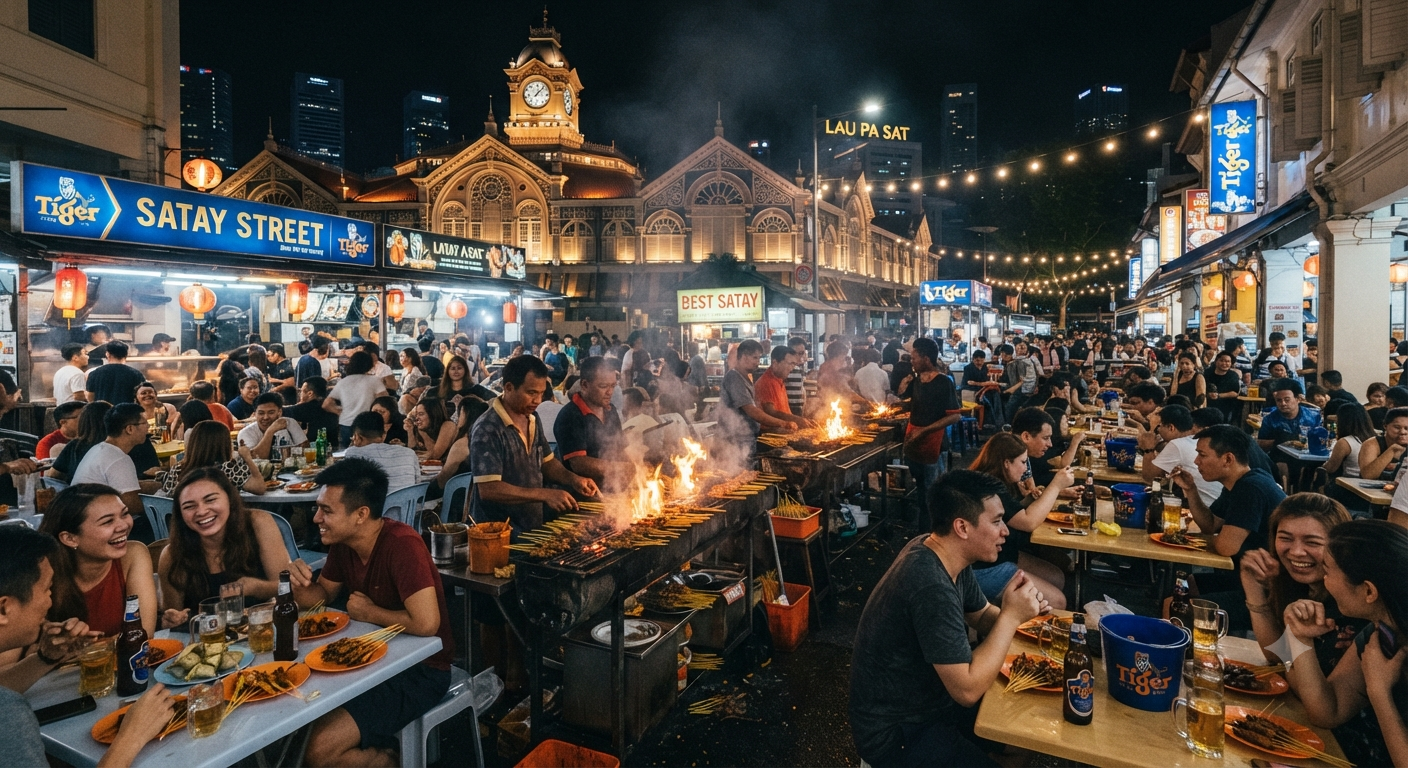
Malaysia and Singapore give us satay at its most refined and ikan bakar at its best, plus charcoal-grilled chicken wings that are worth crossing a city for. This is the part of the region where the grill has been most thoroughly institutionalised, for the reasons above — though the street has a way of reasserting itself. Two places stand for it. In Kuala Lumpur, Jalan Alor sits just off Bukit Bintang and turns after dark into a couple of hundred metres of plastic tables, string lights and charcoal smoke, with satay and grilled stingray going out alongside the barbecued chicken wings at Wong Ah Wah, whose nightly queue is an institution in its own right. In Singapore, Boon Tat Street beside the Victorian ironwork of Lau Pa Sat is closed to traffic every evening and becomes Satay Street — a dozen stalls, tables set out on the tarmac, grilling until three in the morning. Newton Food Centre does much the same trick under a roof. It is the pavement brazier with a postcode, and a face for film besides, turning up regularly in food documentaries and, most famously, as the hawker centre the family descend on in Crazy Rich Asians — luckily, none the worse for it.
On one of my very last flights as a 747 first officer, just about to head off to the 767 for my first command, I took my wife and children to Satay Street. My eldest daughter, who would have been ten at the time, still claims she was the winner of a little interfamily satay eating competition. A self-bestowed title she is obviously proud of. She has since become a vegetarian. A somewhat extreme measure, to my mind, to stop anyone ever challenging her for it.
I hope you will allow me an aside for a bit, and one that is not about barbecue. Singapore was my second trip under training on the 747, and an old training captain took me to Fatty’s and explained on the way why crew go there. The restaurant opened in 1926 as Wing Seong, in a shophouse on Albert Street. During the Japanese occupation the founder and his son carried food out to the mainly Australian and British prisoners of war, at great risk to their own lives. The son was a stout man everybody called Fatty, and in the end the restaurant was called that too. After the war some of those prisoners went on to fly for Qantas and BOAC, and airline crew have been eating there ever since — first out of gratitude, later out of habit, and eventually because the food was very good indeed. The claypot chicken curry in particular.
I went most times I was in Singapore. Fatty’s son ran it for years, and we call him Skinny, affectionately. His own children didn’t want to take it on, and Wing Seong Fatty’s served its last meal at Burlington Square a hundred years after the first one. An institution, a legacy, a culture and perhaps even a habit — all disguised as a street-side restaurant with plastic chairs and an owner who always knew what the crew wanted to eat and who, whatever we ordered, seemed to charge the same each visit. All of it gone with that last meal on 28 June 2026. I suspect most of the younger crew eating there never even knew the story, or what the place was for. Some acts of kindness deserve to be remembered. Maybe this aside is my way of doing just that. And I would still very much like the recipe for that claypot chicken.
Thailand is a grilling paradise, and it is the range that makes it one. Gai yang, the lemongrass-and-garlic grilled chicken, butterflied and pressed flat between bamboo. Moo ping, sweet-savoury pork skewers sold from every market corner and eaten for breakfast without apology. Kor moo yang, grilled pork neck sliced and dipped in a fiery jaew. And pla pao, a whole fish packed in salt and grilled slowly until it steams inside its own crust — the one properly patient dish in a fast repertoire.
Bangkok was my first introduction to Southeast Asian street food. A holiday, years before I was anywhere near longhaul. I could not tell you now what I ate or where I stood to eat it, but the impressions have stayed put. Being a little concerned about the hygiene. Then realising, walking past the stalls, that the intense heat of those braziers and woks was going to render everything perfectly safe. The incredible, exotic taste of it. And the incredulity that one could eat so well for that price.
Laos shares much of this, always with sticky rice to hand — less a side dish there than the cutlery.
Vietnam grills with particular finesse, and with the fire brought closer to the table than anywhere else. Bún chả — smoky grilled pork and patties dropped into a bowl of dressing, the dish that made Hanoi famous — is the star, but there is also thịt nướng, nem nướng, grilled pork sausage, and the turmeric-and-dill grilled fish of chả cá, which arrives at the table still cooking over its own little brazier. So much of a Vietnamese meal is finished, at the last second, over a small charcoal fire, the national position appearing to be that if the food has stopped sizzling, the journey from kitchen to table was too long.
Cambodia and Myanmar run the mainland tradition wider still. Cambodia grills lemongrass-and-garlic beef skewers, sach ko ang, at its roadside stalls. Myanmar’s night markets lay out whole trays of pre-skewered meat, fish and vegetables for you to pick out yourself and hand over to be grilled to order. No menu, no language barrier, and no one to blame but yourself.
The Philippines treats the grill — inihaw — as a national sport, and it is the one country in the region that does the big-occasion fire as enthusiastically as the everyday one. There is chicken inasal, stained gold with annatto and basted with the fat. The pork barbecue skewers sold everywhere. Isaw, skewered and grilled offal: street food in the purest sense, and a fair test of how committed you are to the trip. And presiding over every celebration, lechon: a whole pig turned slowly over coals for four to six hours until the skin shatters like glass. Cebu is the acknowledged home of it, and the town of Carcar, an hour south of Cebu City, is the lechon capital within the lechon capital — a public market whose stalls turn out crackling pigs daily, and where the local claim is that the meat is seasoned well enough not to need a sauce at all. In this region, a considerable boast. Few things on this entire tour are as purely festive, and it is worth noticing that a place built on four-minute skewers still keeps one dish that takes all day. Even the fastest fire tradition wants something to gather around.
Coconut charcoal and the banana leaf
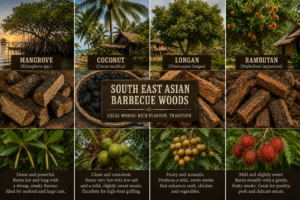
The signature fuel here isn’t a wood at all: coconut-shell charcoal, a by-product of the harvest that lights fast and burns fierce, clean and faintly sweet — exactly what a knee-high pavement trough wants. Britain has nothing like it; we burn the tree, they burn what falls off it. The other great tool isn’t a fuel either. The banana leaf wraps fish and parcels so they steam and char at once without sticking, lines the grill bars, and serves as the plate afterwards, then composts itself — a cooking vessel, a non-stick surface and a plate, with no washing-up and no drawer to keep it in. Between them, a great deal of Southeast Asian grilling runs on what the palm and the plantain give away for free.
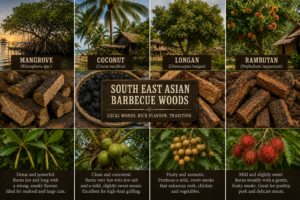
The charcoal itself, though, is a craft worth a book — the mangrove kilns, the six-week burn, and the toxic spurge that shares the forest with the best wood. For all of that, and how to judge a bag, see Southeast Asian Barbecue Wood.
Southeast Asian grilling in a British garden
Of everything on this tour, this is the leg that transplants most easily. There is no twelve-hour commitment here, no expensive cut to ruin, no dawn start and no long afternoon spent nursing a temperature. An afternoon, a bag of charcoal and a bowl of marinade will get you a surprising distance. What actually travels:
- The marinade does the work — coconut milk, turmeric, lemongrass, garlic, palm sugar, fish sauce, given several hours, or overnight if you remember in time. The fire only finishes what the bowl started.
- Small pieces, fierce heat — cut everything down to something that cooks in minutes, and get the coals genuinely hot rather than comfortably warm.
- Constant turning — this is not a put-it-on-and-walk-away tradition. You stand over it, you turn every few seconds, and you accept that being busy is the method. There is no chair in this one.
- Leaves as equipment — wrapping is a technique, not a garnish. It steams and chars at once, and nothing sticks.
And in practice, in a British garden:
- Use coconut-shell charcoal. Widely available online and from barbecue specialists, it gives clean, hot heat and a faint sweetness that suits satay and inasal. It is a by-product rather than a felled tree, too — the other half of the argument for it.
- Cook on a small tabletop grill or brazier rather than a full-size kettle. The scale is much closer to the street setup and it heats up fast — a small, deep bed of charcoal beats a wide shallow one, and you want the food low and close over it.
- Wrap fish or marinated parcels in banana leaves and lay them over the coals for moist, aromatic results. Frozen leaves are easy to find in Asian supermarkets and keep indefinitely; soften them briefly over the heat so they fold without splitting.
- Keep the marinades simple and sweet-savoury — lemongrass, garlic, fish sauce, a little sugar — and grill fast over hot coals, turning often. Anything sweet you want to baste with goes on in the last minute, or you will have carbon rather than caramel.
- Soak your bamboo skewers, and never burn them. Thirty minutes in water stops them going up with the dinner. The tradition is emphatic on this: bamboo is a tool, not a fuel.
What you can’t reproduce is everything around the fire: the specialist who has made one skewer his life’s work, the ninety-second transaction, the fact that the whole thing costs less than a coffee and happens on a pavement in the dark. For that, you buy a ticket. But cut the meat small; give it a bowl of coconut milk and lemongrass and the better part of a day; get the coals hotter than feels sensible; stand over it and turn constantly; and hold the sweet stuff back until the end. The reward arrives in about four minutes, which after a chapter on brisket feels like an outright gift.
There is no bag of coconut charcoal in my barbecue shelter, which I intend to put right eventually. My forays into satay grilling have been over what I had to hand. Embers from Sekelbos logs. The results were delicious, but you can tell the difference. Authenticity is hiding in the coconut charcoal bag. Everything else on this tour has asked me for a day. This one is asking for an afternoon and a decent marinade, and I find I have rather fewer excuses than usual.
Further reading
These guides are on their way — this section will grow as the series does.
- A guide to South East Asian barbecue wood
- Cooking in banana leaf: wrapping, steaming and charring at once
- Coconut charcoal, mangrove and the ethics of the charcoal bag
- Grilling hot and fast: the opposite discipline to low and slow
- Recipe: gai yang, Thai grilled chicken over charcoal
Back to the pillar: Wood-Fired Cooking Around the World, where Southeast Asia sits alongside the Indian subcontinent, the Far East and the rest.