African Barbecue: Braai, Suya and Nyama Choma
African barbecue is a social occasion first and a way of cooking second — the South African braai and much more besides: boerewors, suya, nyama choma, and the long afternoon they belong to. Part of a world tour of wood-fired cooking.
The first thing to get right about a braai is that the word does not name a meal. It names the afternoon.
A South African who says “come for a braai on Saturday” has not told you what you will be eating, only that there will be a fire, that it will be lit some hours before anyone eats, and that the day is now spoken for. The nearest British translation is not “barbecue” but something closer to “we’re having people round” — and even that misses, because ours implies a kitchen where the work gets done out of sight.
This is the African leg of the wood-fired tour, and it takes in a great deal of ground: the South African braai first, since it is the one with the woodpile worth writing about, and then the suya spots of northern Nigeria, the goat roasts of Kenya and Tanzania, the coconut-shell coals of the Swahili coast, Mozambique’s piri-piri chicken and the buried lamb pits of Marrakesh.
More Than a Word for Barbecue
The braai runs on wood, and that distinction matters more than any other in this article. A fire is built and burned down to coals, and the food goes on those coals — not on gas, and traditionally not on briquettes either, though charcoal is common enough now and nobody sensible is precious about it. The wood is the reason a braai takes an afternoon.
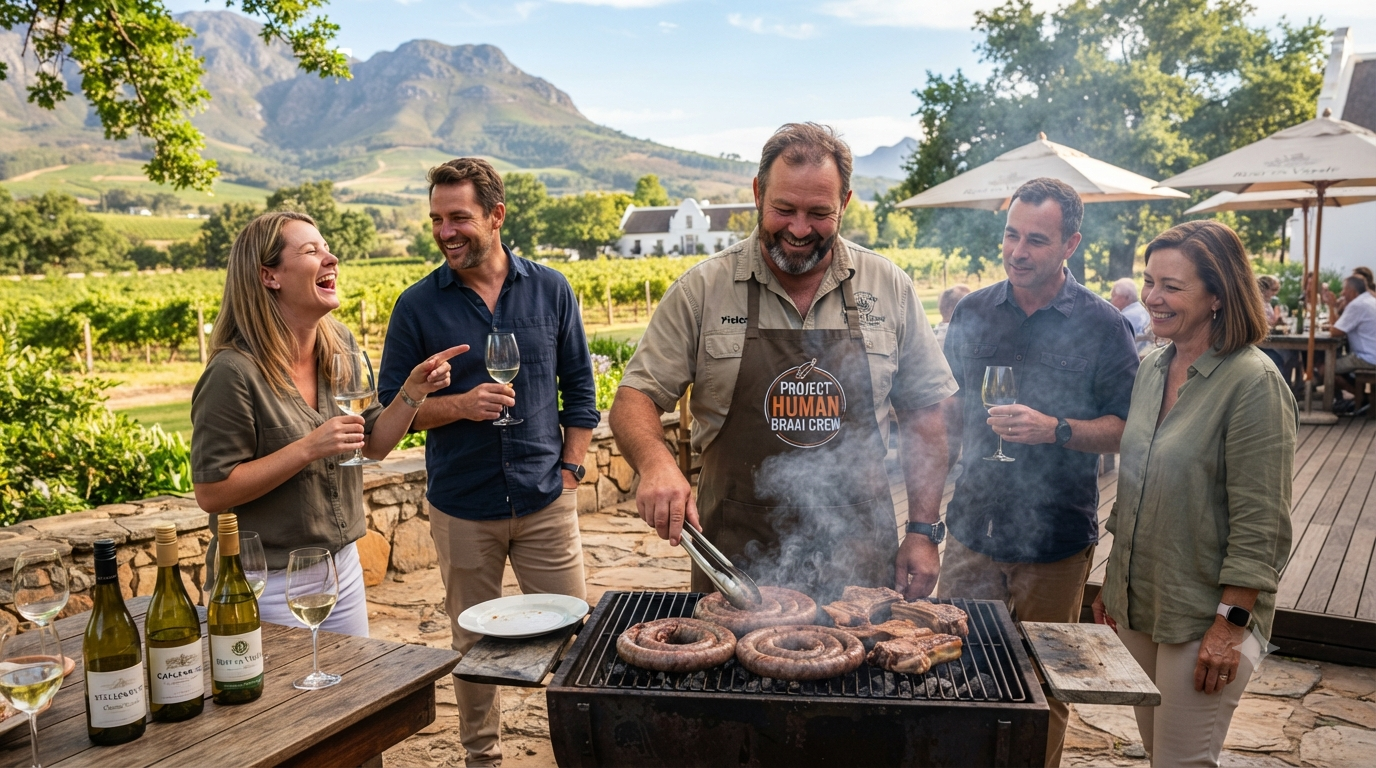
Somebody is in charge of it, and the job has a name. The braai master is usually the host, has traditionally been a man, and comes with one unwritten rule: you do not interfere with another person’s fire. Advice from the sidelines is a national pastime of course; taking the tongs out of his hand is not.
Guests often turn up with meat of their own — a “bring and braai” — because it is an easy way to add to the afternoon, and it is part of why a braai can take in however many people arrive.
A braai, in practice: light the wood early and cook on embers, never on flame. A bed of coals from a dense hardwood wants the better part of an hour before it is ready — flames gone, coals greyed over and glowing beneath. Hold a hand above the grid: three or four seconds before you have to move it is about right for chops and wors. Boerewors goes on in one unbroken coil, ideally turned only once, and is never pricked. The snap test — a trick a South African friend taught me — tells you when it is cooked. The fire is fed at the edge rather than the middle, so fresh coals keep arriving for whatever goes on next. And the braaibroodjies go on last, over the dying heat, because they burn in seconds.
The history is worth having, because the fire came long before the word. The Khoikhoi and San peoples of southern Africa were cooking over open flame as ordinary daily practice for thousands of years, the indigenous root of every fire in this article, and the part most often skipped. Dutch settlers arriving at the Cape in the sixteen-hundreds brought their own grilling habits and, more durably, their own vocabulary: braden, to roast, became the Afrikaans braaivleis, grilled meat, a word in print by the early nineteenth century and eventually filed down by daily use to the blunt little verb everyone uses now.
Its rise to national symbol came later, and not all of it is comfortable. The braai gained real cultural prominence from the 1930s, partly through fundraising gatherings and partly through its adoption as a badge of Afrikaner nationalism. The happier chapter belongs to the new South Africa: since 2005 the country has been encouraged to mark Heritage Day, the twenty-fourth of September, as National Braai Day, a campaign that gained Archbishop Desmond Tutu as its patron and picked, quite deliberately, the one thing almost every South African community was already doing on the same afternoon.
From the Cape to the Sahara
Africa is not one fire. The meat, the spicing, the speed and the scale all change as you move, and only the wood-and-coals part is constant. In brief, before taking them one at a time:
| Where | The meat | The fire |
|---|---|---|
| South Africa — the braai | Boerewors, steak, lamb chops, sosaties, snoek | Rooikrans, swartwattel, sekelbos |
| The townships — shisa nyama | Beef and lamb, bought at the counter | Hardwood coals, at street scale |
| Zimbabwe, Botswana, Namibia | Beef, goat | Mopane and kameeldoring |
| West Africa — suya | Thin beef skewers under yaji | Charcoal, small and fierce |
| East Africa — nyama choma | Goat, whole or jointed | Charcoal, slow |
| Swahili coast — mishkaki | Marinated beef skewers | Coconut shell and hardwood charcoal |
| Mozambique — piri-piri | Spatchcocked chicken, basted | Charcoal, medium and patient |
| North Africa — mechoui | Whole lamb, pit or spit | Olive and oak |
South Africa has a settled cast. Boerewors is the coarse farmer’s sausage, coriander-scented and vinegar-sharp, which arrives as one great spiral and stays that way; it is defined in South African law, with a minimum meat content and strict limits on cereal filler. Sosaties are the local skewer, Cape Malay in origin, lamb marinated with dried apricot, curry spice and tamarind. Then steak, thick-cut rump or sirloin, which for a great many households is the centre of the whole affair; lamb chops; snoek, the Cape fish, split and braaied whole, often under an apricot glaze, and good enough cold the next day to be flaked into a smoorsnoek, braised down with onion and potato; and braaibroodjies, grilled sandwiches of cheese, tomato and onion that punch well above their weight in the national affections.
The steak may well arrive under monkey gland sauce, which contains no monkey or glands whatsoever and never has: it is tomato, Worcestershire, garlic, onion and a good spoonful of Mrs Ball’s chutney, and it is as South African as anything else on the grid.
Alongside sits the rest of the plate, which visitors routinely underrate. Which pap turns up tells you what sort of meal you have walked into: slap pap, loose enough for a spoon at breakfast; stywe pap, stiff enough to slice; and krummelpap, dry and crumbly, which is the braai one and is eaten with the fingers. Over it goes a smoor, tomato and onion braised down slowly into a soft, sweet relish, and the sous of “pap en sous”. Beside it sits chakalaka: carrot, beans, peppers and curry spice, said to have started in the mine hostels around Johannesburg, and sharp enough to hold its own against a fatty chop.
And then there is the potjie, a three-legged cast-iron pot set at the edge of the fire and left to work in the ember-heat for three or four hours. Potjiekos is built in layers — meat at the bottom, then whatever takes longest, then the quick things on top — and it shouldn’t be stirred. That is structure rather than superstition: stir it and the layers collapse and you have made a casserole. The lid comes off to serve, and not much before.
The townships run the same fuel at street scale in shisa nyama — Zulu for “burn the meat”. You buy your cut at the butcher’s counter and it goes straight onto a communal grill to be cooked on the spot, in a crowd, with music going. It is a trade, a social institution and a Saturday afternoon all at once, and for many South Africans it is the braai in its most everyday form.
Zimbabwe, Botswana and Namibia share much of the southern grammar — beef and goat over coals, often at a scale that dwarfs a garden — but burn the great dry-country hardwoods of the interior, which is really why they belong in a row of their own. More on those below.
West Africa works at the opposite tempo altogether. Suya began with the Hausa, up in northern Nigeria and Niger, and has since travelled far enough south and west that you will find it on street corners in Ghana and Cameroon as well. The beef is sliced very thin, usually off the round, which is a cheap cut and would be a tough one if it were not cut so fine — the thinness is what does the tenderising. It goes onto flat sticks and gets painted with yaji long before it goes anywhere near the fire.
Everything depends on the yaji, and it is unlike any rub elsewhere in this series, because its base is groundnut. Kuli-kuli, the pressed peanut cake left after the oil is extracted, is ground to a powder and mixed with chilli, ginger, garlic, cloves and often a stock cube, and it goes on twice: once before grilling and again, generously, after. The peanut toasts against the char and gives suya a savoury, slightly dusty richness — nearer to a satay than to any kebab, though dry where a satay is sauced.
The fire is small — a shallow charcoal trough — and the skewers spend as much time leaning near the heat as directly over it, fanned and turned by the mai suya, the seller, who trades from a roadside stand, and does most of his business after dark. It is served on paper with raw onion, sliced tomato and another handful of yaji. Alongside, in the same tradition, you’ll find balangu, plainer roast meat sold by weight without the spice coating, and kilishi, thin sheets of beef spiced and sun-dried into something close to a peppery jerky. Ghana’s chichinga is in the same family.
East Africa goes slow again. Nyama choma is simply “roast meat” in Swahili, and in Kenya and Tanzania it mainly means goat, though beef and chicken appear. It is a joint rather than a skewer — a leg, ribs, a shoulder — cooked over low charcoal for an hour or more, turned often, seasoned with little beyond salt or salt water brushed on as it goes, until the outside is dark and the fat has rendered right through.
You choose your meat raw, often by weight, and wait. When it is ready, it is chopped into rough pieces on a wooden board. It is served with kachumbari – a sharp raw salad of tomato, onion and chilli, and ugali – the stiff maize meal that plays the same part there as pap does further south. Everyone eats with their hands from a shared board. A nyama choma joint is a fixed social institution — the place a group goes to settle in for a long stretch, in much the same spirit as a shisa nyama.
East African grilling runs almost entirely on charcoal, and charcoal production is a serious driver of deforestation across the region, much of it unregulated and some of it explicitly illegal. Tanzania and Kenya have both tried bans and restrictions with limited success. It is the uncomfortable underside of a series that spends most of its time celebrating burning wood, and stating it plainly is what allows an informed decision about fuel.
The Swahili coast works smaller and more aromatic. Mishkaki are cubes of beef marinated hard — garlic, ginger, chilli, lemon, sometimes papaya to tenderise — then threaded tight onto skewers and grilled fast over coals that frequently include coconut shell, which burns hot and clean and costs the coast nothing. The night market at Forodhani Gardens in Zanzibar’s Stone Town is the photogenic version: dozens of grills going at once along the seafront, seafood and mishkaki and sugarcane juice, lit after sunset.
Mozambique gave us the dish most familiar to British readers, though few of them know where it came from. Piri-piri chicken — galinha à piri-piri — is a Portuguese-African hybrid: the bird spatchcocked flat, marinated in the small fierce chilli the Portuguese moved around their empire, and grilled over charcoal while being basted repeatedly with a sauce of chilli, garlic, lemon and oil. Its close relative frango à cafreal, more herb-heavy, went the other way to Goa. The high-street chicken chain is a South African company selling a Mozambican dish, seasoned with a chilli the Portuguese carried out of the Americas. Four continents, one plate, which is a reasonable summary of how food actually travels.
North Africa rises to the grand occasion in the mechoui, and Morocco does it two ways. At weddings, at Eid and at any feast large enough to justify it, a whole lamb is rubbed with butter, cumin and salt and roasted slowly until the skin blisters and the meat pulls away in the hand. In the countryside that often means a spit over olive and oak embers. In Marrakesh it means something better: a row of stalls off the Jemaa el-Fnaa, known plainly as Mechoui Alley, where lambs are lowered on hooks into underground clay pits fired the night before and left to roast in the residual heat until morning. You point at what you want, it is cut and weighed in front of you, and it arrives with nothing but bread, cumin and salt.
The Butcher’s Window
Back down the continent, then, to Johannesburg — which is where my first 747 flight took me, under training as a first officer. It was my first taste of long-haul, my first taste of Africa, and my first taste of how good a steak can be.
The training captain took me to the Butcher Shop, in Nelson Mandela Square in Sandton. You can order from the menu there like anywhere else, and he told me not to. Go to the window, he said — because there is a chilled counter of meat at the front, and if you go to it you choose your own cut and have it cut in front of you. He wanted me to have the full version of the evening on my first trip, as a demonstration of what this life could put in front of you.
I was asked which cut I wanted and had no idea. Then I was asked how thick. The butcher laid his knife flat on the meat and began sliding it along, telling me to say when. I said when once the cut was about an inch thick. He asked me why I only wanted a starter portion, moved the knife a good deal further along, and cut it there.
His other advice was shorter. No sauce — nothing but the basting — and medium rare.
I have eaten a great deal of steak in the years since, and the best of it has been in South Africa. The best of that has been in Johannesburg, edging out both Cape Town and Durban.
Game means something different there, too. In Britain the word covers pheasant and partridge, pigeon and rabbit, venison off our handful of deer species, and the odd wild boar — most of it seasonal, and most of it something you have to go looking for. In South Africa it means plains game: antelope rather than deer, and ordinary enough to turn up on a supermarket shelf.
Springbok is the one everyone knows, fine-grained and faintly sweet. Kudu is milder and bigger, and takes well to being treated as a steak. Eland, the largest antelope of the lot, is richer than its size suggests; gemsbok is darker and denser; impala and blesbok turn up constantly; warthog eats like a very lean pork; and ostrich, which is a red meat and surprises people who expect poultry, is best barely cooked at all.
I have eaten kudu, springbok and ostrich, amongst others.
Which raises something the River Cottage Meat Book does not cover. Hugh Fearnley-Whittingstall opens that book with a long essay on the ethics of eating meat, and it is still the most useful thing I have read on the subject — but it is written from a British farm, and Africa could do with a chapter of its own. Much of the game sold there comes off ranches rather than out of the wild: fenced, managed and culled, which is not what the word suggests to a British ear. Alongside it sits trophy hunting, and the uncomfortable argument its defenders make: that the very large fees paid to shoot one animal are what make it worth keeping the rest of the herd, and the land it lives on, instead of clearing both for cattle.
I am not going to explore that here. It would be arrogant indeed to offer an opinion from an armchair in Hampshire, without living the life of a game farm owner in South Africa, or of the others who wrestle with the question as part of everyday life. But hunting for food has always seemed to me one of the more honest ways of getting meat.
What they share is leanness, which is also what they share with our own game — anyone who has cooked a saddle of venison or a rabbit already knows the discipline. There is almost no fat protecting the meat, so it wants a fierce fire, a short time over it, a firm stop at medium rare and a proper rest afterwards. Overcook it by two minutes and it goes from excellent to dry with nothing in between. Leanness is also why so much of it is cured rather than grilled, as biltong and droëwors.
The Weed You Burn With a Clear Conscience
Southern Africa’s genius is dry-country hardwood: trees that take decades to grow and are correspondingly reluctant to give the heat back. The everyday favourite is rooikrans, an invasive Australian acacia the law obliges landowners to clear — so you burn it and do the Cape fynbos a favour at the same time. Dense camel thorn and mopane hold a coal bed for hours, though both want buying carefully, the camel thorn being a protected, slow-growing keystone tree; and yellow-wooded sekelbos lends a distinctive bushveld aroma. The one to know and never touch is tamboti — a handsome, sweet-smelling hardwood that is genuinely toxic, whose smoke taints the meat and has laid entire gatherings low with vomiting and cramps.
That is the headline. The full account — the protected woods, the invaders worth clearing right across the continent, and the whole dangerous list — is in African Barbecue Wood.
Borrowing It for a British Garden
Most of a braai is technique and shopping, and both survive the journey north. The parts worth taking:
- Cook on wood coals, not gas. This is the one non-negotiable, and it is what separates a braai from what most British gardens do on a Sunday.
- Light it far earlier than seems necessary. An hour before anything goes on, minimum. The fire is not a preliminary to the afternoon; it is the first hour of it.
- Feed the fire at the edge. Keep new wood catching at the side so there is a fresh supply of coals coming through, rather than trying to build one perfect bed and then rationing it.
- Burn the by-products and the invaders. The Cape’s favourite fuel is a pest species somebody is legally obliged to cut down. That principle survives the flight north intact.
In a British garden, that looks like:
- Buy the wors rather than approximating it. There are South African shops all over Britain – several in Hampshire, and they sell proper boerewors in a continuous coil. It goes on as a spiral, ideally turned only once, and is never pricked. For doneness, use the snap test: bend the wors with the tongs and see whether it breaks cleanly. Underdone, it flexes and gives; ready, it is firm and snaps. Some take it juicy and still a little pink in the middle, others cook it right through.
- Put the cast iron beside the fire, not on it. A lidded pot of lamb or oxtail in the ember-glow for three hours is our nearest approach to a potjie. Resist stirring it.
- Do the toasties. Cheese, tomato and onion between buttered bread in a hinged grid, over the dying coals at the end. They take two minutes and they are what people remember.
- Burn what wants burning. The logic behind rooikrans is portable even where the wood is not. Ash dieback is bringing trees down across the country, and ash is among the best firewood we have — dense, long-burning and generous with its coals. Add storm-dropped timber, orchard prunings, and apple or cherry from a neighbour taking a tree out. Free, plentiful, and better than anything sold in a net at a petrol station.
The part that does not transfer is the assumption underneath it — that of course the fire was lit at two, and of course nobody is eating before six, and of course that is what Saturday is for. In Britain it has to be explained to the guests in advance.
Which is how I have started to do it. An invitation to a barbecue at ours now tends to arrive with “bring your toothbrush” attached, which settles the question of timings by removing it altogether.
The wood, though, turns out to be less of a problem than I expected. I have found a supplier of mopane, sekelbos and kameeldoring whose warehouse, improbably, is in the next village along. There is a stock of sekelbos in my shelter now, and it does carry a steak some way back towards what I ate at the Butcher Shop.
Not all the way. But some way.
Further reading
These guides are on their way — this section will grow as the series does.
- A guide to African braai woods
- How to run a braai: the South African way with the coals
- Cooking with a potjie: the cast-iron pot beside the fire
- Recipe: boerewors and braaibroodjies from scratch
- Suya and yaji: West African street-corner skewers at home
- Braaing South African game: springbok, kudu and the lean-meat problem
- Nyama choma: goat over charcoal, and the kachumbari to go with it
- Recipe: piri-piri chicken, spatchcocked and basted
Back to the pillar: Wood-Fired Cooking Around the World