South American Barbecue Wood: Quebracho, Algarrobo, Lenga
South American barbecue wood, from axe-breaking quebracho and algarrobo to the Patagonian beeches — the dense, long-burning coals the asado is built on, and which woods to avoid. Part of a world tour of wood-fired cooking.
A piece of quebracho colorado does not feel like firewood. It feels like something machined. It is roughly twice the density of British oak, it sinks in water, and the name translates as axe-breaker, which is not marketing. Split a log of it and the face comes off dark red and almost polished.
I have an Argentine parrilla in the garden — the sort with a crank that raises and lowers the grate, and a rake for pulling embers forward — and it was built around the assumption that you have wood of that kind to feed it. You burn the fire off to one side, in a brasero, and shovel the coals under the meat as you need them. The fire and the food are never in the same place at the same time.
South American cooking asks one thing of a wood, and it is not flavour. It wants a great volume of long-lived, even-tempered coal, held for several hours, without spitting. Dense and slow beats aromatic and quick, every time — and that single requirement explains almost every entry below.
Before the lists
None of this is authoritative. It is gathered largely from what is published online, alongside regional cooking traditions and general reading, and I am a cook rather than a botanist or a toxicologist. Common names cover several different trees, species get muddled between countries, and the same wood is often described in contradictory ways by people who all sound confident.
Use it as a basis for your own research rather than a reliable indication of what is safe to cook over. If you are not certain what a piece of wood is or what harm it might do to you, do not put food above it.
The four tiers
Great — worth going out of your way for. Burns clean, holds heat, and either adds a flavour you want or stays usefully out of the way.
Fine — sound fuel. It will cook your dinner and nobody will ask what you used.
Avoid — not harmful, but the food or the fire suffers: poor heat, foul smoke, or a flavour that fights what you are cooking.
Dangerous — the smoke, sap, dust or ash can genuinely injure. No technique makes these acceptable.
A few entries are aromatics rather than fuels: burned by the handful for scent, never used to cook over. Those are marked in place.
The great woods
| Wood | Where | Smoke | Burn | Best with |
|---|---|---|---|---|
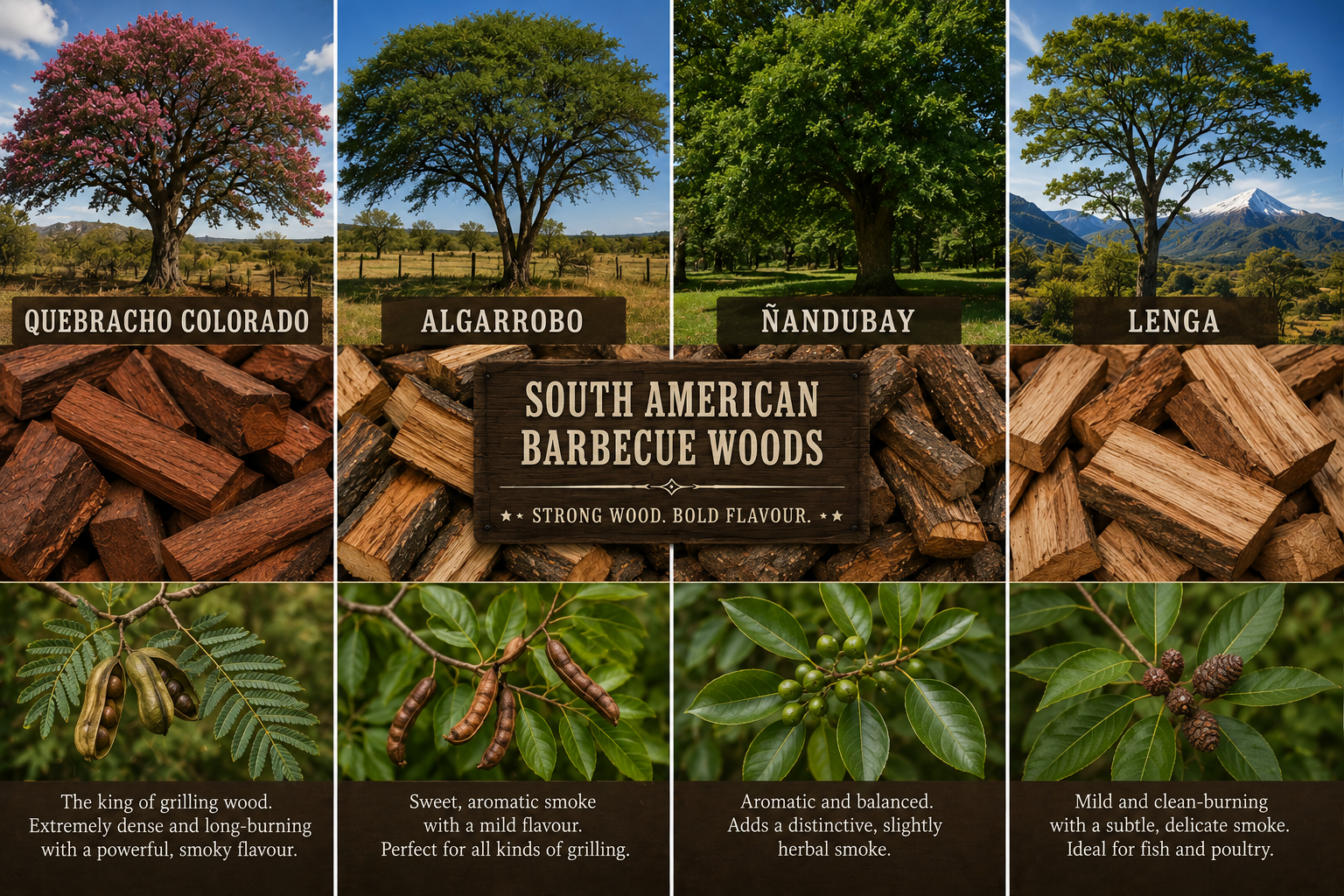
| Quebracho colorado (Schinopsis balansae, S. lorentzii) | Gran Chaco: northern Argentina, Paraguay, Bolivia | Very light, faintly sweet | Three to four hours; enormous, stable coals | Beef of any cut; the benchmark for asado |
| Quebracho blanco (Aspidosperma quebracho-blanco) | Chaco, central Argentina | Light, neutral | Long, slightly quicker than colorado | Beef, offal, sausage |
| Algarrobo (Prosopis alba, P. nigra) | Northern Argentina, Paraguay, Peru | Sweet, resinous, warmer than quebracho | Hot, good coals | Beef, kid, pollo a la brasa |
| Ñandubay (Prosopis affinis) | Entre Ríos, Corrientes, Uruguay | Mild, sweet | Extremely dense, very long | Long asado; whole animals |
| Espinillo / espino (Vachellia caven) | Chile, Argentina, Uruguay | Aromatic, slightly floral | Fast to coal, moderate life | The basis of Chilean carbón de espino |
| Coronilla (Scutia buxifolia) | Uruguay, southern Brazil | Almost none | Very dense, very long | The Uruguayan parrillero‘s first choice |
| Lenga (Nothofagus pumilio) | Patagonia, both sides of the Andes | Clean, light | Good heat, moderate coals | Lamb al palo, Patagonian cooking |
| Ñire (Nothofagus antarctica) | Patagonian steppe | Light, slightly sharp | Burns quickly, decent coals | Lamb, kid, open-fire work |
| Coihue (Nothofagus dombeyi) | Andean Patagonia, Chile | Neutral | Steady, reliable | General fire cooking |
| Naranjo — orange wood (Citrus sinensis) | Corrientes, Tucumán, Brazilian citrus belt | Sweet, distinctly citrus | Moderate, burns out fairly fast | Poultry, pork, fish |
| Eucalyptus (E. grandis, E. saligna) | Brazil, Uruguay, Argentina | Sharp as raw wood; clean once charred | Fast, hot | Charcoal rather than log — see below |
Quebracho is the wood everything else in the region gets measured against. Two unrelated trees carry the name: Schinopsis species give the red quebracho, Aspidosperma the white. The red is the denser of the two, though it is white quebracho that dominates the export trade — most restaurant-grade “quebracho” charcoal sold in Britain is specifically labelled white. You will also see it sold as “South American red oak”, which it is not, and to which it is unrelated.
The species has a difficult history. Quebracho colorado was logged industrially through the late nineteenth and twentieth centuries for tannin extraction, and the Chaco forests were cut back severely. Much of what is exported now comes from land clearance for agriculture in a region still losing forest at pace. If you buy it, it is worth asking where it came from.
Algarrobo sits in the same genus as North American mesquite — Prosopis — and gives a recognisably related smoke, sweeter and rather less brutal. Peru’s pollo a la brasa, the rotisserie chicken that is essentially a national dish, is traditionally cooked over algarrobo coals, and the sweetness is part of why it tastes the way it does.
The Patagonian beeches — lenga, ñire, coihue — are a different proposition entirely. They are lighter woods, and they suit the Patagonian style: a lamb splayed on an iron cross set at an angle beside a fire built on open ground, cooking for four or five hours from the radiant heat rather than from coals underneath. Francis Mallmann built most of his cooking on those woods, and three of his books sit on my shelf for the fire technique not just the recipes.
Eucalyptus is the region’s quiet giant. Brazil is the largest charcoal producer in the world, and the overwhelming majority of Brazilian carvão comes from plantation eucalyptus. As a raw log it gives food a medicinal edge that most cooks dislike. Converted to charcoal, the volatile oils are driven off and what remains burns hot and clean. It is a good illustration of a general point: the objection to a wood as fuel and the objection to it as charcoal are not the same objection.
The fine woods
| Wood | Smoke | Notes |
|---|---|---|
| Guayabo / guava (Psidium spp.) | Sweet, mild | Common in Uruguay and Brazil; pleasant, burns fairly quickly |
| Chañar (Geoffroea decorticans) | Mild, slightly sweet | Northwest Argentina; modest heat |
| Itin (Prosopis kuntzei) | Neutral | Very dense Chaco wood, harder to find |
| Acacia / black wattle (Acacia mearnsii) | Neutral to slightly sharp | Widely planted and widely burned in southern Brazil and Uruguay |
| Peach, fig, olive prunings | Light and sweet | Orchard and vineyard offcuts, used everywhere they occur |
| Grape vine (Vitis vinifera) | Sharp, tangy | Mendoza and the Chilean valleys. Burns out fast; good for a hot, short cook |
Beyond Argentina
The wood list shifts as you move north and west, and it is worth knowing which country a recommendation comes from.
Uruguay is the quiet specialist. Coronilla and ñandubay are the woods a Uruguayan parrillero will name first, both extraordinarily dense, and Uruguayan restaurant grills are often built with a firebox at one end that never stops burning from opening to close.
Chile runs on carbón de espino — charcoal made from Vachellia caven, the thorny acacia of the central valley. It lights readily, burns hot and is the standard bag in every Chilean supermarket. Espino charcoal production has come under scrutiny for the pressure it puts on remaining native dryland forest.
Peru cooks pollo a la brasa over algarrobo, and anticuchos — beef heart on skewers — over charcoal on street braziers. Northern Peru’s algarrobo forests, the bosque seco of Piura and Lambayeque, are a protected dryland ecosystem with a long history of illegal charcoal cutting.
Brazil is charcoal country rather than log country. The overwhelming majority of Brazilian carvão is plantation eucalyptus, produced at industrial scale largely for the steel industry with the barbecue trade as a side effect. Churrasco in Rio Grande do Sul, cooked on long skewers set at an angle beside an open fire, is the exception that still burns wood: eucalyptus, acacia and whatever the region grows.
Colombia and Venezuela cook carne a la llanera on the plains — beef staked on wooden or metal spits around an open fire on the ground, four or five hours, no coals involved at all. The wood is whatever the llanos provide, and the geometry does the work.
Woods to avoid
- Pine and plantation softwood (Pinus radiata). Widely used across Chile and Uruguay to get a fire started, which is a different job from cooking over it. Resinous and sooty. If you light with it, let it burn out completely before any food goes near the fire.
- Green or fresh-cut anything. The dense Chaco hardwoods in particular need real seasoning time; a wet quebracho log will sit in a fire and sulk.
- Cedro and other aromatic tropical timbers (Cedrela odorata and relations). Beautiful furniture woods, unpleasant cooking smoke — perfumed and bitter.
- Balsa, ceiba and the other soft tropical woods. Almost no heat, gone in minutes.
- Palm trunk and coconut wood as a fuel log. It burns wet and fibrous and smells of nothing good. Palm charcoal is a different and better product.
- Salvaged construction timber — see the dangerous list. In practice this is the most common bad wood on a South American fire, not any tree.
Dangerous woods
Manchineel — manzanillo (Hippomane mancinella). Grows along the Caribbean coasts of Colombia and Venezuela. Latex from the tree blisters skin on contact, and the smoke from burning it causes severe eye injury and temporary blindness. Nothing about the tree is safe to handle casually, and it is the single most dangerous wood on the continent.
Sandbox tree — jabillo, ochoó (Hura crepitans). Amazon basin, Venezuela, Colombia. A spurge — one of the Euphorbiaceae, the family that bleeds milky latex — with caustic sap that blisters skin and damages eyes. Most of the genuinely dangerous cooking woods on earth turn out to belong to it. The fruit explodes when it dries, which tells you most of what you need to know.
Cashew wood and shell (Anacardium occidentale). Native to northeastern Brazil. The tree is in the same family as poison ivy, and the shell of the nut contains anacardic acid and cardol — the reason commercial cashews are roasted in an industrial process rather than a domestic one. Smoke from burning cashew shells or green cashew wood is a serious respiratory irritant. Well-seasoned cashew trunk wood is burned in some parts of Brazil, but the shells and the sap are not something to experiment with.
Poison-ivy relatives (Toxicodendron striatum, Comocladia spp., Metopium spp.). Present through the northern Andes, Central America and the Caribbean. Same compound family as North American poison ivy, same rule: urushiol travels in smoke and attacks the airways.
Oleander (Nerium oleander). Not native, but planted everywhere as an ornamental and hedge from Buenos Aires to Bogotá. Cardiac glycosides throughout. Garden clearance is how it reaches fires.
Treated and salvaged timber. Old sleepers, telegraph poles, painted shuttering ply and pallets. Creosote, arsenical preservatives, formaldehyde adhesives. Costs nothing, sits in every builder’s skip, and does more damage than every poisonous tree above it combined.
Getting it here
Quebracho lump charcoal is easy to find in Britain, usually sold as restaurant-grade white quebracho in 12 or 15kg sacks, and it is genuinely excellent — hot, long-burning, very little ash, and permitted in smoke control areas. The sustainability question above is the one to put to your supplier. Quebracho as split logs is a good deal rarer.
For the logs, the honest substitution is British hornbeam or well-seasoned oak, both of which give a long, dense coal bed without much aromatic character. Hornbeam is stocked kiln-dried by a good many British firewood merchants and is the closest thing here to quebracho’s density. Beech works. Ash is easier to light and burns a little faster. None of them will match quebracho’s density, but the parrilla technique — raise the grate, rake the coals forward as you need them — matters far more than the species does.
Next in this series: Africa, which builds the same coal-bed fire from dense, arid hardwood. See also Britain and Europe for what is actually available naturally on this side of the Atlantic.