Southeast Asian Barbecue Wood: Mangrove, Coconut, Longan
Southeast Asian barbecue wood, from mangrove and coconut-shell charcoal to longan, rubberwood and coffee wood — how to judge a bag of charcoal, and the toxic mangrove to avoid. Part of a world tour of wood-fired cooking.
At Kuala Sepetang in Perak there are brick kilns shaped like beehives, each one big enough to walk into, packed floor to roof with mangrove logs standing on end. The kiln is sealed, a fire is lit at the mouth, and then the wood is cooked rather than burned — held at a low heat for a week or more to drive the water out, left to steam for a fortnight after that, then closed off entirely to cool. What comes out is glossy black, hard, and heavy in the hand for its size.
The Matang mangrove forest that supplies those kilns has been managed on a thirty-year rotation since 1902. It is one of the longest-running sustainable forestry schemes anywhere, and it exists because somebody worked out a century ago that you could either have mangrove charcoal for a generation or mangrove charcoal forever. They went with forever.
Almost nothing in Southeast Asia is burned as a log. The region cooks over charcoal, and all the skill goes into making it — which species, which kiln, how long. The fuel on a roadside brazier may well have taken a month to produce.
The grills themselves — satay, ikan bakar, lechon, the pavement trough — are covered in The Fires of Southeast Asia. This is the guide to what goes into them, and to how it was made.
Before the lists
None of this is authoritative. It is gathered largely from what is published online, alongside regional cooking traditions and general reading, and I am a cook rather than a botanist or a toxicologist. Common names cover several different trees, species get muddled between countries, and the same wood is often described in contradictory ways by people who all sound confident.
Use it as a basis for your own research rather than a reliable indication of what is safe to cook over. If you are not certain what a piece of wood is or what harm it might do to you, do not put food above it.
The four tiers
Great — worth going out of your way for. Burns clean, holds heat, and either adds a flavour you want or stays usefully out of the way.
Fine — sound fuel. It will cook your dinner and nobody will ask what you used.
Avoid — not harmful, but the food or the fire suffers: poor heat, foul smoke, or a flavour that fights what you are cooking.
Dangerous — the smoke, sap, dust or ash can genuinely injure. No technique makes these acceptable. Southeast Asia has an unusually cruel version of this, in that one of its most dangerous trees grows in the same forests as its best charcoal wood.
A few entries are aromatics rather than fuels: burned by the handful for scent, never used to cook over. Those are marked in place.
The great woods
| Wood | Where | Smoke | Burn | Best with |
|---|---|---|---|---|
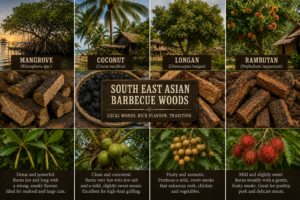
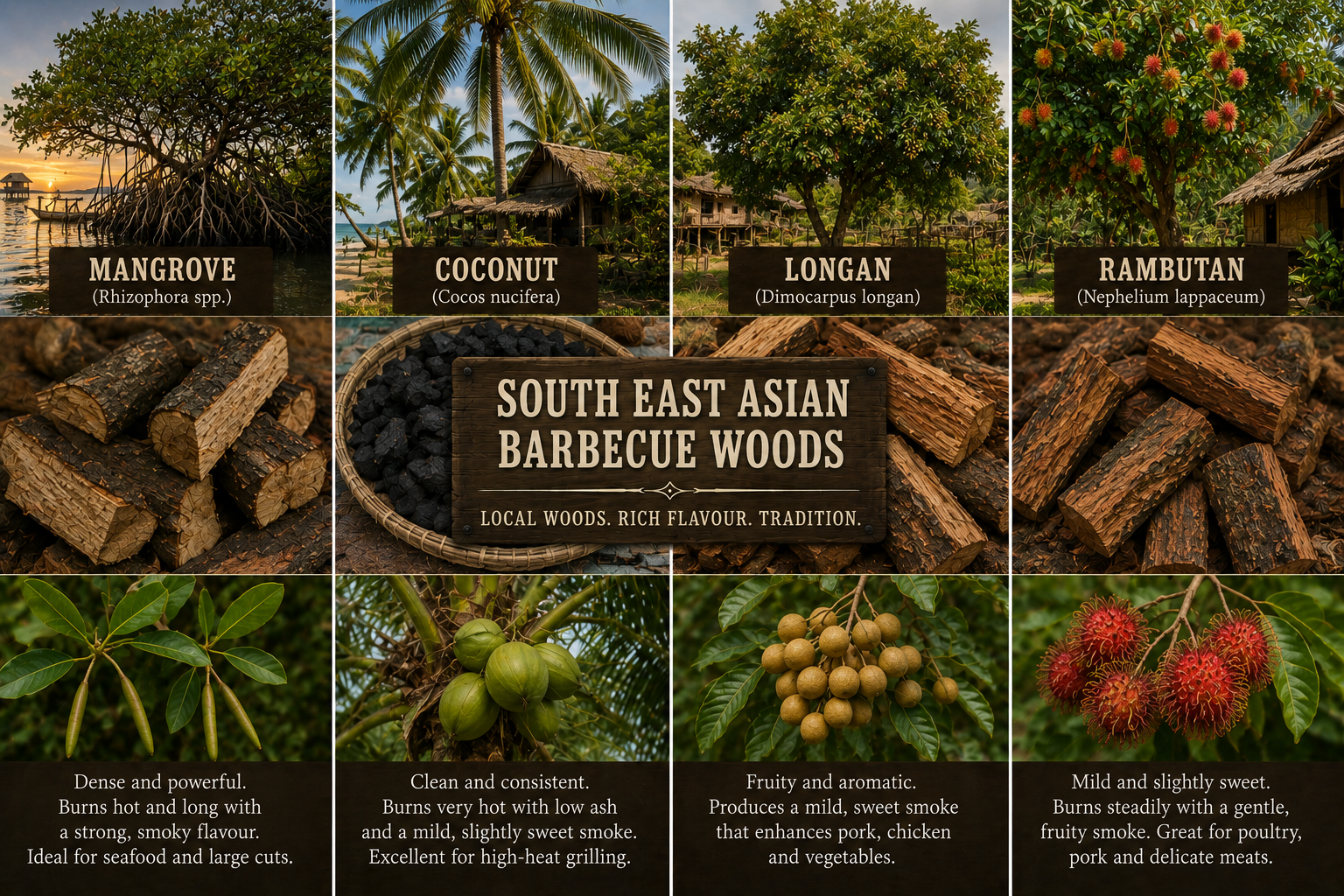
| Mangrove — bakau(Rhizophora apiculata, R. mucronata) | Malaysia, Thailand, Indonesia, Vietnam | Almost none as charcoal | Extremely dense, very long, very hot | The regional premium charcoal. Satay, grilled fish, anything |
| Coconut shell charcoal (Cocos nucifera) | Everywhere coastal | Neutral, faintly sweet | Ferocious heat, fast, very clean | Satay, prawns, quick grilling. A by-product, not a felled tree |
| Coconut shell and husk, raw | Everywhere coastal | Smoky | Hot, but sooty, and about a quarter less energy per kilo than the charcoal | Hearth fuel under a pot. Not for cooking directly over |
| Longan (Dimocarpus longan) | Northern Thailand, especially Lamphun | Sweet, delicate | Dense, long, clean | Thailand’s prestige fruitwood charcoal; excellent with pork and chicken |
| Rambutan (Nephelium lappaceum) | Malaysia, Indonesia, Thailand | Sweet, mild | Good coals | Orchard prunings; sound and pleasant |
| Lychee (Litchi chinensis) | Northern Vietnam, Thailand | Sweet, slightly floral | Dense, long | Poultry and pork above all |
| Tamarind (Tamarindus indica) | Thailand, Cambodia, Myanmar | Mild, faintly sour | Very dense, superb charcoal | Long grilling; gai yang |
| Rubberwood (Hevea brasiliensis) | Thailand, Malaysia, Vietnam, Indonesia | Neutral | Good heat, clean charcoal | The volume fuel of the region. Comes from plantations at end of latex life |
| Mango (Mangifera indica) | Throughout | Sweet, mild | Steady coals | Fish, poultry |
| Jackfruit (Artocarpus heterophyllus) | Indonesia, Philippines, Vietnam | Sweet, gentle | Moderate | Fish, pork |
| Guava (Psidium guajava) | Throughout | Sweet, light | Moderate | Poultry |
| Coffee wood (Coffeaspp.) | Vietnamese Central Highlands, Laos | Faintly sweet, slightly roasted | Dense, hot, long | Prunings and grubbed-out bushes; now exported as a premium charcoal |
| Acacia mangium, A. auriculiformis | Vietnam, Indonesia, Malaysia | Neutral | Hot, good coals | Plantation-grown at scale; the workhorse of Vietnamese charcoal |
| Bamboo (dry, split) | Throughout | Light, grassy | Fast, hot, poor coals | Better as a cooking vessel than a fuel — see below |
Four to look at more closely
Mangrove charcoal is the best charcoal most people in Britain have never used. It burns hotter and longer than almost anything else available, produces very little ash and almost no spark, and Japanese restaurants worldwide use it as a substitute for domestic binchōtan. Thailand, Malaysia, Indonesia and Vietnam all produce it commercially.
The species is also, across most of its range, being cut faster than it grows back. Mangrove clearance for charcoal — alongside shrimp aquaculture and coastal development — has removed very large areas of Southeast Asian mangrove, forests which hold coastlines together and shelter fisheries. Matang shows what managed production looks like. A great deal of what is exported does not come from anywhere like Matang, and there is no obligation on a bag of charcoal to tell you which forest it came out of.
Coconut shell is the region’s most attractive fuel from every angle. It is genuine waste — the shell is what remains after the flesh and water have been taken — and there is a very great deal of it.
Raw and converted are two different fuels, though, and the difference matters. Burned as it comes, shell is hearth fuel: hot enough, distinctly smoky, and worth around 5,500 kcal per kilo. Turned into charcoal it runs closer to 7,200 and burns almost without smoke, which is the whole reason anything cooked close over coals uses the charcoal rather than the shell. Indonesian and Filipino coconut shell briquettes are now a substantial export, largely for shisha, and they are excellent for cooking.
Longan charcoal is the region’s answer to a flavour wood. Northern Thai longan orchards prune heavily, the wood is dense and sweet, and charcoal made from it commands a premium in Thailand for exactly the reasons a Texan will pay more for post oak.
Bamboo is not really a fuel at all. You cook inside it. Sticky rice and coconut milk sealed into a length of green bamboo and roasted beside a fire is khao lam in Thailand and Laos, and versions of the same idea run from Myanmar to the Philippines. The stem chars, the contents steam, and the inner membrane peels off with the rice attached to it.
The fine woods
| Wood | Smoke | Notes |
|---|---|---|
| Durian (Durio zibethinus) | Mild | The timber is soft and light; adequate at best, and orchard owners rarely cut it |
| Casuarina (Casuarina equisetifolia) | Neutral | Coastal plantations throughout; hot and quick |
| Eucalyptus (plantation) | Medicinal as a log, clean as charcoal | Widely planted in Vietnam, Thailand and Laos |
| Sea almond / ketapang (Terminalia catappa) | Neutral | Common coastal tree; sound fuel |
| Cinnamon (Cinnamomum cassia, C. verum) | Strongly aromatic, sweet, spicy | Aromatic, not a fuel. A handful at a time. The woody residue of Vietnamese and Sri Lankan bark-stripping. Note the camphor relation below |
| Areca and palm trunk | Sharp when green | Fibrous, poor as a log, better as charcoal |
| Leucaena (Leucaena leucocephala) | Neutral | Fast-growing plantation fuelwood |
| Teak offcuts (Tectona grandis) | Slightly oily | Burns hot; avoid sawmill dust, which irritates skin and airways |
Woods to avoid
- Green bamboo, unsplit. The sealed internodes burst under pressure and throw embers. Split it or fill it, but do not put a whole green stem on a fire and stand near it.
- Belian / Bornean ironwood (Eusideroxylon zwageri) and merbau (Intsia spp.). Both burn magnificently. Both are heavily overexploited, slow-growing and of serious conservation concern. There are plenty of alternatives.
- Pine (Pinus merkusii) and other conifers. Resinous, sooty.
- Fresh coconut trunk. Wet, fibrous, low heat.
- Peat. Indonesian peatland fires — set largely for land clearance — burn underground for months and produce the regional haze that closes schools and airports across Sumatra, Borneo, Malaysia and Singapore in bad years. Nothing about that smoke belongs near food.
- Salvaged construction timber, plywood and painted offcuts. See below.
Dangerous woods
Blind-your-eye mangrove — buta-buta, gewa (Excoecaria agallocha). The danger here is where it grows. It stands in the landward zone of the same forests that supply the best charcoal in Southeast Asia, and to anyone who does not know what to look for it is just another mangrove. It is not one. It is a spurge, one of the Euphorbiaceae, and that family bleeds latex. The milky sap causes intense pain and blistering on skin, and severe corneal damage and temporary blindness if it reaches the eyes. The Malay name buta-buta means blind. Do not burn it, do not cut it, and treat unidentified mangrove driftwood with caution.
Pong-pong, bintaro (Cerbera odollam, C. manghas). Planted extensively as a street and park tree across Indonesia, Malaysia and Singapore. The seed contains cerberin, a cardiac glycoside, and the entire plant is toxic. It sheds branches and fruit into public spaces where they are swept up with general green waste.
Upas tree — ipoh (Antiaris toxicaria). Java, Borneo, Sumatra, the Malay Peninsula. The latex has been used to poison blowpipe darts across the region for centuries; it contains cardiac glycosides that stop the heart. The European legend that the tree kills anything sleeping beneath it is nonsense, but the sap is entirely real.
Rengas (Gluta spp., Melanorrhoea spp.). Malaysia, Borneo, Sumatra, southern Thailand. A cashew-family timber whose sap raises blisters and sores much as poison ivy does. The irritant is volatile, so the timber is dried for several years before anyone works it and is reasonably safe by then. The heartwood is a beautiful red and goes into furniture, which is how offcuts reach woodpiles. Green rengas has no business near a fire.
Lacquer tree (Toxicodendron succedaneum, T. vernicifluum). Vietnam and southern China. The source of traditional lacquer, and a close relative of poison ivy carrying the same urushiol. Burning it puts urushiol into the smoke, where it attacks the airways.
Cashew shells (Anacardium occidentale). Vietnam is the world’s largest cashew processor, so shells are available in quantity as an industrial residue. The liquid in the shell blisters skin on contact. It is useful enough to be an industrial feedstock in its own right, and it is not something to burn under food.
Oleander (Nerium oleander). Planted as an ornamental throughout. Cardiac glycosides in every part.
Hedge euphorbias (Euphorbia tirucalli and relations). Caustic latex, same family as the mangrove spurge above.
Camphor laurel (Cinnamomum camphora) — the qualified case. Camphor wood is used deliberately in Chinese cooking, in the Sichuan tea-smoked duck covered in the Far East article, where a small quantity of leaves and shavings is used for a short hot smoke. That is a controlled traditional use of natural camphor. Burning camphor wood as a fuel, in quantity, is a different proposition, and synthetic camphor is toxic and should never be used in cooking at all.
Treated and salvaged timber. Painted shuttering, laminate, old furniture, preserved poles. The commonest real harm on this list, and the only entry that costs nothing to acquire.
How to read a bag of charcoal
Since this region’s whole craft is in the conversion rather than the tree, a few things are worth checking before you buy.
Weight for volume. Good hardwood charcoal is surprisingly heavy for its size. A light bag means either a soft feedstock or an incomplete burn.
The sound. Good hard lump gives a clean hollow clack when two pieces are knocked together; a dull thud means moisture or unconverted wood at the core. The true metallic ring is a property of white charcoal only — binchōtan and the Vietnamese and Indonesian versions of it — and no black charcoal will give it to you, however good.
Species on the label. Bags that name the wood — mangrove, coconut, longan, coffee — are almost always better than bags that say “hardwood charcoal”, which means the producer either does not know or would rather not say.
Briquette versus lump. Coconut shell briquettes are compressed shell charcoal with a starch binder and are genuinely excellent: uniform, very long-burning, almost no smoke. Cheap black briquettes made from sawdust, coal dust and fillers are a different product entirely and will give food a chemical edge.
Dust at the bottom. Some is inevitable. A quarter of the bag is not.
Buying it in Britain
Coconut shell charcoal is the easy one, and worth knowing that the small cubes sold for shisha in Middle Eastern and Asian grocers are the same material as the larger pillow briquettes from barbecue suppliers, usually at a better price per kilo.
Mangrove charcoal reaches Britain mostly through the restaurant trade, and often not under its own name — it turns up blended with eucalyptus, or badged as a binchōtan substitute alongside the Vietnamese and Indonesian white charcoals. The question to put to a supplier is where it was cut. Matang and the other managed Malaysian concessions are a genuinely different product from generic Southeast Asian mangrove, and a bag that cannot tell you which it is probably is not the former.
Longan, lychee and rambutan wood are hard to source here. British cherry or apple gives a comparable sweetness, if not the density.
For bamboo cooking, which is the most transportable idea in this article, you need green bamboo with the internodes intact, and British garden bamboo is generally too thin. A specialist supplier or a Chinese supermarket with fresh-cut stems is the route. It is worth doing once. The rice comes out tasting faintly of grass and smoke, and you eat it out of the tube.
Next in this series: The Far East, where charcoal-making becomes an even more exacting craft. See also Britain and Europe for what is actually available naturally on this side of the Atlantic.