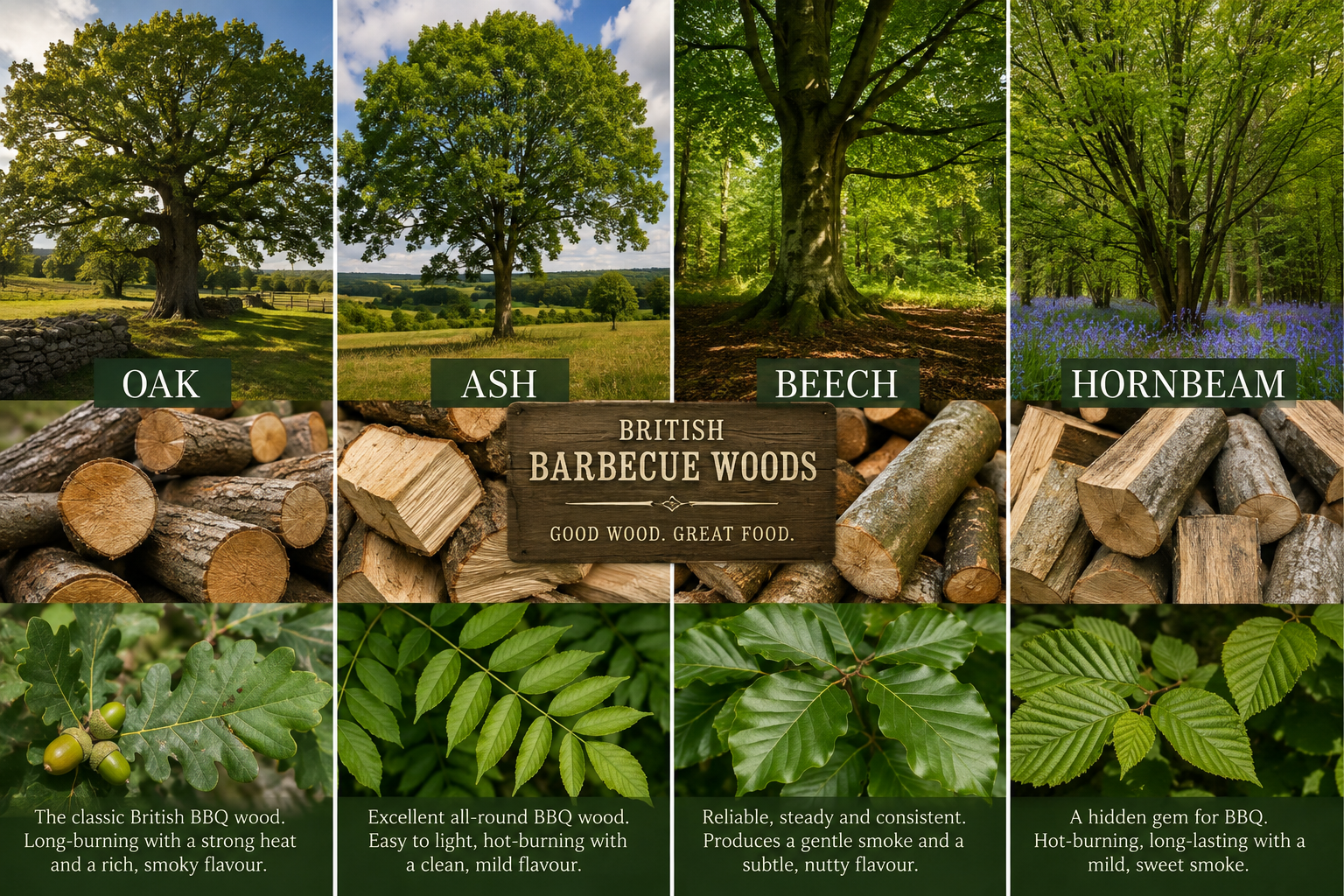
British and European Barbecue Wood: Oak, Ash, Hornbeam
British and European barbecue wood, from oak, ash and hornbeam to the orchard fruitwoods and Mediterranean olive — and the garden plants, yew and laurel among them, that are genuinely dangerous to burn. Part of a world tour of wood-fired cooking.
Europe is the awkward region in this series, because it has no single fire-cooking tradition to organise the wood list around. Spain cooks over holm oak. Sweden smokes over alder. The Black Forest cures ham over fir, which every other tradition on the continent would call an error. Britain, for most of the last century, cooked over briquettes made of coal dust and starch, and has only recently remembered it has forests.
So this is a list of what grows here and what it does, rather than a list of what a tradition demands.
Before the lists
None of this is authoritative. It is gathered largely from what is published online, alongside regional cooking traditions and general reading, and I am a cook rather than a botanist or a toxicologist. Common names cover several different trees, species get muddled between countries, and the same wood is often described in contradictory ways by people who all sound confident.
Use it as a basis for your own research rather than a reliable indication of what is safe to cook over. If you are not certain what a piece of wood is or what harm it might do to you, do not put food above it.
The four tiers
Great — worth going out of your way for. Burns clean, holds heat, and either adds a flavour you want or stays usefully out of the way.
Fine — sound fuel. It will cook your dinner and nobody will ask what you used.
Avoid — not harmful, but the food or the fire suffers: poor heat, foul smoke, or a flavour that fights what you are cooking.
Dangerous — the smoke, sap, dust or ash can genuinely injure. No technique makes these acceptable. Europe has more of these than most regions, because the poisonous species here are garden plants rather than forest trees, and garden clearance ends up on fires.
A few entries are aromatics rather than fuels: burned by the handful for scent, never used to cook over. Those are marked in place.
The great woods
| Wood | Where | Smoke | Burn | Best with |
|---|---|---|---|---|
| Oak (Quercus robur, Q. petraea) | Britain, France, Germany, Central Europe | Medium, dry, tannic | Very long, superb coals. Needs two years’ seasoning | Beef, lamb, anything slow |
| Holm oak / encina (Quercus ilex) | Spain, Portugal, southern France | Light, clean | Exceptional coals; the basis of Spanish charcoal | Everything Spanish: chuletón, suckling lamb, seafood |
| Beech (Fagus sylvatica) | Germany, France, Denmark, Central Europe | Mild, clean, faintly sweet | Hot, even, good coals | Sausage, pork, smoked fish. The German default |
| Hornbeam (Carpinus betulus) | Britain, France, Central Europe | Almost none | The highest heat output of any European hardwood; very dense | Long cooks; the nearest thing here to quebracho |
| Ash (Fraxinus excelsior) | Britain, Ireland, Northern Europe | Neutral | Excellent heat, splits beautifully, burns even half-seasoned | The all-rounder; anything |
| Birch (Betula pendula, B. pubescens) | Scandinavia, Baltic, Scotland | Light, slightly sweet | Fast, bright, moderate coals | Fish, quick grilling. The Nordic staple |
| Alder (Alnus glutinosa) | Poland, Russia, Baltic, Britain | Very light, delicate | Low heat, burns fast | Smoked fish above all — the classic Baltic and Russian smoking wood |
| Apple (Malus domestica) | Everywhere with an orchard | Sweet, fruity, gentle | Moderate heat, decent coals | Pork, poultry, cheese |
| Cherry (Prunus avium) | Kent, Normandy, Germany | Mild and sweet | Moderate | Anything; gives skin a deep reddish colour |
| Plum, pear, quince | Orchard country across Europe | Light, sweet | Moderate to fast | Poultry, pork, fish |
| Olive (Olea europaea) | Spain, Italy, Greece, Portugal | Distinct, savoury, slightly peppery | Very dense, long, hot | Lamb, fish, vegetables |
| Almond (Prunus dulcis) | Spain, Italy, Greece | Sweet, nutty | Hot, good coals | Grilling; prized in Valencia and Andalusia |
| Vine prunings — sarmientos (Vitis vinifera) | Rioja, Bordeaux, Tuscany, the Douro | Sharp, tangy, assertive | Ferocious for five minutes, then gone | Chuletillas al sarmiento — lamb cutlets grilled fast over blazing vine |
| Sweet chestnut (Castanea sativa) | Kent, Sussex, Limousin, northern Italy | Mild | Fine coals once it settles. Spits badly at first | General cooking, if you stand back |
Five of them warrant expanding on.
Ash is the wood every British firewood merchant will tell you is the best, and they are broadly right. It carries less water standing than most, which is why Lady Celia Congreve’s firewood poem — published in The Times in 1930 and still quoted by half the log trade — closes on “but ash wet or ash dry, a king shall warm his slippers by”. Seasoned is still much better. It gives good clean heat and almost no flavour, which makes it ideal fuel and useless as a smoking wood. Ash dieback has killed a very large number of British ash trees over the past decade, so there is more of it about than there was, and there will be much less of it in twenty years.
Hornbeam deserves to be better known. It is the densest hardwood commonly available in Britain, burns with very little flame and produces a coal bed that will outlast almost anything else on this list. If you want to cook South American style — a bed of embers, raked forward under an adjustable grate — hornbeam is the domestic answer.
Holm oak is the wood behind Spanish live-fire cooking. Carbón de encina is the charcoal you find under every serious Spanish grill, and it burns hotter, longer and cleaner than the generic imported lump sold in British supermarkets. It is worth buying deliberately rather than by accident.
Olive is the Mediterranean equivalent of a good fruitwood, except denser and with a savoury rather than sweet character. Old olive prunings are the by-product of an enormous agricultural industry, and olive wood chunks are one of the easier Mediterranean woods to buy in Britain.
Vine prunings are the great short-burn wood. They flare, blaze, throw enormous heat for a few minutes and collapse to ash. In Rioja the technique is built entirely around that behaviour: a wire cage of lamb cutlets held over a fire of sarmientos, cooked in the time it takes the wood to burn out. Trying to use vine for anything slow misunderstands what it is.
A word on Black Forest ham. Schwarzwälder Schinken is cold-smoked over fir and spruce, and it is the standing exception to the rule that conifers have no place in food. The reason it works is that cold smoking never brings the wood anywhere near the temperature at which resins pyrolyse into the harsh, sooty compounds that ruin hot-smoked food. It is a genuine tradition, it is not an argument for putting pine on your barbecue.
The fine woods
| Wood | Smoke | Notes |
|---|---|---|
| Sycamore, field maple (Acer pseudoplatanus, A. campestre) | Mild | Moderate heat, well below oak or ash, but seasons inside a year and lights readily. Sound as fuel, but not a smoking wood. Not the same tree as American sycamore, which is a plane |
| Hazel (Corylus avellana) | Light | Coppice wood, burns quickly, good for a fast fire |
| Hawthorn (Crataegus monogyna) | Neutral | Dense, burns hot and long. Awkward to split and full of thorns |
| Blackthorn (Prunus spinosa) | Slightly sweet | Very hot, very dense, and it will draw blood getting it into the shelter |
| Rowan, whitebeam (Sorbus spp.) | Neutral | Decent heat, unremarkable |
| Robinia / false acacia (Robinia pseudoacacia) | Neutral | Long, hot burn; increasingly common in Central Europe |
| Juniper (Juniperus communis) | Strongly aromatic, resinous, gin-like | Aromatic, not a fuel. A handful at a time in Alpine and Nordic smoking. Note the toxic relative below |
| Heather and peat | Earthy, medicinal | Not wood, but the smoke that defines Scottish and Irish tradition. Peat cutting is now a serious carbon question |
Woods to avoid
- Conifers as cooking fuel — pine, spruce, larch, Douglas fir, Leylandii. Resin, soot, and a turpentine note through everything. The Black Forest exception above is a cold-smoking process, not a barbecue.
- Elm (Ulmus) — smoulders, stinks, and refuses to split. Almost nothing to recommend it.
- Willow and poplar — hold water badly even when seasoned, low heat, quick to ash.
- Lime / linden (Tilia) — soft, low calorific value, burns to nothing.
- Horse chestnut (Aesculus hippocastanum) — spits worse than sweet chestnut and gives less back for it.
- Elder (Sambucus nigra) — burns poorly, spits, and the green wood and pith contain cyanogenic compounds. Folklore across Britain says never burn elder; on this occasion folklore and chemistry agree.
- Driftwood — burning salt-soaked wood produces chlorinated compounds including dioxins. Fine for a beach fire you stand upwind of, wrong for food.
- Anything wet. Below about twenty per cent moisture is the target. Above it, wood smoulders rather than burns, and smouldering wood lays creosote on your food.
Dangerous woods
Europe’s dangerous woods are overwhelmingly ornamental. They arrive on fires through hedge trimming and garden clearance, not through the woodpile.
Yew (Taxus baccata). Churchyards, formal hedges, topiary. Every part except the red aril contains taxine alkaloids, which are cardiotoxic and for which there is no antidote. Yew is the single most likely dangerous wood to appear in a British garden bonfire, and it should never be burned near food, or near people, at all.
Laburnum (Laburnum anagyroides). A very common suburban garden tree, planted for the yellow flowers. Contains cytisine throughout — seeds, bark and wood. Burning it puts cytisine into the smoke, and the reported effects run from nausea and vomiting to convulsions.
Cherry laurel (Prunus laurocerasus). This one catches people out, because it is a hedge rather than a tree and because hedge trimmings look like harmless green waste. The leaves and green wood contain cyanogenic glycosides which release hydrogen cyanide when the tissue is damaged — the reason a freshly cut laurel hedge smells of marzipan. Do not burn laurel clippings, and particularly do not burn them in an enclosed space.
Rhododendron (Rhododendron ponticum). Invasive across Britain and Ireland and the subject of a great deal of clearance work, which means a great deal of it gets burned. Contains grayanotoxins, the same compounds responsible for so-called mad honey poisoning.
Savin juniper (Juniperus sabina). Worth separating from common juniper, which is a legitimate smoking aromatic. Savin contains podophyllotoxin and is toxic. If you are burning juniper for flavour, know which species you have.
Oleander (Nerium oleander). Ubiquitous across the Mediterranean, in hedges, central reservations and hotel gardens. Cardiac glycosides in every part. Common enough in southern Europe that it should be on the list of things you check for when someone hands you a bundle of local firewood.
Box (Buxus sempervirens) and spindle (Euonymus europaeus). Both contain alkaloids. Neither is worth burning on its merits, so there is no reason to take the risk.
Treated timber — the one you are actually most likely to burn. Old fence panels, decking boards, shed cladding and pallets are the commonest bad fuel in Europe by a wide margin, because they are free and they look like wood.
- Tanalised fencing and decking carry copper-based preservatives; older stock may contain arsenic compounds.
- Railway sleepers are creosoted, and creosote is a recognised carcinogen. The retail sale of creosote-treated wood to the general public has been restricted across the UK and EU.
- Pallets stamped HT are heat treated and broadly acceptable once you have satisfied yourself about what they carried. Pallets stamped MB have been fumigated with methyl bromide and must never be burned.
- MDF, chipboard, plywood, laminate flooring and anything painted or varnished all release formaldehyde and solvent breakdown products.
Buying it in Britain
The market here has improved enormously. Kiln-dried oak, ash, beech and birch are available by the crate from most builders’ merchants and a good many petrol stations, and the Ready to Burn certification scheme means the moisture content on the label is now more or less trustworthy.
The fruitwoods are best obtained by asking. Any commercial orchard prunes in winter and burns the arisings; a boot full of apple or cherry costs a conversation and a year of stacking. Vineyards will give away sarmientos on the same terms, and English vineyards are no longer a novelty.
Olive and holm oak arrive as imported chunks and charcoal. Hornbeam, despite being the best of the lot for a long coal bed, is easy to overlook — plenty of merchants sell it kiln-dried by the crate, and it is usually the priciest thing on their list for good reason.
One thing Britain still does poorly is mutton, which is the meat this kind of fire suits best and which I can almost never find. That is a separate complaint for a separate article.
Next in this series: North America, the home of the long, deep-smoke woods. For the tradition of separating fire from food, see South America.