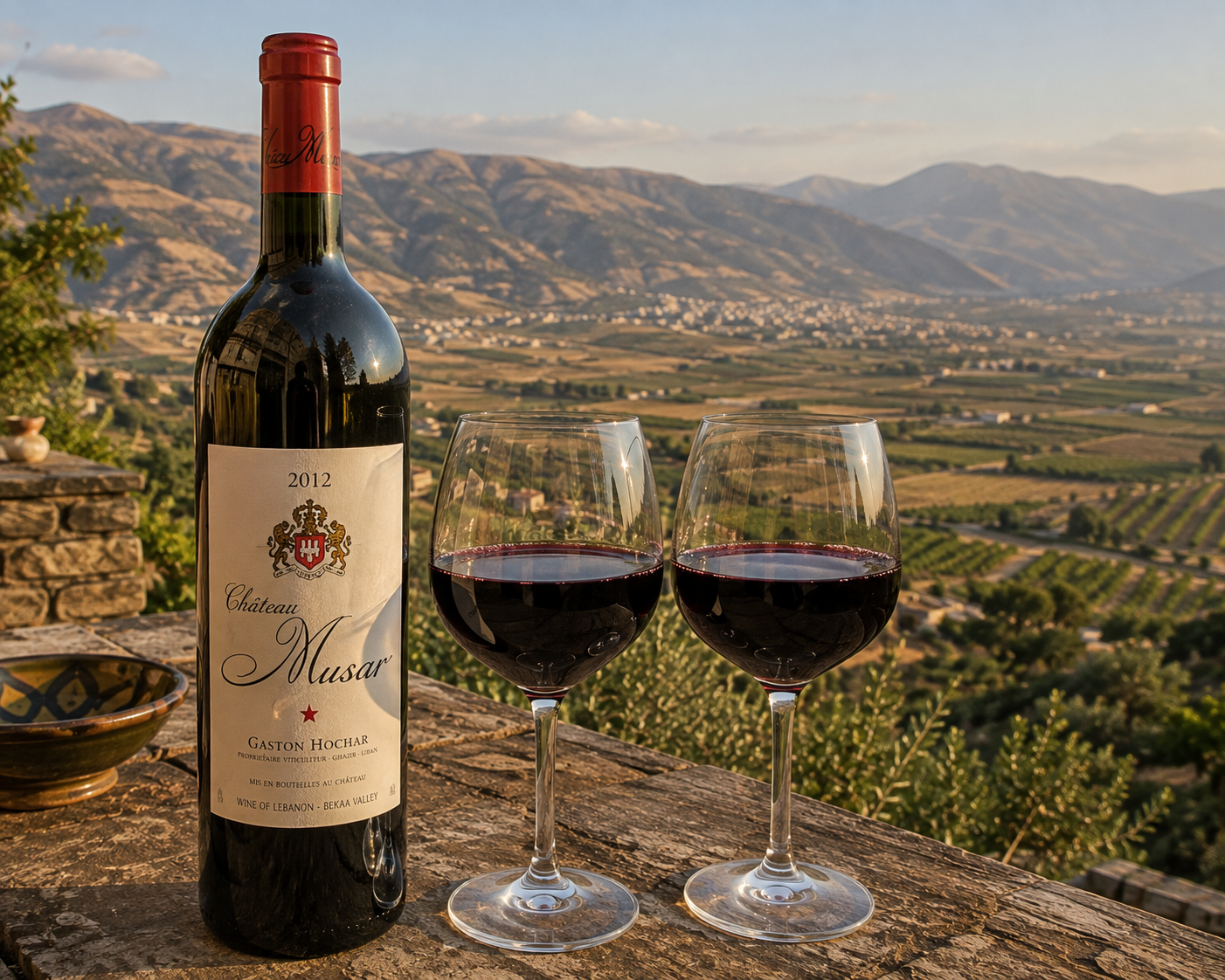
The game, the sommelier, and a bottle of Château Musar
Château Musar comes from the Bekaa Valley in Lebanon and was made all the way through a civil war. It is a natural match for game — the unusual part is thinking of it at all. A sommelier in the New Forest did.
Pigeon to start, then pheasant. We had got that far between us, and were getting lost in a very long wine list, when the sommelier arrived at the table at Careys Manor.
He knew we had got engaged. Everybody there knew. I had proposed in front of the fire in the lounge, having arranged in advance for a bottle of champagne to arrive the moment I had, so the staff at the hotel knew what was coming before my wife did. Thank goodness she said yes.
By the time we sat down to dinner the sommelier knew which wine would help mark it.
It would be unexpected, he said. Then he said it would be Lebanese.
We had questions. He told us to trust him.
It was the first Lebanese wine I had ever drunk, and it has accompanied our marriage ever since.
You end up learning about a wine that attaches itself to you. Mostly by accident, and over a long time.
I did not hear that Serge Hochar had died until years afterwards. He drowned in 2014, swimming on holiday in Mexico, at seventy-five. By the time I found out, my wife and I had been drinking his wine happily for years, along with everyone we ever poured a glass for, and I had still never looked properly into where it came from. That was what sent me reading. I should have started sooner.
The house at Brockenhurst
Careys Manor sits in Brockenhurst, in the middle of the New Forest, which William the Conqueror looked at in 1079 and decided would do for hunting. It has been called The New Forest for nearly a thousand years.
Things take a bit of time to become established in Britain.
The site was one of the lodges the hunt moved between. Charles II later handed the old manor to a John Carey for services rendered. What those services were, I have not managed to unearth. The record says services, it says rendered, and then it changes the subject. The name stuck.
In 1790 the place came to the Bowden-Smith family when a wine merchant called Robert Smith married Miss Bowden. The present house went up in 1888 and turned into a hotel in the 1930s. When we went, in 1996, it was a Small Luxury Hotel. The spa and much of what is there now came afterwards.
A hunting lodge, then a wine merchant, then a hotel, and eventually two people ordering the pheasant.
Seventy kilometres of trouble
The vines grow in the Bekaa Valley at around a thousand metres, with Mount Lebanon standing on one side of them and the Anti-Lebanon mountains on the other. The winery is not there. The winery is at Ghazir, on the coast north of Beirut, seventy kilometres away. Oh — and there is a mountain range in the way.
So somebody has to pick the harvest every autumn and then drive it. In a normal year that is a couple of hours in a lorry and nobody gives it a thought.
Lebanon has not had many normal years.
Two drivers
The civil war ran from 1975 to 1990, and the winery kept going through nearly all of it. Drivers took the grapes down whichever road was passable that week, which meant knowing which militia held which stretch of road. Some years the route went north through the cedars towards Tripoli, some years south over the mountain tracks. A journey of two and a half hours could take five days.
In 1976 they gave up. Serge Hochar, who had been making the wine since 1959, put it about as plainly as it can be put: “In 1976 there was total war in Lebanon. We had no electricity. No fuel. No transport. No harvest. No nothing.” It was the only harvest the winery missed in fifteen years of civil war.
Then there is 1984. Only two drivers were willing to make the run. The harvest went in forty-five days late. The first truck took five days and the second took seven, and by the time the grapes reached Ghazir they were hot, bruised, sticky and already fermenting in the back. Hochar made wine out of them regardless. “I made the 1984 to declare war against war,” he said.
It was never released as a Musar vintage. Look down the list of years the estate sells and 1984 is not on it. Small quantities have found their way to private collectors over the years, so bottles are out there, but the 1984 remains an unofficial wine and, by now, close to a myth.
The same year, Decanter gave him the first Man of the Year award it ever handed out.
The 1990 harvest also had to take a huge detour to cover a distance that would normally have been straightforward. By then the winery had taken a shell itself, in 1989, and the family had spent much of the war letting their neighbours shelter in the cellars among the barrels.
Bristol, 1979
Britain met the wine at the Bristol Wine Fair in 1979. Michael Broadbent ran the wine department at Christie’s. He and the journalist Roger Voss picked the Musar 1967 out of everything on show as the find of the fair. British drinkers have been getting on with it ever since, which is how a Lebanese red came to be within reach of a sommelier in a Hampshire hotel decades later.
The estate goes back well before the war, of course. Gaston Hochar founded it in 1930. He was twenty years old and had just been to Bordeaux. During the Second World War he became friends with Major Ronald Barton of Langoa-Barton, who was stationed in Lebanon and thought the Bekaa could do with some Cabernet Sauvignon. Gaston planted it. He also named his second son Ronald.
The Cinsault and the Carignan had got there earlier, carried over from Algeria by Jesuits. Those three grapes, in proportions that shift about from year to year, are what is in the red.
Seven years before anyone gets a bottle
Musar is made by leaving things alone. The red ferments in cement with indigenous yeasts, spends a year in used French Nevers oak, and is blended and bottled after further maturation. Then it sits. Another three or four years in bottle, so that as a rough rule nothing reaches anybody until about seven years after the harvest. The estate has long farmed with minimal chemical intervention, some of its vineyards later received official organic certification, and it presents the red as a low-intervention wine with relatively little sulphur added.
There is another red under the family name, Hochar Père et Fils — father and son — and the estate is firm that it is not a second wine. It has its own vineyard near Aana and its own bush vines, thirty years old on average, with Cinsault leading the blend. Six to nine months in barrel rather than a year, and out four years after the harvest rather than seven.
Lighter, a bit cheaper, easier to drink. Still delicious.
We drink it mostly in the warmer months, when the Musar itself would be too heavy. It is what we might open for a lunchtime steak from the barbecue and a grilled vegetable salad.
There is a white as well, and it is the strangest thing they make. It is made from Obaideh and Merwah, two traditional Lebanese varieties, spends roughly six years between harvest and release, and has an oxidative style that puts people in mind of old white Rioja. Opinion is split on it, ours included. Waxy is one of the words people reach for, and I would agree with them. My wife does not pick that up at all. For me there is simply too much of it.
Then there is Musar Jeune, in red, white and rosé. Steel and concrete, no long wait, made to be drunk young and without ceremony.
No two bottles of the Musar are quite the same, and the wine divides people accordingly. Firmly, too. Some drinkers taste a fault. Others taste the reason they bought the bottle.
Serge Hochar settled that argument to his own satisfaction a long time ago. “I once produced a wine that was technically perfect,” he said, “but it lacked the charms of imperfection.”
His sons and wider family continue to run the estate.
The red is generally reckoned to come into its own about fifteen years after the harvest, and the cellars still hold bottles dating back to the 1950s.
We drank ours in 1996, and what it cost suggested the sommelier had not reached for the youngest bottle on the list. The 1970s or the 1980s, then. I wish I could remember the year.
It hardly matters. Every Musar between 1975 and 1990 is a wartime wine. Somebody had to look at the roads out of the Bekaa that morning and work out which of them was least likely to get a lorry stopped, and then send the grapes down it.
So whatever was in our glasses had been picked in a war and driven through it, had spent years in a cellar afterwards, and had then made its way to a hotel in Hampshire to be opened in front of two people who had just got engaged and knew none of it.
Back to the table
What I have thought about since is the sommelier. There was a safe version of that evening available to him. Something well known and safely admired, poured with a few warm words, and we would have been delighted and forgotten it by the autumn. He went instead for a country neither of us associated with wine, and then waited while two strangers caught up with the idea.
He was spending his own credibility on a bottle he believed in, for two strangers he would probably never see again, on what was to him another shift. That was a kindness, backed by a quiet confidence in his own knowledge.
He got it right, and it has lasted over thirty years. He will never know that, but I thank him for it.
We have drunk a great deal of it since, so I can be precise about it now. Rich and full, a little spicy, and utterly delicious.
We have gone looking for late 1970s bottles when we could find them, and drunk them with no idea what they had cost to make. That is what I keep turning over now. Every one of them was delicious, and every one of them put us back in front of that fire and close to each other, which is a great deal to ask of any bottle. Those ones had been picked under gunfire and driven out of the valley by men taking a real risk to do it. They managed it anyway.
I never met Serge Hochar. I never shook his hand or saw the place he worked, and I have no claim on him at all. What I do have is a regret, and a sizeable one. We had been drinking his wine happily for a long time, and it took the news of his death, years after it happened, to make me pay proper attention to where it came from.
I was late.
There are two number one slots in our house. Château Musar holds one and my wife’s roast potatoes hold the other, and neither of them is going anywhere. Both are good enough to hold their places on merit. Love is what makes those places unassailable. We got engaged over one, and I married the woman who makes the other.
So a better wine can come along, and a better roast potato, and it will make no difference at all. Second place is available.
Writing this has made me want some. The last bottle in the house is open on the side as I finish, an hour or two ahead of when we will drink it. I probably will not decant it. Today feels like a day for drinking it casually.
It is a 2015, which by the fifteen-year reckoning has a good way to go yet. The more pressing matter is that it is the last bottle in the house. At the time of writing, the 2015, 2017 and 2019 are the easiest to find, and I have no intention of working out which is best. Better to try them.