Looking Into Creatine
Creatine has always struck me as a young man’s thing.
Three of my friends would tell me I’m wrong about that, and they’re not the sort I’d casually ignore. Let’s call them Shabba, Simo and Roth. They’re the fitness ones — the three I contact first when I want an actual opinion rather than a guess — and all three take it, all three swear by it. Shabba’s gone one further: he reckons the right dose keeps him properly alert through a night flight.
So at nearly fifty-six, having heard the word knocking about for years and having three credible people vouching for it, I decided it was time to pay creatine some proper attention. I’d actually been taking it sporadically for about three years by that point — it just took until fifty-six to sit down and find out what I was actually doing. I’m not saying fifty-six isn’t young, by the way. In my head it’s still roughly the same age as my twenties. It’s just my body that needs a bit more convincing these days.
What Seems Settled
The muscle case turned out to be far less of an open question than I expected.
Creatine isn’t exotic. Your own body makes roughly a gram of it a day, in the kidneys, liver and pancreas, and tops the rest up through meat and fish. Supplementing raises the reserve your muscles keep on hand for short, repeated effort, which matters in more or less any resistance training, not just the obvious weightlifting kind.
Paired with resistance work, studies fairly consistently show it helping older adults hold onto strength and lean mass. The training does most of the work; creatine seems to make the training pay off a bit more. Some of that reaches into everyday function too — walking speed, getting up from a chair — though strength and mass are where the evidence is strongest. Either way, a decent case, whatever shape your own training happens to take.
Then there’s the kidney question, which comes up a lot with creatine. Turns out this rests on a small mix-up. Creatine raises serum creatinine, the marker doctors often use as a quick proxy for kidney function, simply because creatine breaks down into creatinine as a matter of course. The marker moves. Actual kidney function, in studies that measured it directly rather than leaning on that one proxy, generally hasn’t — at the standard 3 to 5 grams a day, in healthy adults. If you already have kidney issues, that’s still a conversation for your own doctor, not a blog.
What It Actually Comes As
Almost all of the evidence behind creatine is for one specific form: plain creatine monohydrate. Cheap, extensively studied, no real case for any of the fancier versions lined up next to it on the shelf.
I didn’t start with the plain stuff, though. Gummies were the obvious choice at first — who doesn’t like sweeties — until one of the three, I forget exactly which, pointed out they might not deliver anything close to the dose printed on the tub. Creatine is stable as a dry powder but breaks down into creatinine, the same waste product from a moment ago, when it sits in moisture or heat for long, which is more or less what a gummy is made from. Independent testing has turned up gummies with noticeably less active creatine than the label claims. Then there’s the cost, which isn’t really an argument so much as a fact: powder runs a fraction of the price per gram.
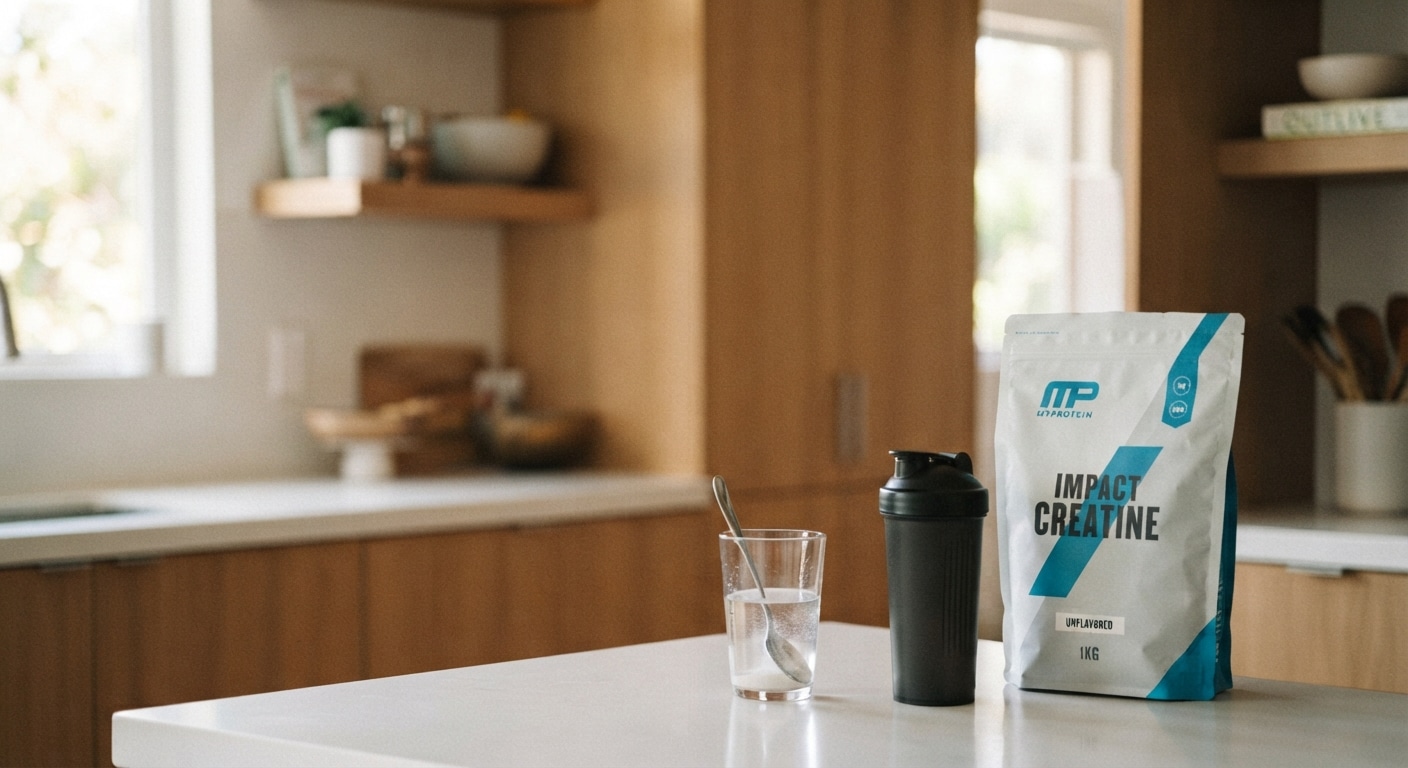
On its own, powder also has a slightly chalky, gritty texture nobody’s pretending is pleasant. Mine goes into a protein shake, or failing that a glass of whole milk, purely for palatability.
What’s Still an Open Question
Its effect on memory and attention is where things get interesting, because the evidence there is still a work in progress.
A systematic review published earlier this year looked specifically at creatine and cognition in older adults. Five of the six studies it covered reported some positive link, mainly around memory and attention. Encouraging, until you read past the headline: one was rated good quality, two fair, three poor. That’s not a reason to write it off. It’s simply where the evidence stands, and I’d rather sit with that than round it up into something tidier.
There’s a plausible mechanism behind it, at least. Creatine crosses into the brain, and the brain draws on the same energy system creatine supports in muscle. Plausible isn’t proven. But it’s enough to keep watching.
Shabba’s Theory
Shabba, Simo and Roth all take creatine, and all three reckon it works. Shabba’s the one with the specific theory. He’s slim, properly disciplined about his fitness, not the type to imagine an effect that isn’t there. He reckons around 10 grams does the job for his body, and that anything past that is what keeps him sharp through a night sector. Simo and Roth back him on the general benefits, though I haven’t checked whether they’ve noticed the same alertness spike Shabba reports.
I had a look at the research behind that claim. There’s actually something there, though it doesn’t quite match the shape Shabba’s given it.
The daily 3 to 5 grams is the standard approach for the muscle side of things, taken steadily over weeks. What Shabba’s describing is something else — a bigger, one-off amount for a single night — and that does map onto its own strand of research: a handful of trials testing a single dose large enough to measurably cut the cognitive fatigue of a night without sleep, the effect holding for most of a shift. Those doses run well above Shabba’s 10 grams. Scaled to a lighter frame, the gap is probably smaller than the raw number suggests — though that’s my own arithmetic, not something the studies tested on him specifically.
So Shabba isn’t wrong that something’s going on. He’s pointing at a real effect, just at a lower dose than the published trials have mostly used. Either way, it’s a single dose for a specific night, not a daily habit, and the evidence is still young — small trials, younger volunteers, nothing done yet on pilots our age flying an actual night sector. Interesting enough to note. Not solid enough to build a routine on, and certainly not something to try for the first time before a real flight. An ordinary evening at home seems the better place to discover how your stomach feels about it.
What Could Go Wrong
Whilst it’s naturally occurring, that doesn’t mean taking it comes without side effects.
Water retention is the most common one, and mostly the harmless kind — inside the muscle cell, not the puffy look people picture. It shows up more with a loading phase or a big single dose than with the standard daily amount.
Stomach upset is the one that actually catches people out. A large safety review of nearly 700 clinical trials found gastrointestinal issues in only a small minority of users, barely above the placebo rate. A newer study looking specifically at loading doses found something rowdier — nearly four in five participants reporting some GI symptom, mostly bloating and stomach discomfort. The two aren’t really in conflict. GI upset is common at higher doses or without food, and much rarer at the standard daily amount. Taking it with food, or splitting a bigger dose across the day, seems to help. This matters especially for Shabba’s version of things: the acute dose in the sleep-deprivation research is large enough that GI discomfort is a real risk.
The hair loss claim gets thrown about a lot, and there’s barely anything behind it — one small 2009 study, a temporary hormone shift within a normal range, never replicated.
And the kidney question, already covered above: doesn’t hold up as a real risk in healthy adults at the standard dose, going by the studies that measured kidney function directly. Still worth a conversation with your doctor if you already have kidney issues.
So What Does That Mean at Sixty?
Sixty isn’t my age, not at time of writing anyway — though a steady number of my peer group are stepping over that threshold every few months, it seems. It’s the line the research draws, the point where the subgroup comparisons split “younger” from “older,” which makes it a more useful marker than “adults in general.”
For the body, the picture is about as reassuring as nutrition science gets. A 2021 statement, drawing on more than five hundred published studies, came down firmly in favour of creatine at the standard dose for healthy adults — nothing in it singles out older age as a reason for caution. Paired with resistance training, it’s turned into a fairly ordinary recommendation for holding onto muscle and bone as you age, rather than some fringe idea. Many researchers keep the advice simple for anyone over fifty: 3 to 5 grams a day, no loading phase, nothing more complicated than that.
For the mind, the picture is less flattering to my own age bracket than I’d hoped. The evidence for a cognitive benefit in people over sixty is still thinner than many of us would like — fewer high-quality trials, mixed findings across reviews, and nothing yet that feels settled.
So, fairly stated: yes for the body, well supported. Genuinely unsettled for the mind, and if anything a touch less convincing after sixty than before it.
Where That Leaves Me
Nothing decided yet, and nothing dramatic even once it is — three years of sporadic habit is proof enough of that. Whatever structure I do have runs to about 10 grams a day, when I remember. That undercuts the careful dosing discussion above more than I’d like to admit.
Going by the evidence, a more structured approach would be the standard 3 to 5 grams taken consistently, alongside the protein and resistance work that were always going to matter more than any powder. It says something that a man capable of writing several thousand words on proper dosing still can’t manage a scoop at the same time each day.
It’s the same approach I landed on with exercise itself, in Procrastination, The Gap and The Baseline Approach — start small, see what happens, adjust from there. Creatine looks, at this point, like a reasonable addition to that list. Not a verdict. Just the next thing worth keeping an eye on.
Further Reading
Books
- Creatine: The Power Supplement — Melvin Williams, Richard Kreider and J. David Branch. The original comprehensive treatment, written by three of the researchers who did much of the early work. Dense in places, but it’s where a good few of the “well, actually” facts above originally came from.
- Essentials of Creatine in Sports and Health — edited by Jeff Stout, Jose Antonio and Douglas Kalman. More clinical in tone, aimed at practitioners rather than the merely curious, but a good next step if the muscle-brain axis section left you wanting the underlying mechanics.
- Outlive — Peter Attia. Not a creatine book at all, but useful for the wider context of why muscle mass and function get treated as a longevity issue these days rather than a vanity one — which is really the argument sitting underneath everything above.
Online
- The 2021 international consensus statement on creatine misconceptions, Journal of the International Society of Sports Nutrition — about as close as this subject gets to an official ruling: link.springer.com/article/10.1186/s12970-021-00412-w
- The 2026 systematic review on creatine and cognition in older adults, Nutrition Reviews — the source for the muscle and memory findings discussed throughout: academic.oup.com/nutritionreviews/article/84/2/333/8253584
- Harvard Health’s plain-language overview of benefits and risks: health.harvard.edu
- The safety review behind the side-effects figures above, drawing on nearly 700 clinical trials, Journal of the International Society of Sports Nutrition: tandfonline.com/doi/full/10.1080/15502783.2025.2488937
- Cleveland Clinic on the hair loss myth specifically: health.clevelandclinic.org
- The single-dose, sleep-deprivation study behind Shabba’s section, Scientific Reports: nature.com/articles/s41598-024-54249-9