Red yeast rice, and the statin in my kitchen
Char siu gets its red edge from a mould. So does the colour of Peking duck, the deep pink of fermented bean curd and the tint in a bottle of Chinese rice wine. Rice is cooked, cooled and fermented with a mould called Monascus purpureus until the grains turn a dark purple-red, and it has been made in China since at least the first century.
There is a bottle of the same stuff in the kitchen, alongside some other supplements I have accumulated. I bought it off Amazon. My friend Shabba, who is far better read on health news than I am, lives in the EU. He mentioned he had started taking it because he had read that it helps keep LDL cholesterol low. I was curious, and I have been casually taking it since simply on the assumption that anything which keeps LDL low has to be a good thing.
It was only when I thought about writing a blog post on red yeast rice that I read the label properly, and then read what the European Commission has been doing about it for the last eight years.
Where the statin came from
In 1971 a biochemist called Akira Endo started screening fungi at the Japanese company Sankyo. His idea came from Alexander Fleming: if moulds make antibiotics to see off their neighbours, one of them might make something that blocks the enzyme our bodies use to build cholesterol.
It was not an unreasonable place to look. For an organism most people associate with the back of the fridge, mould has a decent record: penicillin, blue cheese, and the koji that starts soy sauce, miso and sake. The citric acid in fizzy drinks is grown in vats of Aspergillus niger, a black mould. He and his colleagues grew several thousand and tested the broth of each.
The first success came in 1972 and was a compound called citrinin. It blocked the enzyme. It did, however, also destroy the kidneys of the rats, so the work was abandoned.
By 1976 Endo had compactin, the first statin. In 1979, by then at Tokyo Noko University, he isolated another one from a culture of Monascus ruber and named it monacolin K. Later that year it was confirmed that monacolin K and a compound Merck had found in a different mould were the same molecule. It was renamed lovastatin, and in 1987 it became the first statin approved anywhere for sale.
So red yeast rice does not contain something like a statin. It contains the actual stuff. Albeit, in this instance, made by the same mould that colours the char siu.
What it does to cholesterol
LDL is the cholesterol that collects in artery walls, and statin treatment is aimed at lowering it. Red yeast rice also lowers it, and by a substantial amount.
A review published in 2015 pooled twenty randomised trials covering 6,663 patients. LDL cholesterol fell by 1.02 mmol/L against placebo. Compared with statin therapy in the same analysis, the difference was 0.03 mmol/L. The statins it was measured against were moderate doses, pravastatin 40 mg and lovastatin 20 mg.
A smaller American trial in 2009 was set up to look at a narrower question: what happens to people who cannot tolerate statins at all. Sixty-two patients who had given up statins because of muscle pain took either red yeast rice or a placebo alongside changes to diet and exercise. Their LDL fell by 1.11 mmol/L against 0.28 mmol/L on placebo (43 and 11 mg/dL in the American figures), and their muscle enzymes and pain scores did not change. The study had its limits: one site, sixty-two people, twenty-four weeks, and a cholesterol reading as the measure of success. It is the study quoted most often in favour of red yeast rice.
There is also a review of 53 trials and more than 8,500 people that found no excess of muscle problems. That sits awkwardly beside the regulatory story further down, where the conclusion was that no safe intake could be identified. Both findings are in the literature, suggesting the debate is still ongoing.
Statins are prescribed in Britain because long-term trials showed that the people taking them had fewer heart attacks and strokes. Whilst it is true that, on LDL alone, red yeast rice performed similarly to the statins used in those trials, it does not follow that the evidence for preventing heart attacks and strokes is the same.
What is in the jar
In 2010 a team analysed twelve red yeast rice products, all of them labelled 600 mg a capsule. Total monacolins ranged from 0.31 mg to 11.15 mg per capsule, and monacolin K itself from 0.10 mg to 10.09 mg. Following each product’s own instructions, a customer would be taking somewhere between 0.2 mg and 14.5 mg of a prescription statin a day, with nothing on the packaging to say which.
Four of the twelve contained citrinin.
Fourteen years later, a study of supplements bought from EU online pharmacies and marketplaces found three of the thirty-five above the legal monacolin limit, and at least four giving cause for concern on monacolin content or bacterial contamination. Another analysis found substantial discrepancies between what labels declared and what laboratories measured.
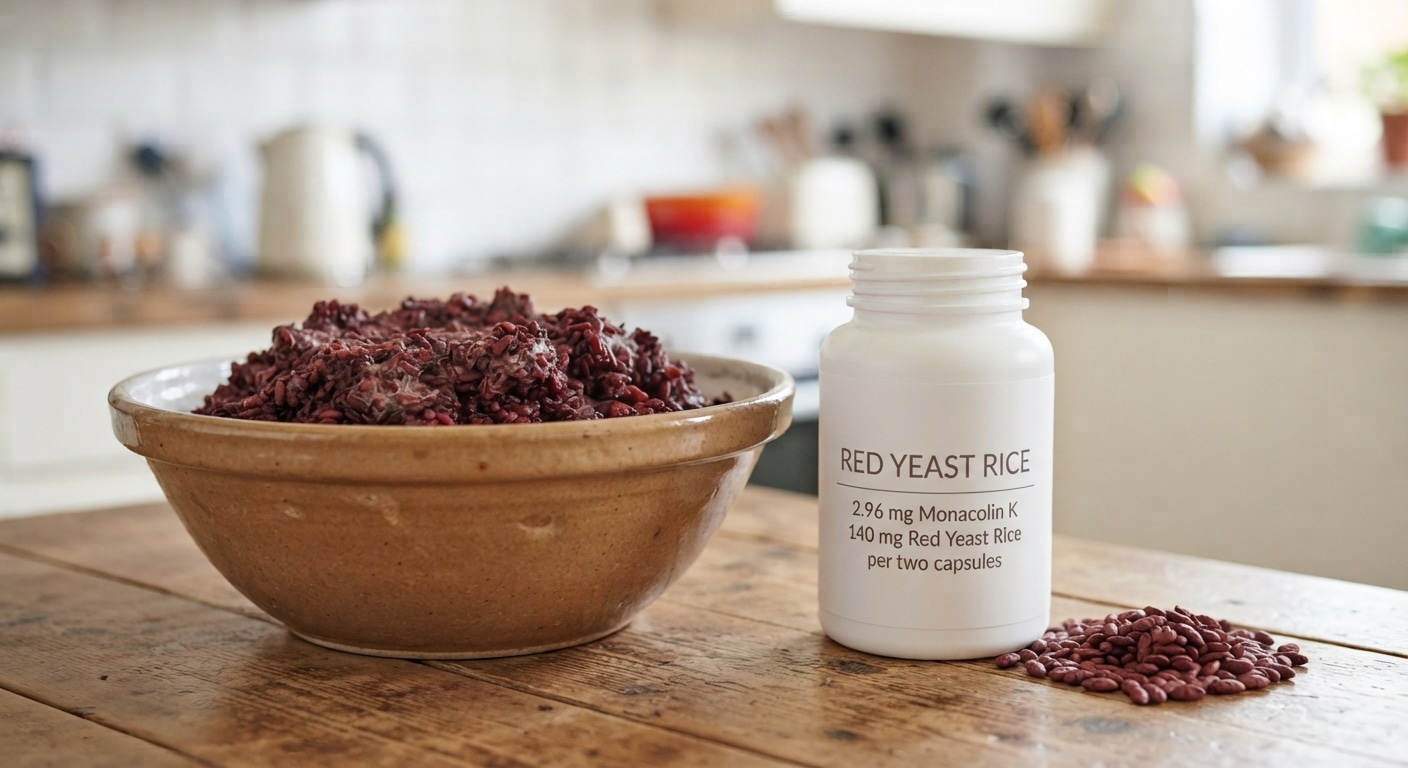
Mine is a red yeast rice complex from a British supplement brand, bought online and sold with coenzyme Q10 and alpha lipoic acid alongside the rice. The website lists the ingredients in order without amounts, but the label itself is specific. Each two-capsule dose contains 225 mg of alpha lipoic acid, 80 mg of coenzyme Q10, and red yeast rice at 140 mg, providing 2.96 mg of monacolin K.
Fermented red rice runs at around 0.4% monacolins by weight, which is also the strength of the bulk extract sold on to supplement manufacturers. At 0.4%, 140 mg would contain only about 0.56 mg of monacolins. Mine contains 2.96 mg of monacolin K alone, which tells me that the material in the capsule is a concentrated extract rather than simply a spoonful of fermented rice.
That is how these products have to work. The rice that colours the pork may hold only traces, so concentrating it is needed to get a useful dose into a capsule. It is also what turns a kitchen ingredient into a drug.
The figure of 2.96 was chosen deliberately. The European limit is 3 mg per daily dose, and a company selling into Europe or Northern Ireland builds one product to the strictest rule it has to meet. The number on a British label is set by a ceiling Britain hasn’t actually adopted.
Coenzyme Q10 is commonly taken in the hope of easing the muscle aches associated with statins.
The warnings on the bottle are the ones every supplement carries: do not exceed the stated dose, food supplements are not a substitute for a balanced and varied diet, consult a doctor if you are pregnant. They would sit as comfortably on a bottle of vitamin C.
So I know my dose, or at least I know what the label says it is. Sometimes those are not the same thing, and the gap between them is the difference between a medicine and a supplement. A prescription drug has to contain what the box says and is tested batch by batch to prove it, which is why 10 mg of lovastatin is 10 mg of lovastatin. A supplement carries a figure supplied by its manufacturer, and there is no equivalent regulated routine check before it reaches you.
Citrinin, and what happened in Japan
Citrinin is a toxin that Monascus produces during fermentation and it damages the kidneys, which is why the EU cut the permitted maximum in red yeast rice supplements from 2,000 micrograms per kilogram to 100, with effect from 2020.
In March 2024 Kobayashi Pharmaceutical recalled three products in Japan, one of them a cholesterol supplement, after customers developed kidney damage. The company was investigating five deaths and 114 hospitalisations. By that June it had 76 further deaths under investigation and tens of thousands of enquiries from worried customers. Most of those cases were never established as caused by the supplement, and authorities have not confirmed a causal link for the reported deaths. Production ended for good that August.
The contaminant was puberulic acid, which red yeast rice does not produce. It came from a blue mould called Penicillium adametzioides that had got into the factory, and a team in Tokyo has since shown how it damages the cells of the kidney tubules.
That was a contamination problem rather than anything to do with monacolins. It is a risk that comes with fermentation: the product is grown rather than made, and something else can grow alongside it.
What Europe decided
The European Food Safety Authority looked at monacolins in 2018 and could not identify a daily amount it was prepared to call safe. The case reports it had were of muscle damage and liver injury. Some involved people taking 10 mg a day, which was the dose the approved health claim was built on. Others involved people taking less than 3 mg.
You may well be wondering how 3 mg can be a problem when lovastatin is prescribed at several times that dose. The difference is not in the compound itself but in everything around it: who is taking it, why, and what checks sit behind the dose. A prescription goes to someone whose cardiovascular risk has been assessed, at a dose chosen for them, with liver tests and a check against everything else they are taking. A supplement you can buy from Amazon doesn’t assess anybody. Not the pregnant, not the over-70s, not the person on other medicines that may push the effective dose up, not the person already taking a statin who has no idea it is the same drug. There is also the question of what you are getting in return. A patient at high risk has something to gain that outweighs a small chance of muscle injury. Somebody taking it as part of a general health and wellness routine is, perhaps unwittingly, accepting the same risk for a benefit that sounds reasonable enough, but that nobody has measured in a person who was well to begin with.
In 2022 the Commission set a limit of less than 3 mg per daily portion, with warnings required against use in pregnancy and breastfeeding, in children, in the over-70s and alongside prescribed cholesterol medicines. This limit sits far below the dose behind the approved claim that monacolin K helps maintain normal blood cholesterol, which rested on 10 mg a day. The EU subsequently removed the authorised health claim in July 2024.
Which leaves the obvious question of whether a legal supplement can do anything at all. It can, though less. Trials at 3 mg a day, usually alongside other ingredients, report LDL falling by about 15 to 17%, against 22 to 27% at the 5 to 10 mg doses used in the earlier research. What a manufacturer cannot do is say so on the packet, because the claim that was authorised belonged to a dose that is no longer legal.
EFSA published a further opinion in February 2025, having read everything the industry submitted in its own defence, and concluded that no safe intake could be identified for the general population or for vulnerable groups at any dose on the market.
On 4 March 2026 the Commission notified the World Trade Organization of a draft regulation moving monacolins from red yeast rice onto the prohibited list. Member states voted it through on 13 May 2026, with Italy against and Portugal and the Czech Republic abstaining. Publication is expected around October 2026, coming into force twenty days later, with a year allowed to clear existing stock. At the time of writing, it has not appeared in the Official Journal.
My dose is 2.96 mg, just under the 3 mg limit. That is less reassuring than it sounds, because some of the muscle and liver cases EFSA reviewed came from people taking less than 3 mg.
And in Britain
Great Britain left the EU before any of this applied. The 3 mg limit and the mandatory warnings never entered GB law, and the Department of Health said at the time that the 2022 regulation had no direct effect on domestic nutrition legislation. Northern Ireland follows the European rules, so the 3 mg limit and the warnings apply there but not here. The Food Standards Agency has not published a position, and no GB regulatory limit equivalent to the EU’s 3 mg rule has been introduced.
So there is no British equivalent of the EU’s 3 mg ceiling on the amount of monacolins a daily dose of a red yeast rice supplement may contain. None of the specific warnings introduced by the EU’s 2022 regulation has to appear on a GB supplement simply because the EU requires it.
The MHRA can regard products with pharmacological activity as medicines, which is where monacolin K becomes particularly awkward: it is pharmacologically the same molecule as lovastatin. No red yeast rice supplement is licensed as a medicine here. NICE guidance recommends prescription statins as the first-line treatment for people whose cardiovascular risk crosses a threshold, and makes no mention of red yeast rice.
Shabba will watch it disappear from the shelves and the websites he buys from. I’m unsure whether to finish or bin mine.
If you are taking it
Tell your GP, and put it plainly: you are taking a supplement containing the same active molecule as lovastatin. That gives your GP a much clearer picture of what you are taking, and what they should make of your medication list and any liver-function tests.
Do not take it on top of a prescribed statin. The interactions that matter to lovastatin matter here too. Grapefruit juice, clarithromycin and some antifungals crowd the same liver enzyme and raise the effective dose without anyone choosing to. Muscle pain, weakness or dark urine mean stop and get seen. So do the liver signs: unexplained tiredness, loss of appetite, pain under the right ribs, or yellowing of the eyes or skin.
If your cholesterol is high enough that you have gone looking for something to lower it, the better route is a GP appointment. A prescription gets you the same molecule at a known dose, with monitoring.
Back to the char siu
The food is not what any of this is about. A pinch of hong qu in a marinade, a splash of red rice wine, the red edge on a shoulder of pork: a trace of it spread across a dish and shared out around a table.
The monacolin K in the marinade, the monacolin K in my bottle and the lovastatin in a tablet are the same molecule. What separates a flavouring from a drug is the dose. In the marinade there is too little to count. In the tablet the amount is measured, printed on the box and verified batch by batch before it leaves the factory. My bottle falls between the two. The amount is printed on it, but nothing has verified that figure, and nobody decided that 2.96 mg was the right amount for a man with nothing wrong with him.
That is the part I keep coming back to. I had nothing to treat. It was meant to be a small step towards living healthier, and having read all this, I am no longer sure it was a step forward at all.
The same mould has been doing its older job on a shoulder of pork for two thousand years, and doing it well. An afternoon cooking over a fire was always going to do more for me than a capsule. I knew that already.
And I would rather have the grapefruit juice.
Red yeast rice remains on sale in Great Britain at the time of writing, with no GB regulatory limit equivalent to the EU’s 3 mg rule and no obligation to carry the warnings the EU introduced in 2022, while the EU moves towards a full ban. If you are taking it, the conversation worth having is with your GP rather than with the label.
Further reading
Plain English first, technical further down.
- Red yeast rice — Mayo Clinic. Two minutes, no jargon, and honest about the fact that you cannot be sure what is in a given bottle.
- Can red yeast rice lower your cholesterol? — Patient.info. Written for a British reader, and covers the drug interactions in ordinary language.
- Key ingredient in red yeast rice supplements varies dramatically — Harvard Health. A short note on a test of 28 American brands, where monacolin K ran from none at all to prescription strength.
- A gift from nature: the birth of the statins — Akira Endo’s own account of the search, in three pages. He starts with his grandfather and the mushrooms, and it is the best thing on this list.
- How monacolins from red yeast rice triggered a global regulatory crisis — NutraIngredients. Trade press, so written for the industry, but it lays out the timeline from the 2018 opinion to the 2026 vote.
- Explanatory memorandum on Regulation 2022/860 — Department of Health and Social Care. Two pages setting out why the EU limit applies in Northern Ireland and not in Great Britain.
- Commission Regulation (EU) 2024/2041 — the removal of the health claim, with the reasoning stated in the recitals.
- Quality control and safety assessment of online-purchased supplements containing red yeast rice — the 2024 study of thirty-five products. Technical, but the tables are readable on their own.
- Scientific opinion on additional data on the safety of monacolins — EFSA, February 2025. Heavy going, and the document the ban rests on.