The Farmer’s Walk — Flight Bags and Suitcases to Dumbbells in the Garden
The Farmers Walk
There’s an exercise that requires no gym membership, no complicated technique, and no instructional video featuring a man with improbable arms. You pick up something heavy. You walk with it. You put it down. Perhaps you brace your core and clench your glutes, if you prefer the modern language of exercise rather than the older, more enthusiastic suck in your tummy and squeeze your buttocks. That is the farmer’s walk, and it is one of the most functional strength exercises you can do.
Functional is a word that gets overused in training circles, often to describe exercises performed on wobble boards whilst pondering where your wobble board mastery can be usefully deployed in everyday life. But the farmer’s walk earns the label honestly. It builds grip strength, improves posture, strengthens the core, and develops the sort of whole-body endurance that has less to do with gym heroics and more to do with carrying things through the world without immediately regretting it.
I know this because I spent roughly thirty years doing it without realising, or at least a version of it — let’s call it the First Officer’s walk. I just wasn’t paying attention.
The Exuberant Years
When I was a young first officer, I carried everything by hand. Flight bag in one hand, suitcase in the other. This was simply how it was done. You walked through terminals, across aprons, down jetbridges, through crew rooms, and into hotels, and you carried your bags because that was what bags were for and hands were for carrying them.
Nobody called it training. Nobody called it anything. It was just more convenient than trying to wheel unbalanced suitcases — and flight bags with wheels seemed very much for an older pilot.
And, as it turns out, it was also a rather respectable form of grip-strength work.
Bangkok and the Moment of Clarity
Then came Don Mueang.
Don Mueang is Bangkok’s original international airport — now a domestic hub, though for many years it handled everything — and it is famous for two things. The first is Kantarat Golf Course. Not beside the airport. In it. Between the two active runways, which raises certain questions about aviation planning during that era — one of them being have you seen how far left or right my tee shots go? The second is the walk.
The walk from aircraft to arrivals at Don Mueang was long. Genuinely, seriously, I-wish-the-airline-paid-for-stands-closer-to-the-immigration-desks long. I do not remember the exact distance. I remember arriving at the other end and deciding that the older pilots were perhaps wiser pilots when it came to luggage choices.
I bought a flight bag with wheels shortly afterwards. I presented this to myself as a sensible upgrade. It was, of course, a surrender, though a very efficient and satisfyingly smooth one.
The Smooth-Wheels Era
The capitulation, once begun, became a rout. By the end of my career I had graduated to a suitcase whose main selling point — the feature I would extol to colleagues — was the quality of its wheels. Smooth. Effortless. Practically self-propelling.
I had spent half a career unknowingly building functional strength and the second half methodically engineering it out of my working life. The bags rolled. The hands were passengers. The shoulders apparently relaxed into retirement before I did.
This was, in a purely logistical sense, a great step forward. In a fitness sense, it was a step back.
It occurred to me later that modern life has become remarkably efficient at removing useful effort. We take the lift instead of the stairs. The escalator instead of the steps. Groceries arrive at the door. Robot vacuum cleaners tidy the floor. Suitcases glide effortlessly behind us on beautifully engineered wheels.
None of these things are bad. In fact, most of them are wonderful.
The problem is that each removes one small opportunity for the body to quietly practise being a body. We don’t become weaker because of one wheeled suitcase. We become weaker because of ten thousand tiny conveniences that, individually, make perfect sense.
Starting Again, One Small Step at a Time
Retirement has a way of returning things to you, including the problems you thought you had neatly solved.
My wife was in the gym. I was sitting in the garden deciding that I really ought to start doing some strength training again. This was, naturally, accompanied by scrolling through social media in search of motivation rather than actually lifting anything.
Somewhere in amongst the inevitable productivity advice, one idea caught my attention: kaizen, the Japanese philosophy of continuous improvement through small, consistent steps.
What appealed to me wasn’t the promise of becoming stronger. Most people like the idea of becoming stronger. It was the permission to begin ridiculously small.
Modern fitness has a habit of announcing transformations. Kaizen quietly suggests another lap of the garden.
That struck me as a philosophy with rather wider application than exercise.
So I started small.
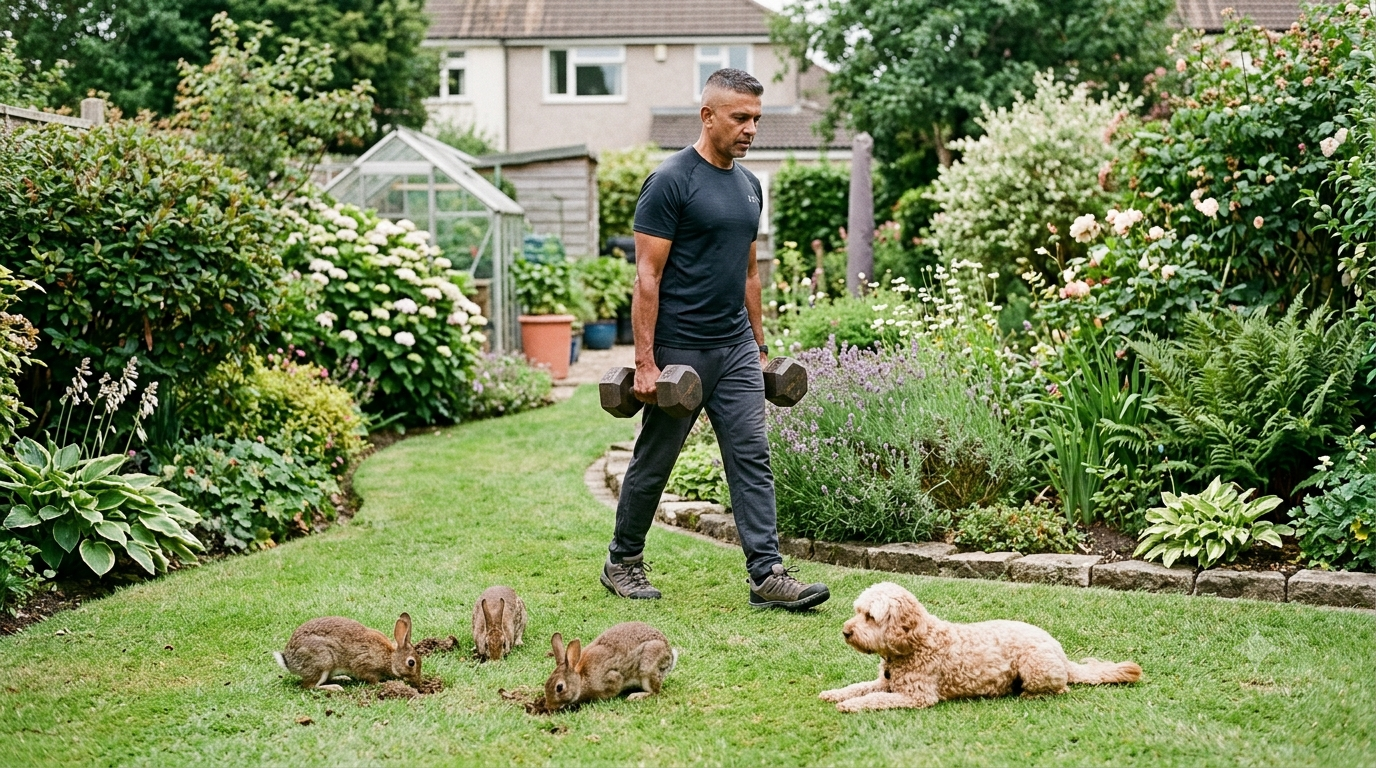
Ten kilograms in each hand. A circular route in the garden. Roughly fifty seconds at a walking pace. Not impressive. Not meant to be impressive — though the rabbits digging up the lawn did seem to be mildly curious. Just enough to begin.
The farmer’s walk suits this principle perfectly. There is no technique to master before you can begin. There is no threshold of competence you must first achieve. You pick up the weights, you walk, you put them down. Next session, you do it again. Over time, the weight goes up, or the distance goes up, or the time goes up. Or all three. The kaizen logic takes care of the rest.
Why It Matters
The farmer’s walk works because life involves carrying things. Luggage. Shopping. Children. Dogs who have decided it’s too hot to walk and would prefer you to carry them to the water bowl if that is not too inconvenient. Bags of compost. The ordinary demands of life are often grip-based and load-bearing, and this is the exercise that trains exactly that.
It also does something useful for posture. Carrying weight in both hands encourages the body to stay tall and braced instead of collapsing into the shape modern life tends to prefer. You feel it in the shoulders, the core, the forearms. It turns out that walking purposefully around a garden with ten kilograms in each hand is a reasonable way to remember you have a body, and that the body has opinions about how it would like to be held. That particular benefit may not appear in the brochure, but it should.
How to Start the Farmer’s Walk
The entry requirements are minimal. Five to ten kilograms in each hand is entirely sufficient for a beginner — enough to feel the work without making the first session a reason not to do the second one. Pick up the weights, walk for thirty to sixty seconds, put them down, and rest. Repeat three to five times. That is a session.
Adjustable dumbbells work well. So do kettlebells, a loaded shopping bag, or — if you happen to have them — farmer’s walk handles. The equipment matters considerably less than the habit.
A simple progression might look like this:
| Stage | Goal |
|---|---|
| 1 | Find a weight you can carry comfortably for 30–40 seconds |
| 2 | Add a little distance |
| 3 | Add a little weight if the previous step feels easy |
| 4 | Repeat |
What It Taught Me
I pick up the dumbbells. I walk the circuit. I put them down.
That is the whole thing. It is simple, natural, and enough.
I had, for years, been doing a version of this in airports and hotel car parks and along the long, indifferent corridors of airline life. I just wasn’t paying attention. The body knew what it was doing even when I didn’t.
Which is a fairly good summary of a lot of useful exercise: obvious in hindsight, mildly ridiculous in practice, and better than it first looks.
The farmer’s walk is not glamorous. It does not promise miracles. It just makes you better at carrying what needs carrying.
And, as training philosophies go, that is hard to beat.
Continue Exploring
Books
One Small Step Can Change Your Life: The Kaizen Way — Robert Maurer. The book behind the idea that started this particular lap of the garden. Maurer makes the case for small, consistent steps as a serious strategy rather than a consolation prize for people who can’t manage big ones. Short, practical, and rather persuasive.
The Comfort Crisis — Michael Easter. A well-argued investigation into what modern convenience has quietly cost us, and what happens when you deliberately reintroduce difficulty. Relevant to everything in The Smooth-Wheels Era section, and then some.
Atomic Habits — James Clear. The most widely read book on habit formation of the past decade, and for good reason. The overlap with kaizen is considerable. If the idea of building something useful from very small beginnings appeals, this is where to go next.
Online
What Are the Benefits of the Farmer’s Walk Exercise? — Healthline. A thorough, well-sourced overview of the exercise, the muscles it works, and the evidence behind the benefits. Good starting point for anyone who wants the science behind the claims.
Farmer’s Carry Workout, Benefits, and Form Tips — REP Fitness. The most practically useful guide in the search results — covers programming, sets, rest periods, and variations in plain language. A good companion to the How to Start section for anyone who wants to go further.
Farmer Carry Exercise: How to Do It, Benefits, Muscles Worked — Defined. A clear, step-by-step technique guide for anyone who wants form breakdown beyond what this article covers.