The Blackberry: Free, Good for You, and Better Off the Bush
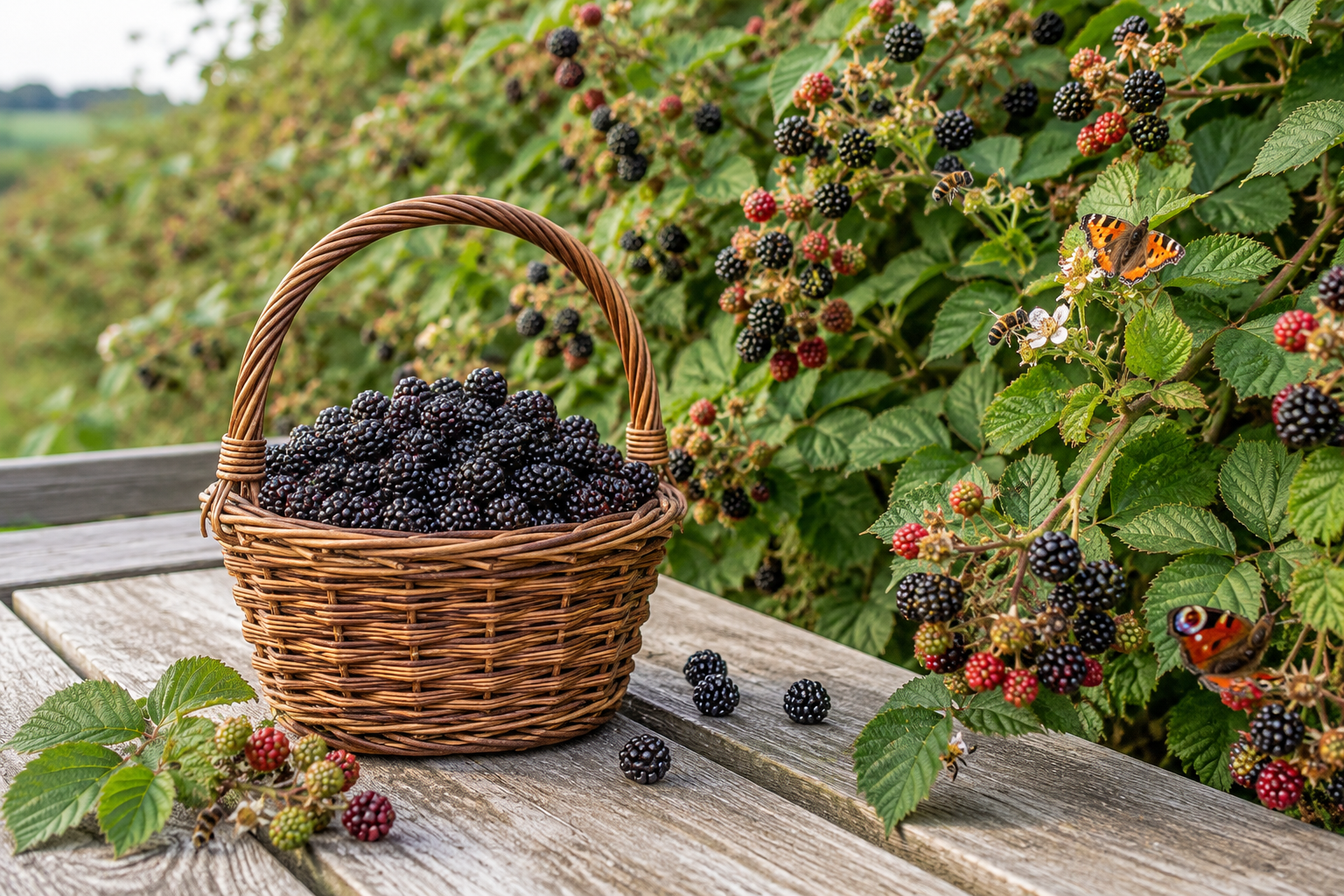
Come the back end of summer, the hedgerows start giving food away. It is one of the few things in modern life still handed over for nothing — no label, no queue, no small print — provided you’re willing to reach past the thorns to get it. Foraging blackberries asks for a bit of effort and the occasional scratched forearm, but in return gives you one of the healthiest fruits you can eat all year.
The pleasure comes first
I’m not going to pretend that the health part is why anyone picks them. You pick them because it is a good way to spend twenty minutes.
There is a quality to foraging that a supermarket can’t match. You are outside, moving slowly, looking at a hedge rather than a neatly arranged aisle, and it is genuinely difficult to check a phone while balancing a tub of fruit and keeping a sleeve off the thorns. The best ones are always just out of reach, or already claimed by a bird, but that’s part of the deal.
Half the pleasure is in the details you only get standing still in a hedge: the warm, jammy smell that comes off the hedgerow after a sunny afternoon, the surprising give of a ripe berry, and the way your fingers end up stained a deep purple that no amount of scrubbing will shift entirely. You just have to wait until it decides to fade on its own.
It is a way of noticing the year turning. The blackberry is a calendar you can eat.
It is companionable, too. Picking alongside someone is an easy, unhurried business, and if the conversation dries up now and then, nobody minds — the quiet usually means the other person is doing what you are doing, eating a fair share rather than dutifully filling the basket. Half of what you pick never reaches the tub. A perk of the job.
It is also the best introduction to foraging there is for children. Blackberries are almost impossible to misidentify, they grow at just the right height for small hands, and the reward is immediate and sweet. But the fruit is almost beside the point. A child learns that food does not only arrive in packaging, that some of the best of it costs nothing and asks a little patience, and that there is a small thrill in gathering your own. A child who will not touch a vegetable will happily strip a hedge and eat the evidence, purple to the elbows, and count it among the best afternoons of the summer.
How to pick, and what to leave
A few rules make the difference between a good haul and a disappointing one, and most of them are common sense.
Wait for a few dry days before you go. Blackberries picked after rain are watery and turn to mush in the tub, whereas a spell of sunshine concentrates the sugar and firms them up. Pick only what comes away easily; a berry that resists is telling you it is not ready, and one that stains your fingers before you have even lifted it is telling you it is past its best. I should admit I rarely follow this rule. I rather like mine sharp.
Be fussy about where you pick, too. Leave the fruit beside busy roads, and anywhere that looks as though it might have been sprayed. And there is a sensible reason to ignore anything below roughly knee height, which every dog walker will understand.
The last rule is the one that matters most. Never strip a bush bare. The hedgerow is not a shop laid on for us; it is feeding birds, insects and a good many other animals heading into autumn, and a stripped bramble is a small act of greed at their expense. Take a share and move along to the next one. There is always more than you can carry anyway, and the birds will have the highest and best of it regardless. They have had more practice.
What is actually in them
The surprising part is how much a small, scruffy fruit is carrying about, and the numbers are better than you would guess of something growing wild in a hedge. Rather than scatter them through the next few paragraphs, here they are in one place:
| Per 100g (a generous handful) | Amount | Roughly |
|---|---|---|
| Calories | ~47 kcal | about 2% of a day’s energy |
| Fibre | ~5.2 g | about a sixth of the 30g daily target |
| Manganese | ~1.1 mg | around three-quarters of the adult daily need |
| Vitamin K | ~14 µg | about a fifth of the adult daily need |
| Vitamin C | ~10 mg | about a quarter of the UK recommendation |
| Sugar | ~6 g | low, and none of it “free” sugar |
| Anthocyanins | ~100–250 mg | among the highest of any common fruit |
Composition per 100g from the European Ciqual 2020 food tables; “roughly” compared against UK Dietary Reference Values (vitamin C RNI 40mg, fibre 30g, and the safe-intake levels for vitamin K and manganese).
The vitamins are all doing useful work, but what each of them is for is a subject for another article. Two lines on that list are worth pausing on, though: the manganese and the fibre.
The manganese is the surprise. A single handful covers the best part of a day’s worth — enough that the blackberry officially counts as “high in manganese”, one of the richest sources of it of any fruit — and it is a mineral the body leans on for turning food into energy and keeping bones in order. Not bad for something you picked off a hedge.
The fibre is the part I would actually make a fuss about, though. Around five grams in a generous handful is remarkable for a fruit, and fibre is precisely the thing most of us are running short on. We are told to aim for about thirty grams a day; the average person limps in nearer twenty. A bowl of blackberries does not entirely close that gap, but it makes a colourful and delicious start.
The colour is doing something
That deep purple is not just for show. It comes from those anthocyanins in the table — plant pigments, and blackberries are stuffed with them, more than almost anything else you’d find in the fruit aisle, often rivalling, and sometimes exceeding, the blueberry everyone makes such a fuss of.
These pigments are part of a broader family called polyphenols, which are actually the plant’s own defence chemicals. The interesting bit is that they seem to do us a good turn as well, mostly by tidying up the low-level wear and tear that goes on in the body simply from being alive and breathing oxygen all day. The research here is promising rather than proven, though, and anyone telling you a berry will fix everything is probably running on faith. But the evidence has been nudging the same way for a long time, and it amounts to the least surprising advice in the world — eat more of the colourful plants.
A word on the gut
We have become increasingly interested in gut health. The bacteria living in your gut turn out to do a great deal more than break down lunch; they seem to have a hand in your immune system, in inflammation, and possibly even in your mood. It is a field that has exploded in the last decade and still has plenty left to prove, so I will not oversell it.
What I can say is that blackberries appear to be very good dinner for them. The fibre and many of those purple plant compounds largely escape digestion before reaching the lower gut, where the resident bacteria set about them and produce compounds linked to a calmer, healthier gut lining. Most of the strongest research has looked at berries as a family rather than the blackberry on its own — but the blackberry is made of exactly the stuff that seems to matter, so it is fair to assume it is pulling its weight. Put plainly: the bacteria that are good for you like the things a blackberry is made of, and when they are thriving, you generally are too.
Sweet, but not the kind that turns on you
Blackberries taste sweet, yet there is not much actual sugar in them — around five grams per hundred, low for a fruit — and the fibre slows down what little there is, so it arrives gently rather than all at once. Same craving answered, none of the mid-afternoon slump that follows a packet of biscuits.
They earn their place in a pudding, of course. But the best of them never make it that far. Eaten straight off the bush, still warm from the sun, they are as good as fruit gets, and they cost nothing at all.
That, in the end, is the whole appeal. No plastic punnet, no sticker, no one calling them life-changing. Just a good thing in a hedge, every year, waiting for anyone willing to lean in past the thorns.
A short reading list
If a hedge in September leaves you wanting to know more, a few books are worth the shelf space.
The one to start with is Richard Mabey’s Food for Free, first published in 1972 and still the classic British foraging handbook — more than a hundred wild plants, sensibly described, with enough on what not to eat to keep a beginner out of trouble. The pocket-sized Collins Gem edition is the one to actually carry.
For the rhythm of the year rather than an A to Z, John Wright’s The Forager’s Calendar takes you month by month through what is worth gathering and when, in the dry, funny voice of someone who has clearly eaten a few things he now advises against. His River Cottage handbooks on hedgerows and mushrooms are excellent too, and reassuringly cautious.
And for the hedge in particular, Adele Nozedar’s The Hedgerow Handbook leans into the folklore and the cooking as much as the identification, which suits a fruit as steeped in old superstition as the blackberry.
None of them is strictly necessary. You can pick a blackberry perfectly well without a book. But they make good winter reading for anyone who has spent an afternoon with purple fingers and started to wonder what else the hedge has been quietly offering all along.