Procrastination, The Gap & The Baseline Approach
I had a plan for retirement.
It was, though I say so myself, an excellent plan. Sensible. Measured. The sort of plan you’d expect from that one friend who appears to have their life in optimum working order.
Six months. That was the plan. Six months to focus—properly focus—on getting fit. Build a solid foundation. At the very least, establish a fitness habit. Become, not impressively athletic, but certainly on the road to being reliably functional.
After years of sitting in a cockpit, it felt less like a grand ambition and more like a small but necessary lifestyle correction. A return to something the body had been hinting at for a very long time.
The treadmill incident
Day one began with intent.
And then the treadmill broke.
Not metaphorically. It simply stopped working, with the quiet finality of a machine that has decided it has done enough.
This, as it turns out, was all the invitation I needed.
Because while I did have other equipment—kettlebells, a perfectly serviceable rowing machine, some dumbbells and a pretty reasonable knowledge of calisthenics — I also had a problem. A broken treadmill is not just a broken treadmill. It is a project.
And projects are wonderfully accommodating when it comes to avoiding the thing you originally meant to do.
So I researched. Thoroughly. Impressively, even.
Specifications were compared. Reviews were analysed. Friends were consulted. Entire evenings were devoted to understanding incline gradients and motor capacities, as though I were planning to equip a boutique gym rather than simply walk briskly in my own home.
Weeks passed.
No training occurred, but a great deal of preparation did, which felt adjacent enough to progress to be quite satisfying.
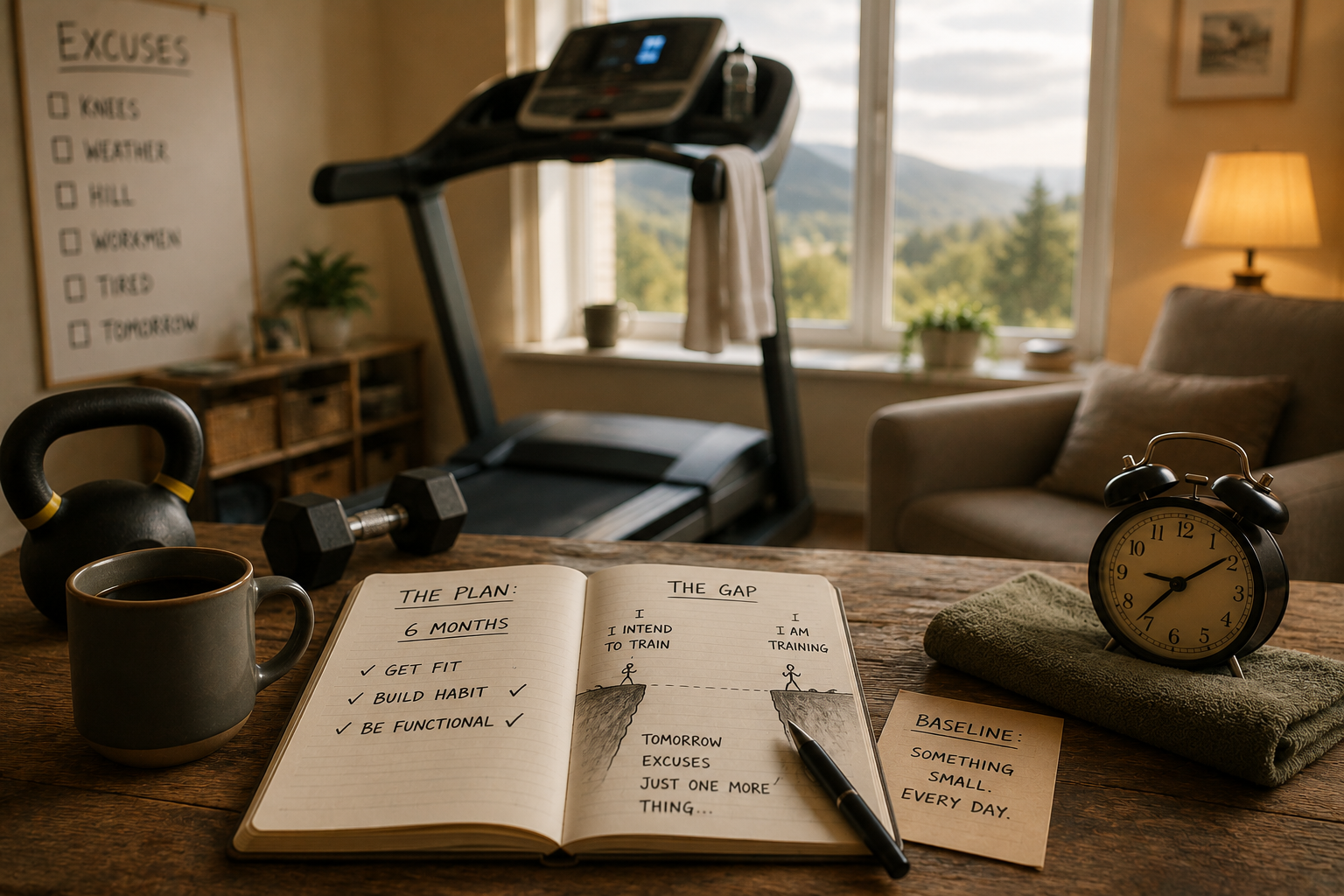
Eventually the new treadmill arrived. Not just any treadmill—a top-end, beautifully engineered piece of equipment. The sort of machine that implies its owner takes fitness extremely seriously — or at least enjoys appearing to.
The excuses multiply
However, once the treadmill was in place, new and gleaming and judgmental, a fresh set of obstacles emerged.
After only a few overly energetic sessions, my knees, which had remained diplomatically silent throughout the entire research phase, suddenly developed opinions.
Workmen were around all day, creating an environment in which using the gym felt socially improbable, if not mildly theatrical.
Of course, I could have gone for a walk or a jog outside.
I did think of it.
But it was January, cold, and I live on a hill, which means every pleasant downhill walk is eventually paid for by the return journey against gravity, which somewhat discolours the memory of an otherwise pleasant walk.
So I would decide that time would be better spent on a comfy sofa, a good book in hand and a mug of tea in easy reach. At least till I was sure that my knee was fully rested and I was able to restart the exercise programme without further injury.
And that, of course, is how procrastination likes to dress itself — not as avoidance, but as good judgement.
The gap
It was around this point that a slightly uncomfortable pattern became difficult to ignore.
The problem was not the equipment.
It was not the plan.
It was not even the very slightly sore knee.
It was The Gap.
That small space between “I intend to train” and “I am, in fact, training,” where the mind becomes both highly persuasive and deeply unhelpful.
Left unchecked, The Gap will happily expand to fill weeks. It will take a broken treadmill and turn it into a multi-stage justification system. It will quite convincingly suggest a slight knee twinge requires an extra few weeks of rest, just to be sure.
Tomorrow, as ever, remains undefeated.
The baseline
So I’ve adjusted the mission.
The goal is no longer to launch a fully realised fitness routine, complete with structure, progression, and a satisfying sense of momentum.
The goal is to establish a baseline.
A modest, almost unambitious starting point. Something repeatable. Something that survives imperfect days, mildly creaky knees, and the occasional excuse dressed up as common sense.
Some days, that baseline is a few minutes on the treadmill. Not a heroic run—just movement. Enough to remind the body that it was designed for better than chairs.
Other days, it’s a handful of kettlebell swings. A few pushups. A brief, slightly undignified negotiation with gravity.
Nothing that would impress anyone.
Which is, I’ve found, rather an important point.
Because this isn’t about performance—at least not yet. It’s about re-establishing a relationship with movement after an extended period of sitting very still in the cockpit and then, in retirement, having a little too much of the same.
Functional strength, in this context, is less about how much you can lift and more about how consistently you can show up and do something that looks, even if only from a distance, like exercise.
So this is the new approach.
Not a transformation. Not a dramatic overhaul.
A baseline.
Something I can build from. Something that doesn’t require perfect conditions or an inspiring mood. Something that begins, quietly, even when part of me is still looking for a reason to put it off until tomorrow.
Public accountability
Perhaps this is the ultimate way of holding myself to account. With this blog, and it’s not just despairing friends who may keep an eye on my progress now — it’s the rest of the internet, which is a much more intimidating audience.
If you’ve ever found yourself waiting for the ideal moment to start—when the equipment is right, the weather is kinder, the hill is flatter, and your knees have signed off on the whole enterprise—consider this an alternative.
Start slightly before you’re ready.
Start with less than you think is necessary.
Start in a way that feels almost too small to matter.
Because, as I’m beginning to suspect, that’s exactly the sort of start that actually sticks.
I’ll probably start tomorrow.