Indian Subcontinent Barbecue: The Tandoor, the Kebab and the Art of Smoke
Indian barbecue spans the whole width of fire, from the searing tandoor to the sealed dum pot — the great regional kebabs, the dhungar smoke trick, and the Sri Lankan hearth. Part of a world tour of wood-fired cooking.
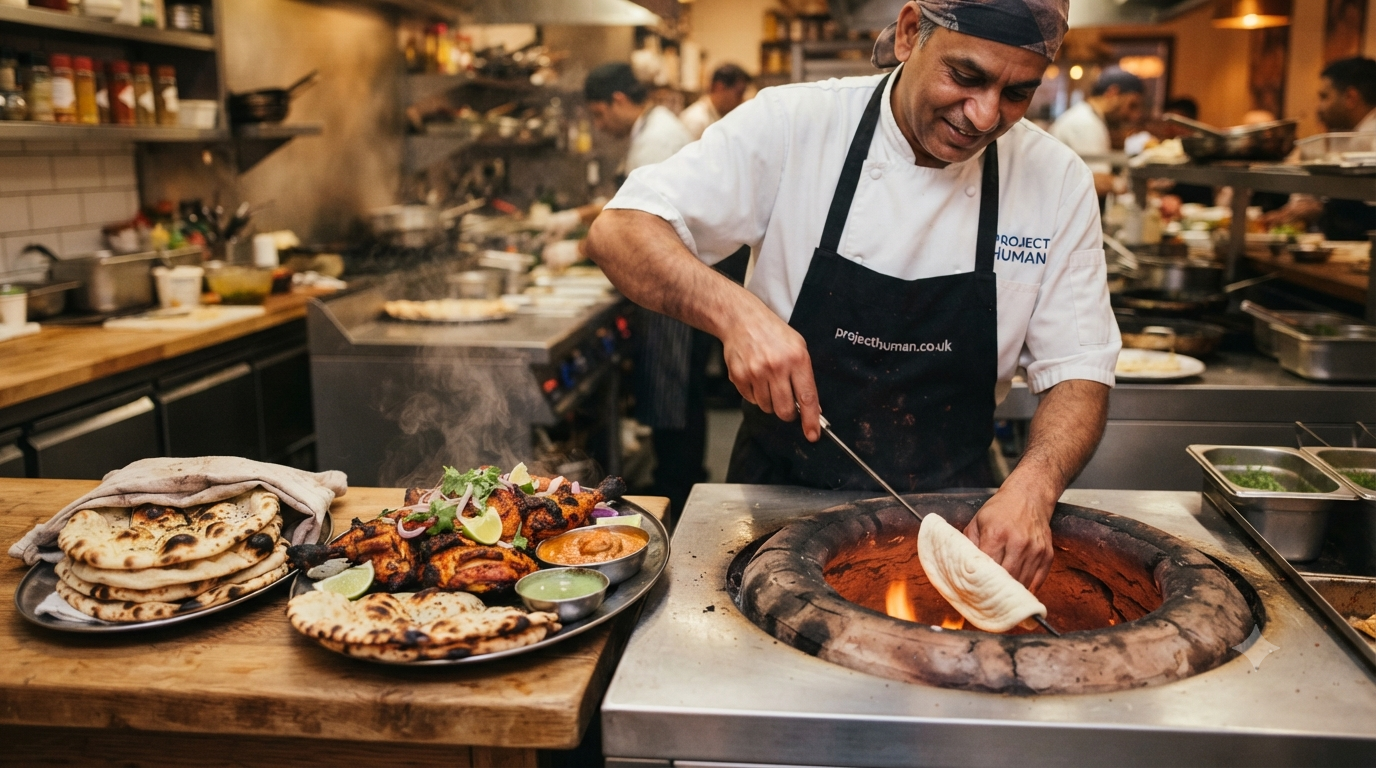
Watch a tandoor cook for a minute and the first thing you notice is that he never looks down. There is a cushioned pad in one hand and a disc of dough in the other, and he leans over the mouth of the clay well, puts his whole forearm into it for about a second — long enough to be faintly alarming from where you are standing — presses the dough flat against the wall and comes back out. Half a minute after that he hooks the naan off blistered and swollen and flicks it into a basket, and by then there are three more stuck to the wall behind it and he is lowering a metre of iron skewer down the same hole, the chicken hissing as its fat falls onto the coals below.
He will do all of that several hundred times before the evening is over. The oven is never allowed to cool between orders, and he never really stops moving.
That little clay well is one of the reasons the Indian subcontinent changed the way much of the world thinks about cooking over fire. It also sits at one end of a range wider than any other tradition on this tour. At the far end is dum — a sealed pot, a lid pasted shut with dough, embers laid on top and underneath, and several hours in which nothing is seen, stirred or checked. Ferocious, minutes-long heat at one end; slow, patient, invisible heat at the other. Most fire cultures pick a spot on that spectrum and stay near it. This one lives at both ends at once. This is the subcontinent leg of the wood-fired tour.
Two ways to use a fire
The tandoor is a barbecue stood on its end, and once you have seen the logic you cannot unsee it. A grill puts the meat above the fire and loses most of the heat to the sky. A tandoor traps everything: heat from the glowing charcoal, heat stored in the clay walls, and a column of hot air rushing upwards through the middle. Food goes in vertically, dripping fat back onto the coals, and comes out again before it has had time to dry out.
Dum works the other way entirely. Persian-derived in name — dum pukht, roughly “to breathe, to cook” — and influenced by courtly cooking traditions, it is a matter of sealing meat, rice, spice and almost no added liquid inside a heavy pot, luting the lid on with a rope of chapati dough, and giving it gentle heat from above and below until everything inside has cooked in its own steam. No smoke reaches the food at all. The fire’s only job is to be modest and not go out.
Between the two sits dhungar, which we will come to, and which is the cleverest of the three.
The numbers behind it: a working tandoor runs at roughly 350–480°C (650–900°F) — three or four times a domestic oven, and hot enough that a naan bakes in thirty to sixty seconds and a chicken tikka in eight to ten minutes. It is fired once and kept going, because a clay tandoor that is heated and cooled quickly will crack. Dum, at the other end, is barely a fire at all: a modest bed of coals below and a scattering on the lid, held for two to four hours, with the seal broken only at the table.
Court, city and frontier
The kebab did not arrive as one thing. Skewered meat came in along the same routes as everything else — Persian and Central Asian, carried by Turkic and Mughal courts — and then landed in a subcontinent that already had its own fire cooking, its own spice trade and a great many cooks with time and money to work with. What each region did with it depended on who was paying.
| Region | The dish | The fire |
|---|---|---|
| Awadh (Lucknow) | Galouti, kakori, shami | Gentle charcoal, or a flat iron plate over embers |
| Punjab and Delhi | Tandoori chicken, barra, tangri, tikka | Charcoal tandoor |
| Hyderabad | Pathar ka gosht | A slab of granite heated over wood |
| Tamil Nadu | Ambur and Dindigul biryani, Chettinad meats | Wood fire under a sealed pot, coals on the lid |
| Kashmir | Tujji, seekh | Open charcoal troughs |
| Balochistan | Sajji | Whole animal beside an open wood fire |
| Khyber Pakhtunkhwa | Chapli, namkeen | Iron tawa, or a charcoal trough |
| Sindh and Karachi | Bihari kebab, seekh | Charcoal, close and fast |
| Northeast India | Smoked pork, bamboo-cooked meat | Hearth smoke, green bamboo |
Each of those is really a different answer to the same question: what happens when someone puts imagination in front of a fire?
Awadh is where somebody worked out that flavour was not the difficult part. Under the Nawabs of Lucknow the competition moved to texture, and the galouti is what came of it: minced mutton worked with raw papaya and a spice list of ludicrous length until it will barely hold together, then cooked for moments on a flat iron plate over coals. It reaches the table intact and stops being a solid somewhere around the first bite. The name says as much — something close to melts in the mouth.
Lucknow will tell you it was made for a Nawab who had lost his teeth but not his appetite, and that there are a hundred and sixty spices in it. Neither is written down anywhere. The texture comes from the papaya and from how long the mince is worked. Kakori, from the town of that name just outside the city, takes the same idea further with kidney fat, cashew paste, poppy seed and rose, until the mince is smooth enough to spread. This is food cooked gently over coals and handled with the care other kitchens keep for pastry.
Punjab and Delhi own the tandoor as most of the world knows it, though it reached Delhi late and from somewhere else. Tandoori chicken was being cooked in Peshawar before Partition. Like millions of people displaced in 1947, the cooks carried recipes with them, and Delhi became the second home of a Peshawar fire tradition. The marinated, blistered, red-stained bird went from regional dish to national one, and then to every high street in Britain. Butter chicken came out of the same kitchens, invented to use up tandoori chicken that had begun to dry out. Around it sits the rest of the tandoor’s range: boneless tikka, malai and reshmi tikka silky with cream, seekh pressed onto the skewer by hand, tangri drumsticks, and barra, the great mutton chops of the Punjab. The common thread is a yoghurt marinade, which tenderises without turning the surface to mush the way an acid one will, and clings well enough to survive the trip down into the heat.
One of the hotels we laid over at had a restaurant given over entirely to fire-cooked food: a set menu, as much off it as you liked, and naans so large they took up most of the table. You were given a cloth bib and you ate with your fingers, tearing off bread to mop up anything saucy. The speciality was sikandari raan, a leg of lamb so tender it came away from the bone on its own.
Before lockdown you could pay for a cooking lesson there — down early to make kebabs and learn the marinades, back in the evening to eat what you had made. A good deal of crew signed up in the open hope of getting the raan recipe out of the chef. I was one of them. He was immovable. There was a rumour on the fleet that someone had once got it out of him, though it was never anyone I flew with.
Hyderabad does something no one else does. Pathar ka gosht is thin slices of marinated mutton cooked on a slab of granite that has been sitting over a wood fire for hours — a griddle made of rock, the heat arriving entirely by conduction, with no flame anywhere near the meat.
Tamil Nadu never took to the skewer. The tandoor turns up in restaurants and nowhere else, and the fire here goes under the pot rather than round the meat: Chettinad kitchens work in clay over wood, and the state’s great fire dish is a biryani.
Ambur makes the famous one, with Vaniyambadi and Dindigul close behind, and it is cooked over firewood in the pakkistyle — pakka meaning cooked, as against kacchi, raw — so the meat and the short, round seeraga samba rice are done separately, layered, then sealed and left under dum with hot coals on the lid. The style goes back to the Nawabs of Arcot in the 1800s: a Persianate court kitchen a long way south of where accounts of this food usually stop.
Ask about the wood and you will get tamarind, which burns away to nothing and holds an even heat for as long as the dum lasts.
Kashmir cooks most of the wazwan, its great set-piece meal, in pots rather than over fire. The seekh and the tujji are the exceptions, skewered and cooked over long charcoal troughs.
Balochistan offers the showstopper. Sajji is a whole lamb or chicken, salted, skewered on a stake and set upright besidean open wood fire rather than over it, turned as it goes, cooking for a couple of hours in radiant heat alone. An Argentine asador would recognise the method on sight — it is essentially the same reasoning as the cross, arrived at independently at the other end of Asia, and worth reading alongside the South American leg of this tour.
Khyber Pakhtunkhwa gives us the chapli, the great flat patty of Peshawar — beef or mutton with tomato, coriander seed, pomegranate seed and green chilli, pressed thin and fried on a wide iron tawa in its own fat. The fire is under the iron rather than under the meat, which makes the chapli a cousin of Hyderabad’s granite slab.
Sindh and Karachi were on the other side of the same upheaval. The bihari kebab came west with migrants from Bihar in 1947 and became a Karachi dish: long thin fillets cut along the grain, tenderised with papaya, marinated for hours and grilled hard and close over charcoal.
The Northeast puts the household cooking fire to a second use. In Nagaland, Mizoram, Manipur and the Assam hills, pork is hung above the hearth and smoked for weeks over whatever the family happens to be cooking, until it will keep without a fridge — the same logic as in the Pacific Northwest. Meat and fish are also cooked inside sections of green bamboo laid on the embers, the tube steaming and scenting its contents before being split open at the table. No marinade, no tandoor, no court kitchen; just fire, smoke and a long winter to get through.
Nepal: the hills and the skewer
Nepal has a substantial grill tradition, and it owes nothing to the tandoor. Sekuwa — from sekne, to cook over direct heat — is marinated goat, buffalo, pork or chicken threaded onto iron skewers and cooked over wood coals rather than in the flame. It comes from two directions: the eastern hills, where Limbu and Rai kitchens work over wood and bamboo coals, and the Kathmandu valley, where Newar cooks took it towards mustard oil and timur, the pepper that leaves your mouth faintly numb.
The Newar dish proper is choila: buffalo cut into strips and roasted over an open fire, then chopped and dressed while still hot with chilli, ginger, garlic, fenugreek and mustard oil heated until it smokes. The fire is a stage in the recipe rather than the end of it.
Sukuti is meat sliced thin, rubbed with salt, cumin, chilli and turmeric and hung above the chulho, the household wood stove, until the smoke and the dry air between them have taken everything out of it.
Sri Lanka: the fire in the corner of the kitchen
Sri Lanka has no tandoor and nothing much that would answer to the word kebab, and anyone who goes looking for skewers there will come away thinking the island has no fire tradition to speak of. It has one of the most thoroughgoing in the region. It simply keeps the fire indoors and puts a pot on top of it.
The hearth is the dara lipa in Sinhala. In Tamil it is the viraku aduppu — firewood stove, a plain description rather than a name, and the same words used across the water in Tamil Nadu. Either way it is clay, or three stones set in a ring, with firewood burning between them and an earthen pot — hatti in Sinhala, chatti in Tamil — balanced across the top. It is fed with whatever a coconut economy produces in quantity: firewood, husks, dried fronds and shells, all of which burn hot and leave very little behind. Rice and curry cooked over it carry a background of woodsmoke that a gas ring does not reproduce, which is why people who grew up eating it can taste the absence. It comes at a cost though. Cooking over an unvented indoor fire exposes whoever is doing it to very large quantities of smoke, and the WHO attributes several thousand deaths a year in Sri Lanka to indoor air pollution.
The island’s actual smoking, in the sense the rest of this article has been using, happens to fish and happens months before dinner. The result is called Maldive fish in English, after the islands that first made it and still do; umbalakada in Sinhala; maasi karuvadu in Tamil — though to me, who left as a boy of just under four still not having the hang of longer words, it was maas-maas, and that is how I think of it still. Skipjack tuna, filleted, boiled, smoked over a fire overnight and then left in the sun for days, until the pieces are as hard as offcuts of timber. Grated into a coconut sambol — pol sambol in Sinhala, thengai sambol in Tamil — or into a curry, it supplies the deep savoury note underneath a great deal of Sri Lankan cooking, and it is smoke used the way dhungar uses it: concentrated, stored, and spent a little at a time. Plain salted dried fish — karawala in Sinhala, karuvadu in Tamil — does related work.
In the north and east the Tamil kitchens keep the same hearth and ask something different of it. Jaffna cooking is defined by roasting: the curry powder is dry-roasted dark over the fire before it is ground, and that roasting, more than any individual spice, is what separates a Jaffna curry from a southern one. The pots are clay, the fuel is wood, and the slowness those two things impose is taken as the method rather than an inconvenience.
There is also one properly communal open fire. Odiyal kool is cooked outdoors in a pot big enough to need help: odiyal — flour ground from the root of the palmyra, the palm that stands in for the coconut across the dry north — thickened with rice and loaded with crab, prawn, cuttlefish and whatever else the sea has given up, stirred over a wood fire for hours and eaten by a crowd straight from the pot it was cooked in.
Pittu belongs here too — puttu in Tamil. Rice flour and coconut are steamed inside a length of bamboo, the pittu bambuwa, stood upright over the hearth — which is what the Naga hills are doing when they cook meat inside green bamboo, two thousand miles away. Whether either ever borrowed from the other I have no idea. A tube of bamboo is simply what a steamer looks like in a place where bamboo grows.
The Maldives: cooking where there is no wood
Maldive fish carries the name of the Maldives because that is where it is made, and it exists in the form it does because of a shortage. An atoll has coral, sand and palms and almost nothing you would call timber, so the entire fire culture runs off the coconut: shells and husks for the coals, dried fronds and palm wood for the fire, and palm stalks lashed into the dhumashi, the rack the fish is laid across.
Valhomas, the smoked tuna itself, is gutted and filleted, cut into long strips, boiled in salted water in big pots over a fire of coconut shell and wood, then smoked over open pits overnight and left out in the sun for about three days. Hikimas is the same thing dried without the smoking.
What happens to the water is the part worth knowing. The salted broth left behind in the pot is reduced over a low fire for hours until it becomes rihaakuru, a dark brown tuna paste eaten more or less daily with rice, roshi or breadfruit. The fish is kept by smoke; the liquid it was boiled in is kept by patience.
Dhungar: smoke without a grill
The cleverest fire trick here uses almost no fire.
Dhungar is a way of putting the aroma of the grill into something that has never been near one. A small metal cup — traditionally a hollowed onion — is nestled into the middle of a curry, a dal, a marinade or a pot of biryani. A lump of glowing charcoal goes into the cup, a spoonful of ghee is poured over the coal, and the lid goes on immediately. The fat hits the ember, catches, and fills the sealed pot with dense fragrant smoke, which the food absorbs in three or four minutes. Then the cup comes out and nobody at the table can work out what you did.
It is usually credited to the Awadhi kitchens, and it is the technique that ties the two ends of this tradition together: a way of getting the flavour of the tandoor into food that has to be cooked by dum. Fire used as a seasoning, measured out by the lump.
Charcoal, and the woods that are actually used
Almost none of these fires cook directly over flame; the wood is turned to charcoal or a settled bed of embers first, so density and clean, long-lived coals matter more than aroma. The everyday fuel is charcoal — dense babool (keekar) in the north, tamarind in the south, coconut shell down the coasts — with mango the one wood reached for when the smoke itself is wanted. Green bamboo, packed with sealed chambers of air and water, must never go whole on a fire: it bursts like a shotgun.
The subcontinent also carries an unusually long list of genuinely dangerous woods — spurges and cashew relatives whose smoke blisters and poisons. For the full account, and what to burn instead in Britain, see Indian Subcontinent Barbecue Wood.
Borrowing it for a Hampshire garden
Very little of this needs a clay oven, which is fortunate, because a real tandoor is a serious commitment — it wants to be lit once and kept hot, and it does not forgive being heated and quenched on a Saturday afternoon. What travels is the thinking behind it.
- Heat that is fierce and short, not modest and long. This is the opposite decision to American barbecue. Small pieces, high heat, minutes rather than hours, and the food off before it dries.
- Yoghurt as the marinade. It tenderises slowly and gently, and it clings, which is why tandoori food chars in patches instead of sliding off into the coals.
- Fat falling onto coals as part of the recipe. The smoke that comes back up is the seasoning. Vertical cooking is simply a way of guaranteeing it.
- Smoke applied on purpose, in a measured dose. Dhungar is the whole principle in one move.
On a kettle, a parrilla or a plain box of coals, that looks like:
- Get the fire hotter than feels sensible, then cook close to it. Direct heat, a full chimney, and chicken tikka or seekh in under ten minutes. If you are used to holding 110°C for a shoulder, this will feel like a different hobby.
- Marinate in two stages. A short first marinade of salt, lemon or vinegar and ginger-garlic; then the yoghurt and spice for several hours or overnight. Hang or drain the yoghurt first so it coats rather than runs.
- Watch for the marinade catching. Yoghurt, cream and any sugar in the mix will blacken well before the meat is done. Keep a cooler corner of the grate to move things to, and expect to.
- Use charcoal for the cook and wood for the flavour. Lumpwood for the heat; a small piece of apple or cherry if you want the smoke, and not much of it.
- Try dhungar indoors. A ramekin in the middle of the pot, one small lump of lit charcoal, half a teaspoon of ghee, lid on hard, four minutes. It is the only technique in this article that needs no barbecue at all, and it is the one most likely to surprise people.
A ramekin, one lump of charcoal and half a spoonful of ghee. Of everything in this article it is the least impressive thing to own, and the only one I could do tonight — indoors, over a pot of dal, with the coal lit on the gas ring and no barbecue involved at all.
That is the part of a fire tradition you can actually carry home. Not the oven. The idea of measuring smoke out.
I left Sri Lanka too young to have strong memories. But though they lay dormant for many years, my love of wood-fired cooking is intertwined with what did survive — impressions, possibly more imagined than recalled, of the smells, the sights and above all the people. A word, a sound, woodsmoke, a few seconds of something, surfacing without warning and gone again before I can get a proper look at them.
Maas-maas is one of them.
So is a smile from my grandmother.
Further reading
More of these are coming as the series fills out.
- A guide to the cooking woods of the Indian Subcontinent
- Yoghurt marinades: how they work and why they cling
- Dhungar step by step, with a ramekin and one lump of charcoal
- The kebabs of Lucknow: galouti, kakori and the texture obsession
- Jaffna curry powder, and why the roasting is the recipe
- Recipe: chicken tikka over charcoal, without a tandoor
Back to the pillar: Wood-Fired Cooking Around the World