Middle Eastern Barbecue: The Mangal, the Kebab and the Masgouf
Middle Eastern barbecue is the charcoal grill and the shared table at once — the mangal, the kebab, the masgouf and the mandi. Part of a world tour of wood-fired cooking.
A mangal is a metal trough about as long as your arm and a hand’s depth, with two lipped rails running down the sides and a bed of charcoal in the bottom. There is no grate. There is no lid, no vent, no dial. The skewers lie across the rails with the meat hanging clear of the coals, and the cook turns them with one hand while fanning with the other, sending up a scented gust of lamb fat and smoke.
It is the grill of Tehran, Beirut and Istanbul, and its design has barely changed in centuries. It also cooks only a handful of skewers at a time and no more, so the food cannot arrive all at once, plated, a portion each. It comes off in relays, onto bread, into the middle of a table that started eating long before the first skewer was ready.
This is the Middle Eastern leg of the wood-fired tour. The fire takes different forms as you travel — a trough of charcoal, an open blaze of apricot logs, a clay oven sunk into the ground — but the meal at the end of them is much the same: the food in the middle, bread instead of cutlery, and no portion belonging to anybody in particular. Where that came from, and what keeps it in place, is most of what follows.
A Trough of Coals and a Row of Skewers
The mangal’s ancestry is nomadic: a portable fire for people who had to carry their kitchen, along with the rest of their house, with them. Everything the design does is in service of moving quickly and wasting nothing. A narrow trough concentrates a small amount of charcoal into a long, even line of heat. Skewers use no pan and no fat. The absence of a grate means the cook can lift, turn and shuffle each skewer independently, so the fast-cooking chicken and the slow lamb share one fire without either being ruined.
It also means the cook cannot walk away, which is the real difference between this and the American pit. There is no closed chamber holding a temperature for you.
Around the mangal grows mezze — the long, unhurried spread of small dishes that arrives before the skewers and carries on arriving after them. The word comes from the Persian maze, meaning taste or relish. By the time the first skewers land, the table is already crowded with hummus, smoked aubergine, herbs and warm flatbread, and the meal is already well under way.
How a mangal is actually run: a bed of charcoal two or three fingers deep, lit and then left until every flame has died and the coals have greyed over — a mangal is worked over glowing coals, never fire. Skewers are flat and wide, because a round skewer lets the meat spin as you turn it. Nothing sits on a grate; the meat hangs an inch or two above the coals on the rails. Heat is raised by fanning rather than by adding fuel. Minced kebabs cook fast and need turning almost continuously; cubed meat takes longer and is left alone more. The skewers are laid on flatbread as they come off, so the bread takes the juices.
Kabāb comes into Arabic, Persian and Turkish from older Semitic roots meaning to burn or char. The Ottoman kitchens codified it, named the variations and sent them out across an empire that ran from Basra to Belgrade, which is why a Bosnian ćevap, a Greek souvlaki and an Adana kebab are recognisably related.
The Cloth on the Floor
The grill explains how the food is cooked. The shared table it is carried to explains the form the food takes.
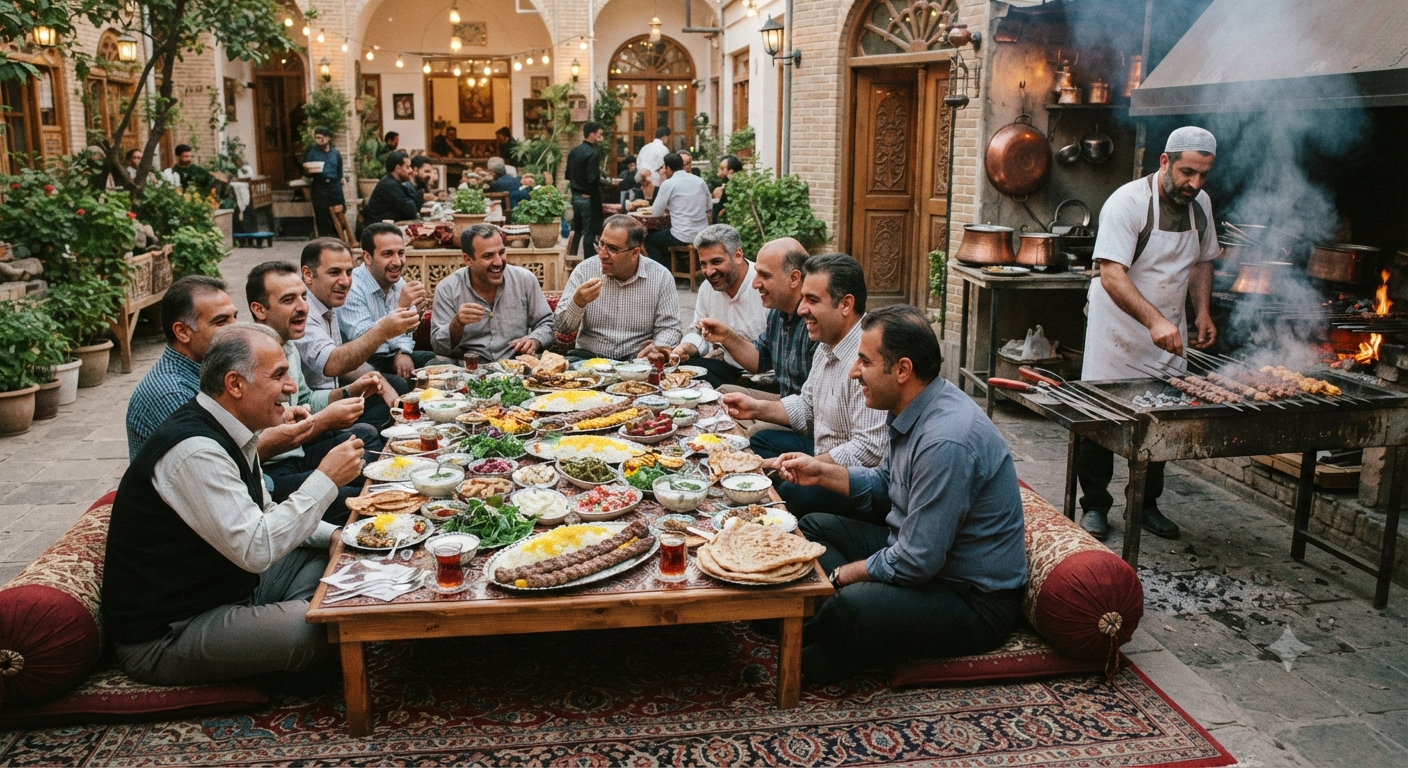
In Iran that is the sofreh, a cloth spread over the carpet with the dishes set out on it and everyone sitting round the edge. Because it is not limited by the number of chairs, it takes however many people turn up. In Turkey it is the sofra, and in its older form the yer sofrası — a low round tray, seventy or eighty centimetres across, set close to the ground so four to six people can reach the middle and nobody sits above anybody else. The hammered brass or copper tray itself is a sini. In Turkish, to open a sofra is the ordinary way of saying you are feeding people.
Nobody gets a plate of their own. The dishes go in the middle, and the convention is that you eat from the part of the platter directly in front of you rather than ranging across it. You eat with the right hand, never the left. The eldest, or the host, starts. Bread is the utensil — flatbread torn and used to scoop, wrap and lift, and then eaten itself.
There is religious weight behind it as well as practical habit. A well-known hadith has the Prophet telling his companions to eat together and not separately, because the blessing is with the company; his own serving bowl, al-Gharrā’, is described as taking four men to carry.
Eating this way is neither universal nor fixed. Iran is the outlier: a Persian chelo kabab arrives as one person’s plate of rice with the skewers laid over it, though the sofreh around it is still covered in dishes everyone reaches into. And in the cities, individual plating has been gaining ground for a generation.
From Tehran to the Tigris
What changes country to country is the marinade, the cut and the bread it lands on.
| Region | The dish | The fire and fuel |
|---|---|---|
| Iran | Chelo kabab — koobideh, barg, jujeh | Charcoal, bare channel, no grate |
| The Levant | Shish taouk, kofta, arayes, shawarma | Charcoal mangal (mashawi) |
| Turkey | Adana, Urfa, İskender, çağ, döner | Charcoal at the ocakbaşı |
| Iraq | Masgouf — whole split carp | Apricot and fruitwood logs, open fire |
| Yemen & the Gulf | Mandi, madfun, madhbi | Samr acacia in a sunken tannour |
| Egypt | Kofta, kebab, hawawshi | Charcoal |
| Everywhere | Flatbread, slow-roast shoulder | Wood-fired clay oven (tannour) |
Iran does a handful of kebabs, and does them properly. Chelo kabab is as close to a national dish as anything gets: skewers laid over a mound of buttered, saffron-flecked rice, with a grilled tomato and a dish of sumac alongside.
Koobideh is the one you meet everywhere. Minced lamb or beef is worked with grated onion until it turns sticky enough to cling, pressed along a wide flat skewer by hand, and grilled until the edges catch. Barg is the expensive end of the same idea, long ribbons of marinated tenderloin; the name means leaf. Ask for both on one plate and you get soltani, in the style of a sultan. Jujeh is chicken steeped in saffron, lemon and onion. Bakhtiari has chicken and lamb on the same skewer.
All of it cooks over a bare charcoal channel with no grate, the skewers resting on the rails, turned and fanned by hand from the first minute to the last.
The Levant calls the grill the mashawi, and lighting it is a routine part of the week rather than something saved for special occasions. The repertoire is generous: shish taouk, cubes of chicken marinated in yoghurt, garlic and lemon; kofta of spiced minced lamb moulded down the skewer; whole cuts of lamb; and, turning slowly at the side, the vertical spit that gave the world shawarma.
Toum, the fierce whipped garlic emulsion, comes with it. There are no courses; the table simply fills up and stays full. Arayes is the simplest thing on the list and the easiest to replicate: a pocket of pita split, filled with spiced mince and pressed straight onto the coals until the bread crisps and the fat soaks through from inside. It is the sort of idea that seems obvious when you hear it. The sort that makes you wonder why we are not doing it already.
Turkey has very nearly a kebab per province. The famous pair are Adana, minced lamb loud with red pepper, and the milder Urfa; Adana kebabı is chopped by hand with a zırh, a curved two-handled blade, and carries a protected designation in Turkey that specifies the meat, the fat content and the method. İskender drapes shaved döner over torn pide, then floods it with tomato, browned butter and yoghurt.
Çağ kebabı, from Erzurum, runs the spit horizontally rather than upright, the marinated lamb sliced off onto skewers to finish over the coals — which is how döner was done before İskender Efendi is said to have stood it upright in Bursa in the 1860s. That vertical tower has since travelled further than any dish on this tour. The natural home of all of it is the ocakbaşı, literally “fireside”: a restaurant built around a sunken grill where you sit at the coals and the cooking happens at arm’s length, close kin to Korea’s tabletop barbecue and every bit as sociable.
Iraq‘s masgouf is theatre. A whole carp is split down the back and opened out flat like a book, seasoned with not much more than salt, turmeric and tamarind, and then stood upright on stakes in a ring around a blazing open fire of apricot logs. Not sitting over the flames. It roasts beside them, for the better part of an hour, before being laid flat over the embers at the end to finish.
The fire is built on a raised sandbox, and the ritual belongs to the banks of the Tigris in a line that runs back through Mesopotamian history. It is done over wood rather than charcoal, because the fruitwood smoke is part of the seasoning. The river’s fish stocks have declined sharply in recent decades, and much of the carp now sold is farmed.
Yemen and the Gulf bury the oven. Mandi — eaten across the Gulf — is fragrant spiced rice with slow-cooked lamb or chicken, made in a tannour, a clay oven sunk into the ground. Wood, classically the desert acacia known as samr, is burned down inside the pit; a pot of rice is set on the coals; the marinated meat is hung above it so its dripping fat seasons the rice while everything cooks in the trapped, smoky heat.
It has two close relatives. Madfun means “buried”, and is exactly that. Madhbi comes back above ground, cooking the meat on a flat stone laid over the fire. Across the Gulf there are restaurants that serve little else, and they all do it the same way: one platter of rice set down in the middle with a whole shoulder on top, no serving spoons, everyone working the section in front of them with the right hand. Kabsa and haneeth are served the same way. A single dish, however many people are round it.
Egypt runs on charcoal and mince. Cairo’s kebab houses grill kofta and lamb cubes to order, and often let you pick the meat at the counter first. The local answer to arayes is hawawshi: spiced mince sealed inside baladi bread and cooked until the crust shatters. Stuffed grilled pigeon, hamam, is the other speciality.
Charcoal, and the Trees It Comes From
The region runs on charcoal for the fast skewer work — much of it now imported by ship, Indonesian hardwood and coconut shell above all — and on wood only where the fire is slow: apricot and other orchard fruitwoods for the masgouf, samr acacia and olive prunings for the tannour and the grill. The one to keep well clear of is oleander, the beautiful, poisonous shrub of every warm-climate roadside, whose straight young stems look like ready-made skewers and must never touch food.
For the full account — the oaks of the Zagros, the olive pomace, the protected desert trees, and the whole dangerous list — see Middle Eastern Barbecue Wood.
Borrowing It for a Hampshire Garden
A mangal needs charcoal, flat skewers, and someone prepared to stand over it for the length of the meal. None of that is hard to come by here.
What actually transfers:
- The trough, not the grate. A narrow bank of coals with the meat suspended above it on skewer rails, so each piece can be lifted, turned and moved independently.
- Flat, wide skewers. The single cheapest upgrade available. Round skewers spin, and minced kebabs slide off them into the fire.
- The marinade does the heavy lifting. Grated onion squeezed of its juice, yoghurt, garlic, lemon, saffron. These are cures as much as flavourings, and a few hours of marinating changes the texture, not just the taste.
- One dish, not six plates. The food goes into the middle and stays there. Nothing arrives already divided, and nobody sits waiting for their own portion.
- Bread instead of cutlery. The skewer comes off onto flatbread, which catches the fat, does the scooping and lifting, and gets eaten at the end.
- Fan it, don’t feed it. Heat is adjusted by moving air, not by throwing on more fuel and waiting.
In practice, on a kettle, a parrilla or a couple of rows of firebricks:
- Build a channel. Two lines of firebricks on a paved base, set a skewer’s width apart, is a mangal. On a kettle, rake the coals into a long narrow bank and lay the skewers across the rim. On a parrilla, the grate comes out and the skewers rest on the frame.
- Burn the fire down properly. Grey, ashed-over coals, no flame anywhere. Fat drips constantly onto an open bed of charcoal, so flare-ups are managed by moving the skewer, not by dousing the fire.
- Work the mince until it is sticky. Koobideh, kofta and Adana all depend on mince worked and slapped until the protein binds. If it will not cling to the skewer, it has not been worked enough, and squeezing the water out of the grated onion matters more than any spice in the bowl. The wider flat skewers are best for this, since there is more for the mince to grip. Watching your kebab tear slowly off the skewer and into the coals is a tragic thing. You have been warned.
- Save the wood for fish. The masgouf principle — a split fish propped upright beside a fruitwood fire rather than over it, then finished flat on the embers — is the one thing here that genuinely wants logs. Apple or cherry will do the job apricot does on the Tigris.
- Feed people before the meat arrives. Hummus, aubergine, herbs, bread, pickles. The kebabs are the last act, not the whole evening.
The skewers and the charcoal are the easy part to copy. The harder borrowing is what they exist to serve: the food in the middle, bread instead of cutlery, and nobody sitting there waiting for a plate of their own.
Two rows of firebricks set a skewer’s width apart, and a bed of coals burned down grey. That is the whole apparatus.
The rest is bread, one dish set in the middle, and more people round it than you had planned for. Try it that way once and the equipment stops being the interesting part.
Further reading
These guides are on their way — this section will grow as the series does.
- A guide to Middle Eastern woods
- How to run a mangal: skewers, coals and the art of fanning
- Koobideh and kofta: getting minced kebabs to stay on the skewer
- Masgouf at home: cooking a whole fish beside the fire
- The clay oven: tannour, tandır and tandoor
Back to the pillar: Wood-Fired Cooking Around the World, where the Middle East takes its place alongside the asado, the braai, the American barbecue belt and the rest.