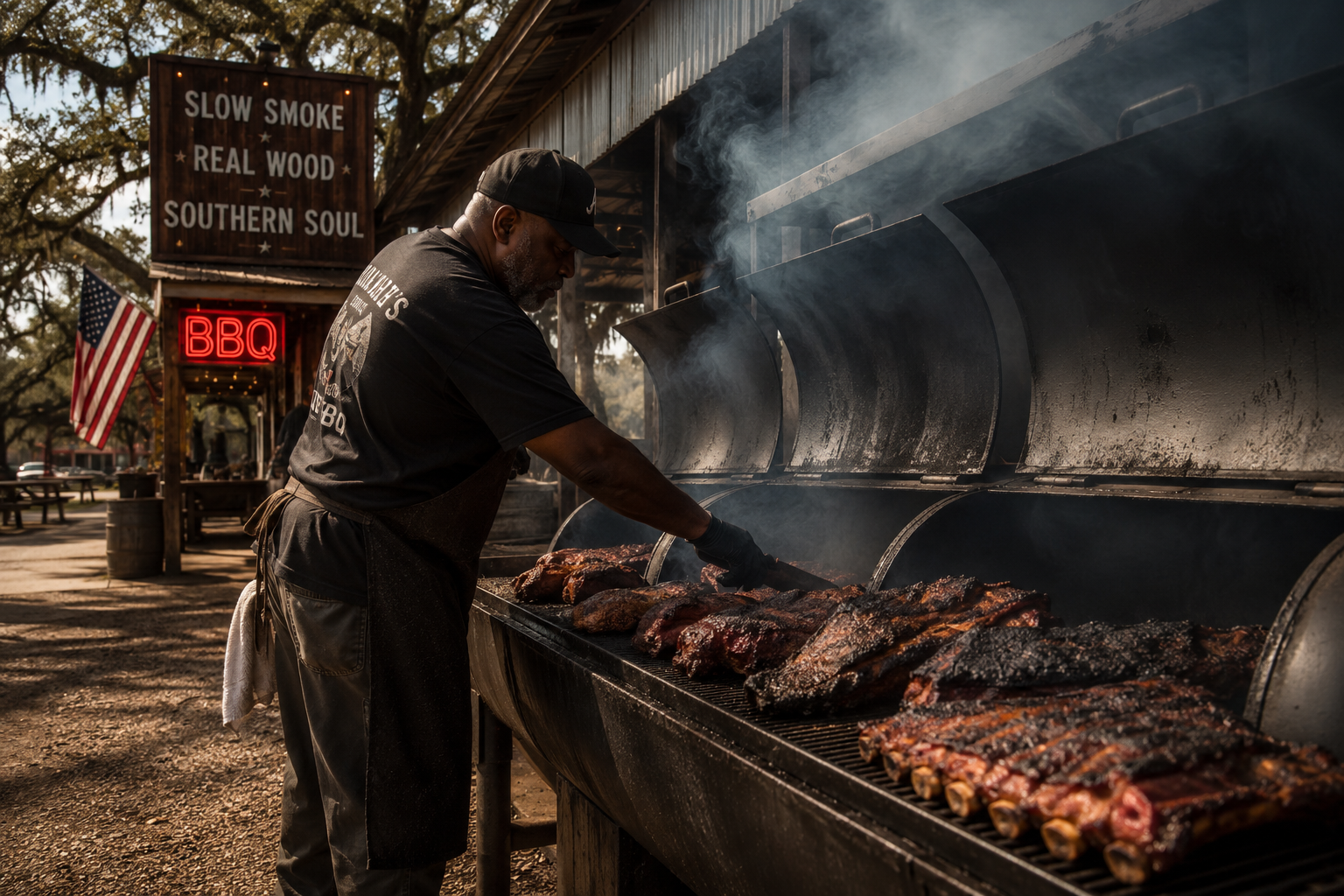
North American Barbecue: Brisket, Burnt Ends and the Barbecue Belt
North American barbecue is a philosophy of patience dressed up as regional rivalry — the Texas, Carolina, Memphis and Kansas City schools, and the pitmasters who tend them. Part of a world tour of wood-fired cooking.
Here is a thing I have decided about American barbecue, having eaten a fair bit of it in its home country over the years: it is not really about the meat. Or rather, it is entirely about the meat, but only in the way a football match is about the ball. What it is actually about is the argument.
Because that is the strange, lovable heart of the whole business. A very old, very patient way of cooking — one America inherited and then refined — wrapped inside a permanent, cheerful, but deadly serious quarrel about who does it properly. The patience is the technique. The arguing is just how they keep themselves entertained while they wait. This is the North American leg of the wood-fired tour, and it is all about taking time.
The Cult of Low and Slow
It all comes down to one common decision: cook it low, and cook it slow.
The insight underneath American barbecue — and it is one worked out over generations by people making dinner from the cuts nobody else wanted — is that the toughest, cheapest, most gristly lump of an animal turns into the best thing on the table if you will only leave it alone in gentle smoke for most of a day. Not seared over a roaring fire, which is a different thing altogether, but held at barely more than a warm-oven heat while all that stubborn connective tissue quietly melts into the meat and the smoke lays down its dark, savoury bark. Which is why a pitmaster will talk your ear off about keeping the fire steady rather than fierce. The enemy isn’t heat; it’s heat that can’t make up its mind. The art is holding a modest, even glow for far longer than any sensible person would want to stand about tending it — which is exactly why the good ones get treated as artists.
For the record, here are the numbers behind the romance:
Low and slow, in practice: cook at around 100–120°C (225–250°F) for many hours, often until the meat’s internal temperature reaches the high 90s Celsius. Somewhere in the middle it will hit the “stall” — an indeterminate plateau where the temperature stops climbing for an hour or two — maybe even three — while collagen breaks down and moisture evaporates off the surface. Many pitmasters wrap the meat to push through it, then rest it afterwards so the juices settle back in.
It’s worth knowing how the whole tradition began, because the real story is richer and more tangled than the modern version usually lets on. The technique isn’t American at all. When the Spanish reached the Caribbean they found the Taíno cooking over a slow fire on a raised wooden frame — a barbacoa — and the word and the idea travelled north. It became a Southern institution on the plantations, and this is the part usually left out: the skilled, gruelling, all-night work of tending the pits was done by enslaved Africans, who brought their own long traditions of cooking over open fire. A great deal of American barbecue comes directly from that Black Southern expertise — something the tradition has only recently begun to acknowledge. The rest is economics: pigs were cheap and fed themselves by foraging, slow smoke made the worst cuts delicious and, before refrigeration, kept them from spoiling, and it all fed a crowd, which is why barbecue originally lived at church picnics and rallies long before restaurants.
The Barbecue Belt and Its Feuds
The heartland runs in a broad band across the South and lower Midwest, and every stretch of it has planted its flag on one animal, one cut, one thing to slather on. Order the wrong meat in the wrong state and you’ll get a look. If you want the shape of it at a glance before we dig in:
| Region | The meat | The wood |
|---|---|---|
| Texas | Beef, above all brisket | Post oak (hickory or mesquite for grilling) |
| The Carolinas | Whole hog pork | Oak and hickory, sauce varies |
| Memphis | Pork ribs, dry or wet | Oak / hickory |
| Kansas City | Everything, sweet sauce | Oak, hickory, some fruitwood |
| Kentucky | Mutton | Hickory |
| Louisiana | Whole-hog cochon de lait, smoked sausage | Pecan and sugarcane |
| Santa Maria | Tri-tip, grilled fast | Coastal red oak |
Texas is cattle country, so Texas barbecue is beef, and the altar is brisket — a full day in the smoke, seasoned with little more than salt and coarse pepper, until it wears a black bark over meat that gives way under the side of a fork. Behind it come beef ribs the size of a small forearm and the smoked sausage the German and Czech settlers brought. I know the pull of the place first-hand: I used to lay over in Austin, in a hotel five minutes from Aaron Franklin’s — the most famous brisket on earth just now — and I’d wander past on my walks, and every single time the queue was three or four hours deep, folding chairs and cool-boxes of beer down the pavement, the “sold out” sign going up while people still hopefully joined the back. I never once had the hours to spare, and it nags at me still. What I did manage was the opposite sort of place — one that asks nothing of you. Out at Driftwood in the Hill Country there’s the Salt Lick, a rambling limestone barn with an open pit smouldering in the middle of the room, cash-only, bring your own beer, which just sits you down and keeps the family-style plates coming until you have no option but to admit defeat. On a rare two-day layover the first officer and I hired a car and washed up there for dinner, and it’s still one of the best meals I’ve had in America. One you queue half a day for, and by all accounts it earns every minute; the other simply feeds you until you surrender. I’d have happily done both.
The Carolinas move the animal to the pig, and the row turns theological, because here the sauce isn’t a condiment, it’s an identity. Eastern North Carolina does whole hog, chopped and dressed in a thin, sharp vinegar-and-pepper mop that cuts the fat rather than burying it — and at the Skylight Inn in Ayden — run by three generations of the Jones family, in a cinderblock building topped, entirely straight-faced, with a little silver Capitol dome — you can still hear the steady chop of cleavers doing it just as it was done a century ago. Cross into South Carolina and you meet the great oddity of the tour: a mustard sauce, the “Carolina gold” the German settlers left, which everyone two states away finds faintly heretical. Sweatman’s, a weekends-only farmhouse at Holly Hill, is a good place to make your acquaintance with it.
Memphis stakes everything on pork ribs and hands you a delicious choice of character: dry, under a crust of rub and nothing else, or wet, painted with sauce as they cook. No wrong answer, just a personality test. The dry rib was more or less invented at Charlie Vergos’ Rendezvous, in a basement down a downtown alley, where in 1948 a Greek-American found a coal chute venting into his cellar, turned a disused lift shaft into a smoker, and cooked neglected racks under a rub of his father’s Greek spices and some Cajun heat from New Orleans.
Kansas City is the broad church that’ll smoke anything and lacquer the lot in thick, sweet, tomatoey sauce — the version most of the world now pictures. Its gift to civilisation is burnt ends: the dark, over-barked tips of the brisket point they used to trim off and give away free to people in the queue, on the assumption nobody would pay for them, until everyone realised they were the best bit on the counter. The shrine is Arthur Bryant’s, quite possibly the most famous barbecue joint in America — a plain brick room of formica tables whose line runs back to Henry Perry and his alley stand in 1908, and which Calvin Trillin once called, straight-faced, possibly the best restaurant in the world.
Kentucky does the thing almost nobody else will: it barbecues mutton. Around Owensboro they take old sheep past their wool-earning days, give them the full slow treatment over hickory with a thin, dark, Worcestershire-sharp dip, and serve it at church picnics run on a near-industrial scale. The keeper of the flame is the Moonlite Bar-B-Q Inn, grown from a roadside shack into a hall built around a forty-foot buffet with the mutton at its heart. As one of rather few Britons who actually likes mutton and can almost never find it, I find myself rather envying the Owensboroans.
Louisiana offers something that isn’t quite barbecue but earns a discussion — a fire tradition that runs on pork and smoke rather than the long brisket. The centrepiece is the cochon de lait, a whole young pig cooked before an open hardwood fire, over pecan and sugarcane, until the skin blisters and the meat drops off the bone. Around it sits the communal boucherie, the hog-butchering that turned one animal into cracklins, boudin and a deep smokehouse pantry full of andouille and tasso, smoked pork built for the stew pot rather than the plate. The smell is different here too: less the perfume of pepper and smoke, more garlic, cayenne and the deep savoury promise of tomorrow’s gumbo.
And Santa Maria, on the California coast, is the exception that proves the rule: not low and slow at all, but tri-tip grilled fast and hot over coastal red oak to a rosy medium-rare, salt and pepper and garlic and no sauce worth arguing about — a straight inheritance from the Spanish and Mexican ranches. The Hitching Post is the widely known name, its branch in Buellton — the Hitching Post II — the one you may recognise from the film Sideways.
Franklin’s and Salt Lick I can vouch for. The others are not personal recommendations; they’re institutions with strong reputations for their local style. Treat them as your first port of call, then ask a local where they go.
It would be poor manners to write “North America” and stop at the US line. Mexico has the better claim, to be honest, since “barbecue” is a Mexican and Caribbean word first: the Maya were burying meat in stone-lined pits — pib — long before Spanish cattle arrived, and it was the Taíno who gave us both the method and the name.
And the living tradition there is richer, and far more steeped in ritual, than a passing mention can do justice to. In the centre of the country — Hidalgo above all, whose town of Actopan calls itself the capital of the whole business — barbacoa de borrego is a Sunday institution. A whole lamb is wrapped in maguey leaves and lowered into a pit over hot stones to cook overnight. Underneath, a pot catches the falling juices and turns them into consomé — a deep, restorative broth, ladled out on Sunday mornings as much for the night before as for the day ahead.
Every region has its own version. In the Yucatán, the same buried-pit logic gives cochinita pibil: pork stained achiote-red, sharpened with bitter orange, wrapped in banana leaves and slow-roasted in the píib. Jalisco has birria — traditionally goat, pit-cooked and served swimming in its own chilli broth. And up in the cattle north, around Sonora, the fire comes back above ground for carne asada: thin beef seared hard over mesquite, a whole weekend social ritual in its own right.
Buried pit and open flame; lamb, pork, goat and beef. All of it older than the border it sits beneath.
Canada has no deep low-and-slow tradition of the American kind — or maybe it’s just that I am yet to find it — and Montreal smoked meat, fine deli craft though it is, owes more to the smokehouse than to the fire. But the Pacific coast is another story, and an old one. The First Nations of British Columbia built a whole culture around salmon, wood and smoke: sides of fish splayed on cedar or alder stakes and roasted beside an open fire rather than over it; salmon and roots steamed in stone-lined cooking pits; and, above all, the smokehouse, where the catch was cured over alder to carry a community through the winter. Salmon that good barely needs anything doing to it.
The Trees Behind the Smoke
Each of these schools grew up around a particular tree — Central Texas around post oak, Kansas City around hickory, the Pacific Northwest around alder — it was simply what grew nearby. Post oak is the most famous, mild and steady and pitched exactly where beef wants it over a long cook, with hickory the stronger, bacon-scented partner to pork, and gentle pecan and maple for poultry and ham. The one to be wary of is black walnut, whose smoke runs heavy and can turn bitter used in any quantity — and the one to keep well off the fire entirely, a peculiarly American hazard, is any log carrying a dried poison-ivy vine, which sends its rash straight up into the smoke.
That is the headline. The full account — the four tiers of wood, the fruitwoods, and the serious list of what will genuinely harm you — lives in North American Barbecue Wood.
Stealing It for the British Garden
You can’t import the four-hour queue outside Franklin’s, or the century-old arguments about vinegar and mustard. But the idea underneath the whole quarrel travels beautifully, and it’s unexpectedly simple: a cheap cut, a cheap fire, more patience than seems reasonable, and a wood matched to the length of the cook. The transferable bits:
- Tough, cheap cuts — brisket, pork shoulder, even mutton if you can find it. The whole tradition is built on turning awkward, collagen-rich meat into something extraordinary.
- Low and slow as a principle — not a magic number, but the decision to hold meat for hours in gentle smoke rather than sear it over a fierce fire.
- Steady fire over fierce fire — the enemy isn’t a little less heat, it’s heat that lurches about. A modest, even burn for longer than feels sensible.
- Wood matched to the cook — long smoke wants clean, steady wood; quick grills can take bolder, faster stuff in small doses.
On a British kettle, drum smoker or backyard rig, that looks like:
- Choose one cut and give it time. Brisket, pork shoulder or a big lamb shoulder are the smaller close approximations to Texas brisket and Carolina whole hog. Treat it as a half-day project, not an after-work grill.
- Run a modest, steady fire. Indirect heat, a temperature that feels almost too low for roasting, fuel added little and often rather than in dramatic corrections. Over wood, let it burn down and cook over the glow, not the flame.
- Match the wood to the cook. For long smokes, clean-burning hardwoods that hold heat and don’t shout — oak, ash, beech, apple, cherry. For a quick fierce grill use bolder woods in small doses. Our native English oak behaves more like Texas post oak than almost any other readily available British hardwood, making it an excellent place to start.
- Keep the seasoning simple. The Texas model just uses salt, coarse pepper, faith. Sauces and rubs are decoration on top of the real work — the cut, the fire, the time.
Some of what makes this great can’t be bottled: the certainty that the sauce is vinegar and not mustard, the pride of a town that’s argued about pork for a century, the four-hour queue that beat me every time. Those belong to the places that made them, and the only thing to do is go and eat your way through them. But buy the toughest, least fashionable thing on the butcher’s counter; keep the fire modest and steady; give it — and yourself — the better part of a day; reach for oak or a little apple over anything that burns hot and fast; and then leave it alone; as the pitmasters say, if you’re lookin’, you ain’t cookin’.
There are boxes of seasoned beech and sweet chestnut waiting in my barbecue shelter right now. Ready to meet a chicken or perhaps a pork shoulder for a day that I expect will arrive soon. Wrong wood for a brisket, entirely — but the right one for practising the patience a brisket will one day ask of me.
One fire at a time.
Further reading
These guides are on their way — this section will grow as the series does.
- A guide to American smoking woods
- How to smoke a brisket: a low-and-slow guide for the British garden
- Managing a barbecue fire: reading your coals and holding a steady heat
- Carolina mop, Kansas City glaze: a tour of American barbecue sauces
- Recipe: proper Texas-style beef brisket over post oak
Back to the pillar: Wood-Fired Cooking Around the World