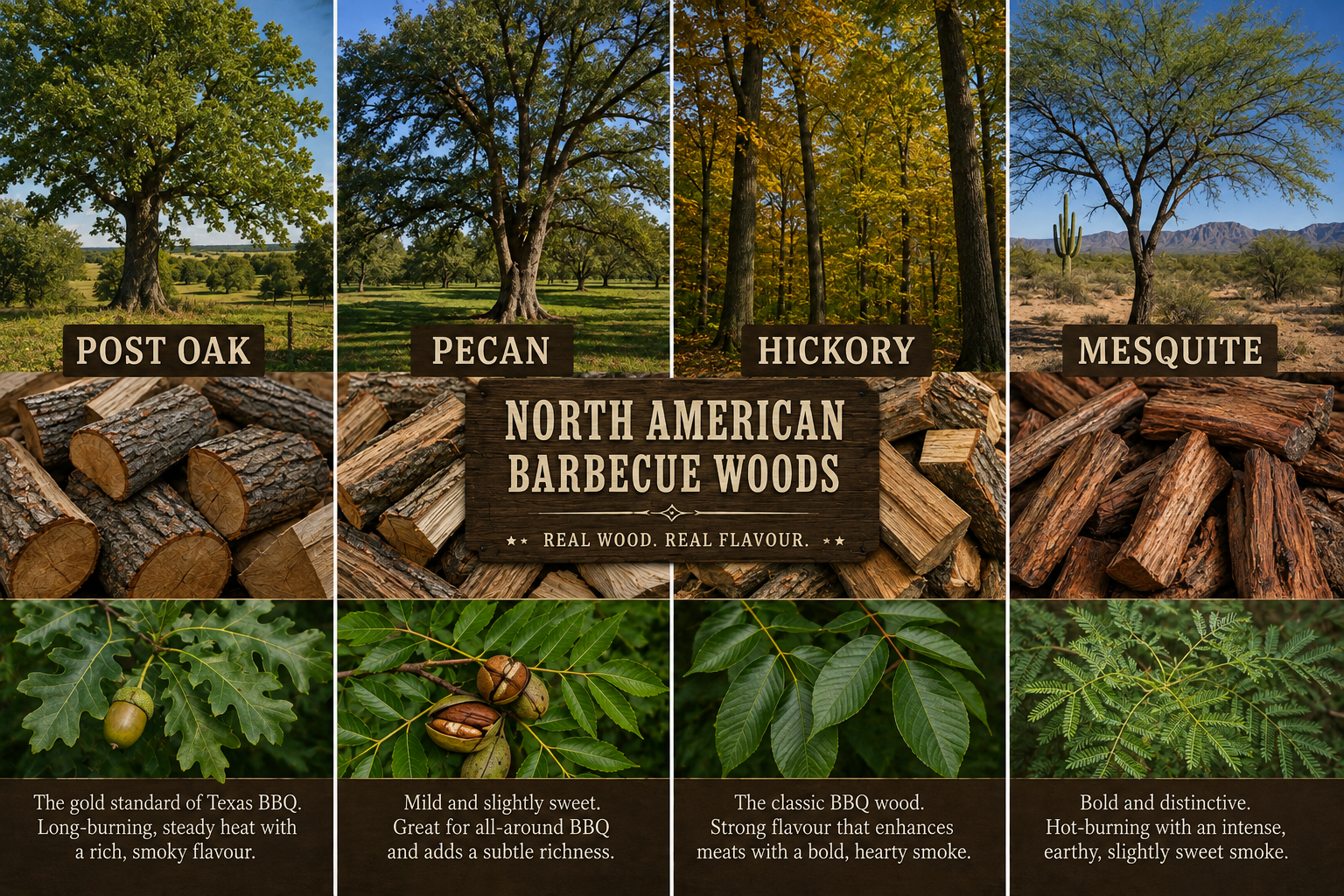
North American Barbecue Wood: Post Oak, Hickory, Mesquite
North American barbecue wood, from post oak and hickory to mesquite, alder and the fruitwoods — which tree each regional school runs on, and the short list that is genuinely dangerous. Part of a world tour of wood-fired cooking.
The wood stacked behind Franklin Barbecue in Austin is post oak, split and ricked in rows, and there is a great deal of it. You can smell it from the pavement before you can see it, but probably not before you see the queue that has formed already. Well before opening time.
American fire cooking is not one tradition. It is about six, and each of them grew up around a different tree. Central Texas got post oak. Kansas City got hickory. The Pacific Northwest got alder. Nobody chose these woods from a catalogue.
The regional schools those woods belong to — Texas brisket, Carolina whole hog, Kansas City burnt ends — are covered in North American Barbecue. This is the guide to the trees.
What follows is what burns well across the continent, what burns adequately, what will spoil your dinner, and the short and serious list of what will do you actual harm. Plenty of good cooks disagree at the margins, and where they do I have said so.
Before the lists
None of this is authoritative. It is gathered largely from what is published online, alongside regional cooking traditions and general reading, and I am a cook rather than a botanist or a toxicologist. Common names cover several different trees, species get muddled between countries, and the same wood is often described in contradictory ways by people who all sound confident.
Use it as a basis for your own research rather than a reliable indication of what is safe to cook over. If you are not certain what a piece of wood is or what harm it might do to you, do not put food above it.
The four tiers
Great — worth going out of your way for. Burns clean, holds heat, and either adds a flavour you want or stays usefully out of the way.
Fine — sound fuel. It will cook your dinner and nobody will ask what you used.
Avoid — not harmful, but the food or the fire suffers: poor heat, foul smoke, or a flavour that fights what you are cooking.
Dangerous — the smoke, sap, dust or ash can genuinely injure. No technique makes these acceptable.
A few entries are aromatics rather than fuels: burned by the handful for scent, never used to cook over. Those are marked in place.
The great woods
| Wood | Where it belongs | Smoke | Burn | Best with |
|---|---|---|---|---|
| Post oak (Quercus stellata) | Central Texas | Medium, clean, faintly sweet | Long, very steady coals | Brisket, beef ribs, sausage |
| Red oak (Q. rubra, Q. agrifolia) | Santa Maria, Texas | Medium, slightly sharper than post oak | Good coals, fast to establish | Tri-tip, steak, lamb |
| White oak (Q. alba) | Eastern seaboard, Midwest | Medium, dry, tannic | Long and even | Anything; the safe default |
| Hickory (Carya ovata, C. glabra) | Missouri, Tennessee, the Carolinas | Strong, bacon-like | Hot, long, excellent coals | Pork shoulder, ribs, ham |
| Pecan (Carya illinoinensis) | Texas, Louisiana, Georgia | Hickory softened by about half | Steady, mild | Poultry, pork, long cooks |
| Mesquite (Prosopis glandulosa) | West Texas, Sonora, northern Mexico | Aggressive, oily, unmistakable | Very hot, fast, fierce coals | Direct grilling: skirt, fajitas, goat |
| Apple (Malus spp.) | Everywhere with an orchard | Sweet, light, fruity | Moderate heat, decent coals | Pork, poultry, cheese |
| Cherry (Prunusspp.) | Michigan, the Northeast | Mild, sweet | Moderate | Anything; prized for the mahogany colour it puts on skin |
| Sugar maple (Acer saccharum) | Vermont, Quebec, the Great Lakes | Delicate, sweet | Hot, long, superb coals | Ham, poultry, game birds |
| Red alder (Alnus rubra) | Pacific Northwest, coastal British Columbia | Very light, slightly sweet | Fast, low heat | Salmon, halibut, shellfish |
| Osage orange (Maclura pomifera) | Great Plains, Oklahoma | Neutral | Ferocious heat, throws sparks | Fuel rather than flavour; burn down to coals first |
| Pacific madrone (Arbutus menziesii) | Northern California, Oregon | Clean, neutral | Very hot, dense coals | Grilling; a west coast oak substitute |
| Manzanita (Arctostaphylosspp.) | California chaparral | Neutral to slightly sweet | Extremely hot, long coals | Direct grilling; often sold as charcoal |
| Grape vine (Vitis vinifera) | Napa, Sonoma, Finger Lakes | Sharp, tangy, quite strong | Burns out fast | Quick grilling; small quantities only |
Four of them need a paragraph to themselves.
Post oak has become the most famous barbecue wood on earth largely by geography. It is a scrubby, unimpressive tree of the Texas Post Oak Savannah, and it happens to produce smoke in almost exactly the register that beef wants — present but not shouting. Demand has pushed prices up steeply, and Texas pitmasters now talk about post oak supply the way British cooks talk about the price of olive oil.
Mesquite is the wood most often misused. In northern Mexico and West Texas it is a grilling wood: you burn it down, cook fast and hot over the coals, and the harshness never gets the chance to build. Run mesquite for twelve hours under a brisket and the result is acrid. The wood has not failed. It has been asked to do the wrong job.
Alder is worth knowing about, even if you never get your hands on a piece. The Pacific Northwest salmon tradition — fish split, pinned to a cedar frame, set at an angle beside an alder fire — is a genuinely different way of cooking to anything in Texas, and the cedar is structural rather than fuel. Cedar planks flavour by scorching underneath the fish. Cedar as firewood is a different matter, and belongs in the avoid list below.
Cherry does something no other common wood does, which is turn poultry skin and pork a deep reddish brown that looks like it took twice as long as it did. Competition cooks use it for exactly that reason. Blend it with oak or hickory and you get colour without the sweetness taking over.
The fine woods
These all work. The food will be good, just not quite as good as it would have been over anything in the list above.
| Wood | Smoke | Notes |
|---|---|---|
| Yellow birch (Betula alleghaniensis) | Light, faintly like maple | Burns quickly; good kindling, adequate fuel |
| White ash (Fraxinus americana) | Almost neutral | Excellent heat, very little flavour. Increasingly available as emerald ash borer kills trees across the Midwest and Northeast |
| American beech (Fagus grandifolia) | Mild, clean | Steady and unremarkable in the best way |
| Black locust (Robinia pseudoacacia) | Neutral | Enormous heat and very long burn. The bark and seeds are toxic to eat, but the seasoned wood burns clean and is widely used as fuel |
| Mulberry (Morus spp.) | Sweet, close to apple | Undervalued; worth grabbing if a tree comes down |
| Peach, pear, plum (Prunus, Pyrus) | Light and sweet | Same family of flavours as apple, in smaller quantities |
| Walnut, black or English (Juglans spp.) | Heavy; bitter used alone | Cut it well back with fruitwood or oak. See the note below |
On black walnut. The wood contains juglone, the compound that kills the plants underneath walnut trees. It is not classified as toxic to humans, and black walnut is sold commercially in bags labelled for smoking. The practical objection is flavour rather than safety: used on its own the smoke turns bitter and heavy. Most people who use it cut it heavily with fruitwood or oak. If you are uneasy about the juglone question, there is no shortage of alternatives and nothing is lost by choosing one.
Woods to avoid
Nothing here will poison anyone. It will simply produce a worse dinner.
- Cottonwood and poplar (Populus spp.) — almost no heat and gone to ash in minutes. Harmless, and a waste of the space in the firebox.
- Sassafras (Sassafras albidum) — traditional in parts of the American South and it smells wonderful, but the bark and root contain safrole, which the US Food and Drug Administration banned as a food additive after it was shown to cause liver tumours in laboratory animals. Nobody has studied what happens to safrole in a smoker, so the risk is unquantified rather than disproved. Cooks who use it strip the bark first. There is no shortage of alternatives.
- All conifers — pine, spruce, fir, larch, hemlock, redwood, and cedar burned as fuel. Resinous, sooty, and the smoke tastes of turpentine. Pine sap also lays a sticky tar on the inside of a smoker that is miserable to clean.
- Elm (Ulmus spp.) — smoulders badly, smells foul, and will not split. It has almost no redeeming qualities as cooking wood.
- American sycamore (Platanus occidentalis) — poor heat, unpleasant smoke.
- Eucalyptus — widely planted in California and widely regretted. The oils give food a medicinal, cough-sweet note that is very hard to hide.
- Driftwood — sea salt is sodium chloride, and burning chlorides can generate dioxins. Beach fires are one thing; cooking food directly over burning driftwood is another.
- Anything green or unseasoned — wet wood smoulders rather than burns, and smouldering wood produces the thick white creosote-laden smoke that makes food taste like a chimney. Season hardwood for six to twelve months, longer for oak.
- Any wood covered in shelf fungus or badly rotted — the heat output is negligible and the smoke is musty.
Dangerous woods
This is the section that matters. North America’s particular problem is poison ivy, which arrives in the woodpile attached to wood that is otherwise perfectly good, and so catches people who would never dream of burning oleander.
Poison ivy, poison oak and poison sumac (Toxicodendron radicans, T. diversilobum, T. vernix). Poison ivy grows as a hairy vine up the trunks of exactly the sort of trees people fell for firewood, and the vine dries in the woodpile alongside everything else. The active compound, urushiol, does not burn away — it volatilises and travels in the smoke. Inhaled, it can cause a severe reaction in the airways and lungs. This is a genuine emergency-room presentation every year in the United States, and it is entirely avoidable: check split logs for dried hairy vines before they go anywhere near a fire, and never burn brush clearings without knowing what is in them.
Oleander (Nerium oleander). Planted by the mile along highways and around swimming pools across the Southwest, California and the Gulf Coast. Every part of the plant contains cardiac glycosides, which act on heart rhythm. It should not be burned in any fire you intend to stand near, let alone cook over.
Manchineel (Hippomane mancinella). Coastal south Florida, the Keys and the Caribbean. The sap blisters skin, and burning the wood produces smoke that causes severe eye injury and temporary blindness. Trees in Florida are often marked with painted bands or warning signs. Leave it entirely alone.
Chinaberry (Melia azedarach). Naturalised across the southern states. The fruit is toxic; the wood is not worth the argument.
Yew (Taxus spp.). An ornamental rather than a woodland tree in North America, but it turns up in garden clearances. Contains taxine alkaloids and belongs nowhere near food.
Treated, painted or manufactured timber. The largest real-world risk on this list, because it looks like firewood and it is free.
- Pressure-treated lumber, green or brown, may contain chromated copper arsenate. Burning it concentrates arsenic in the ash.
- Old railway sleepers and utility poles are treated with creosote or pentachlorophenol.
- Pallets are a lottery. Stamps reading HT indicate heat treatment and are broadly acceptable; MB indicates methyl bromide fumigation and must never be burned. Unstamped pallets have unknown histories and often carry chemical spills.
- Plywood, MDF, chipboard, laminate and anything painted or varnished releases formaldehyde and assorted solvents.
None of this is exotic knowledge, but it accounts for far more harm than the poisonous plants do, because nobody stacks oleander next to the smoker by accident and a great many people burn scrap timber.
Buying it in Britain
Very little of this is available here in the form it takes over there, and the substitutions are straightforward. British and Irish oak stands in for post oak perfectly well — slightly tannin-heavier, no more than that. There is no domestic hickory, and imported hickory chunks are expensive enough that most people save them for pork. Apple, cherry and plum are the easy wins: any orchard doing winter pruning has more than it can use, and a box of split apple costs nothing but the asking and a year of seasoning.
Mesquite chips and chunks are easy to find here, and lump mesquite charcoal is everywhere. What you cannot readily buy is mesquite as split logs, which is the form the tradition actually runs on. A handful of chips in a kettle gives you a hint of the flavour; a bed of mesquite coals under a skirt steak is how it is actually done.
Next in this series: South America, where the same fire is built for an entirely different reason. See also Britain and Europe for what is actually available naturally on this side of the Atlantic.