South American Asado: The Parrilla, the Cross and Chimichurri
The South American asado worships two things: the fire itself, and the person tending it — the parrilla, the whole lamb on the cross, and the asador who presides over the embers. Part of a world tour of wood-fired cooking.
Of all the fire traditions on this tour, the South American asado is the one that most stubbornly refuses to be about the food. The meat is superb and taken very seriously, but it is not really the point; the point is the long afternoon it sits at the centre of. Everywhere else the fire is a means to a meal. In South America the meal is almost an excuse for the fire.
And for the person tending it. Here is a very old, very patient way of cooking, wrapped this time not in a regional argument like North America — though there is plenty of that too — but in something nearer to reverence. North America worships time taken to cook a cut of meat; South America worships the time taken to eat the meal, the fire itself, and, more surprising to a British sensibility, the man standing in front of it while everyone else stands about with a glass and lets the day go slow. This is the South American leg of the wood-fired tour. If North America is unhurried cooking, this is unhurried eating.
What is a South American asado?
Where American barbecue comes down to one decision — cook it low and slow — the asado comes down to a stranger one: you hand the fire to one person, and then get out of his way.
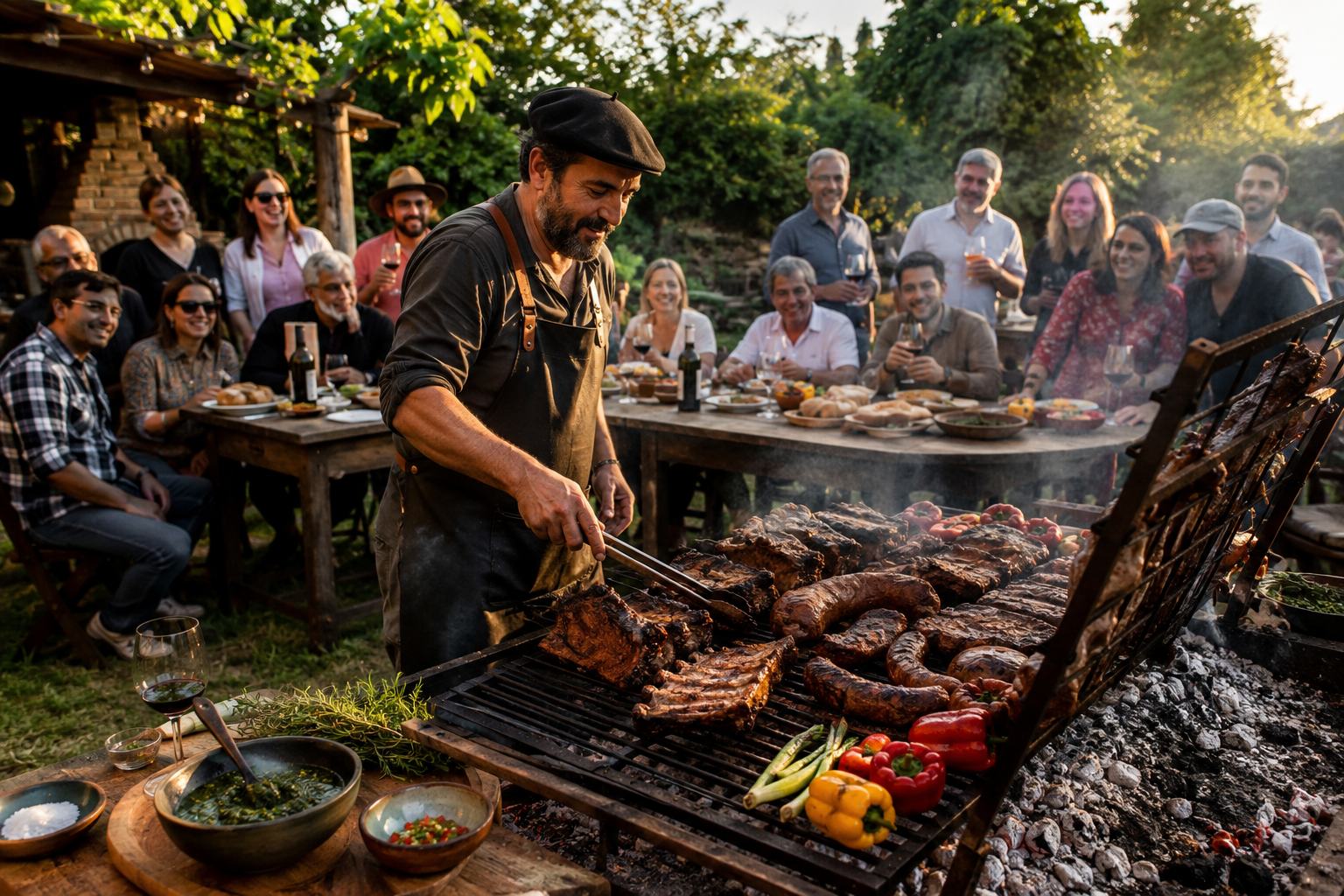
The asador is not a cook in the way we usually mean the word. He is something nearer to a host crossed with a master of ceremonies: a man given the fire because everyone trusts his judgement about it, and who will then spend hours tending it while the party gathers around him. He does not plate up so much as preside. In Britain we pass someone the tongs as a mild joke; in Argentina it is closer to being made captain for the day, and the honour is real. The word “asado” does not name a dish, either. It names the whole event — the gathering, the fire, the long unhurried succession of things that come off it, the standing about with a glass while the asador works. You are not invited to eat. You are invited to an asado, and the eating is one slow part of an afternoon whose real purpose is that nobody is anywhere else.
How a South American asado works: the parrilla, the cross and fire control
Ask an asador about his asado and he will answer about the fire, not the meat. But where the American guards a low, even heat across half a day, the South American guards one rule above all others: no flame ever touches the food. The craft beneath the ceremony runs like this:
The parrilla, in practice: the grill sits over a bed of wood embers, usually with a firebox or a corner of the pit kept burning to one side. The asador keeps a fire alight in one place and cooks in another, raking fresh coals under the meat and adjusting how many rather than how fierce — a moderate radiant heat held for hours, with never a lick of flame on the food. For the whole-animal asado a la cruz, the beast is spread on an iron cross and stood upright a foot or two from the embers, then turned and moved nearer or further to hold the pace: four to six hours, often more. It is the same instinct as the American pitmaster’s low-and-slow, arrived at on the other end of the continent and entirely separately.
It’s worth knowing how all that reverence took hold, because the real story is knottier than it’s usually told. There were no cattle on the Pampas until the Spanish brought them; the first herds reached the Buenos Aires region around its refounding in 1580, and then the animals did what cattle do on endless fertile grassland with no predators and no fences — they multiplied into wild herds numbered in the millions by the early eighteenth century. Into that vast open larder rode the gaucho, the semi-nomadic horseman of the plains, who was never one people but a mix of Indigenous, Spanish, Criollo and — the part the national story has been slow to admit — Black. The Pampas gave the gaucho almost nothing to eat but beef and fire: no crops to speak of, no bread, little seasoning. So he cooked the only way the country allowed, a few hunks of meat propped over a fire and eaten where he stood.
History doesn’t really sit comfortably beside the romance. The gaucho is a figure of national pride now, put on stamps and sung about, but in his own century he was more often distrusted, moved on, conscripted and legislated against; and the sizeable Afro-Argentine population that helped build both the cattle culture and the country was later written almost entirely out of the story. The asado carries all of that under its smoke. This was never a cuisine that took up a fire. It began as a fire, and the people who lived by it, and only slowly grew into a cuisine — in a country still learning to say whose fire it was.
South American asado by region
The heartland runs down the River Plate and across the Pampas, then follows the cattle and the mountains along the whole spine of the continent, and each stretch of it swears by its own animal, its own cut, its own way of setting it against the fire. These are loyalties rather than preferences, and a visitor does well to tread carefully around them. The lie of the land, before we dig in:
| Region | The style | The signature |
|---|---|---|
| Argentina | Parrilla | Beef above all — short ribs, flank, skirt — under chimichurri |
| Uruguay | Parrilla | Nearly identical, claims it got there first, and out-eats everyone |
| Southern Brazil | Churrasco | Skewered beef, above all the rump cap they call picanha |
| Patagonia | Asado a la cruz | A whole lamb or young goat splayed on an iron cross |
| The Llanos (Colombia/Venezuela) | Mamona a la llanera | A whole young calf on wooden stakes around the fire |
| The Andes (Peru) | Pachamanca | Meats and tubers buried to cook over hot stones |
Argentina brings the food off the grill in a set order, and that order matters as much as the meat. It opens gently, with the sausages — chorizo, and the darker, richer blood sausage called morcilla — and with the achuras, the offal the British squeamishly leave off the grill and the Argentines treat as a delicacy. Chief among these are the mollejas, sweetbreads, cooked until crisp at the edges and soft within, which anyone who has eaten them will tell you are the best thing on the whole grill, and which most of us at home never think to cook at all. Then the main event: the beef. Short ribs cut across the bone, called asado de tira; the flank they call vacío; the skirt, entraña. Somewhere in the middle a slab of provolone goes straight onto the grill to blister and half-melt into provoleta. And over the beef goes chimichurri — that sharp, green, garlicky herb-and-vinegar sauce that does for the parrilla exactly what a Carolina vinegar mop does for pork, cutting the richness rather than burying it. The showpiece of the modern version is Don Julio, a corner parrilla in the Palermo district of Buenos Aires. It has climbed to the top of Latin America’s restaurant lists on dry-aged beef and little fuss, its walls papered with signed, empty wine bottles. A few streets away, La Cabrera does the louder, more generous version, its plates crowded with little side dishes of trimmings.
My own first Argentine asado, though, came not in the city at all but out in the Tigre delta, an hour or so north of Buenos Aires, at a place called Gato Blanco — the White Cat. Getting there was half the pleasure: a bus out to the river at Tigre, and then a launch that threads the brown channels of the Paraná delta past stilt houses and dense green banks, the city falling away behind until there is nothing but water, wooden jetties and the low drum of the boat. The restaurant sits right on the water, rustic and unhurried, its terraces open to the river, and you step off the boat almost straight to the table. The menu is a parrilla menu, which is to say a lesson in Argentine priorities: beef, and then more beef. There was ojo de bife, the eye of the ribeye, thick and unapologetic; brochette de lomo, tenderloin threaded onto a skewer; and behind them the usual procession of ribs and sausages and offal off the grill. The delta adds its own touches — river fish like pacú come off the same fire, alongside homemade pasta and chicken for anyone who has already had their fill of beef — but out there, over embers, with a glass of Malbec and the water sliding past, it would take a peculiar sort of contrarian to order anything but the beef.
Uruguay makes nearly identical claims for its own parrilla, and fiercely so. Any Uruguayan will tell you, with feeling, that they got there first, or do it better, or simply eat more of it — and on the last count they may be right, since Uruguay vies with Argentina for the highest beef consumption per head on earth. The place to meet it is the Mercado del Puerto in Montevideo, an iron-framed Victorian market hall now given over almost entirely to parrilleros, their grills roaring the moment you walk in through a fog of woodsmoke and the smell of the asado de tira.
Southern Brazil takes the whole thing in a different direction as churrasco, born among the gaúchos of Rio Grande do Sul, the cattle country hard against the Uruguayan and Argentine borders. Here the beef goes on long skewers — above all the prized picanha, the rump cap, salted and bent over the sword to catch the fire — and is carved straight onto your plate. That is the rodízio, the endless-skewer format that the big churrascarias like Fogo de Chão, founded in Porto Alegre in 1979, have since exported to steakhouses the world over — usually flashier, and with much of the soul left behind.
This is part of the tour I can write about from experience. My first churrascaria was Vento Haragano in São Paulo, a favourite on a layover — partly for the food, which was exceptional, and partly because they would run a van to the hotel and back, which on a crew’s evening off counts for a great deal. You walk in past the meat already turning on its skewers by the fire. In the middle of the room stands a vast table of salads, vegetables, cheeses and condiments to help yourself from, and at each place setting waits a small disc, red on one face and green on the other — your only instruction to the waiters, who otherwise never stop coming. Turn it to green and they arrive in a steady procession, skewer after skewer, slicing straight onto your plate: half a dozen cuts of beef and about as many other meats besides, all of it the same fixed price, all of it as much as you can manage. It turns, almost against your will, into a game — can you eat your money’s worth before your resolve gives out? After years of these places, all over the world, I know the mistakes the first-timers make and the quiet tactics the waiters use to keep the house ahead. I am not going to give them away here; they have earned their living fairly and can keep their edge. Sit down with me at one and I might. Vento Haragano has since closed, I was sorry to learn — it was the making of a São Paulo trip, and somewhere I had hoped to go back to, with my wife this time.
Patagonia cooks over a different kind of fire altogether. A whole lamb or a young goat is splayed open on an iron cross, the asado a la cruz, and stood upright beside a bed of embers to roast slowly by radiant heat for hours — a Patagonian speciality and one of the great sights of outdoor cooking anywhere. It is also the image the chef Francis Mallmann has carried around the world: the Argentine who trained in the grand French kitchens, won their prizes, and then walked away from all of it to cook over open fires in the Patagonian wind and on a private island of his own. More than anyone, through his books and a turn on television that reached the rest of us, he made the case that a fire, a cross and an unhurried afternoon might be the whole of a cuisine rather than the primitive start of one.
He has, I should confess, become my own wood-fire idol. Three of his books sit on my shelf, and they are not really recipe books at all but a whole philosophy of cooking over flame — the seven fires he has made famous, from the plain parrilla to the infiernillo that sandwiches food between a fire above and a fire below, to rescoldo, which means burying the thing to be cooked directly in the embers and ash and trusting the fire to be kind. My own arrangement is more timid: an oversized smoker and an Argentine-style parrilla for anything that doesn’t need the whole day, the parrilla earning its keep because it lets me raise and lower and rake the fire and switch between a dozen ways of cooking over it. Mallmann bothers with none of that machinery. He does it the old, elemental way — and where I still flinch at the edge of too far, and make a decent joke at my own expense about the attempts that come off tasting mostly of charcoal, he treats that same char as a seasoning, a deep bittersweet crust chased on purpose rather than apologised for. It is a level of the craft I am cheerfully, and so far unsuccessfully, aspiring to.
But the Pampas is only the most famous part of the story, not the whole of it. The fire runs the length of the continent, and changes its habits as it travels.
Up in the Llanos, the great cattle plains of Colombia and Venezuela, the llanero cooks mamona, also called ternera a la llanera. A whole young calf is quartered and lashed to wooden stakes, which are driven into the ground in a ring around an open fire and left to roast for hours by radiant heat. It is asado a la cruz by another name and another people — the same idea, sprung up independently a thousand miles north.
In the Andes, the fire moves underground. The pachamanca of Peru is older than the Inca: marinated meats, potatoes and broad beans are buried among fire-heated stones in a pit, then sealed under earth and leaves to steam. It is a near-cousin of the Mexican pib and the Polynesian earth oven — the same buried-stone logic, turning up wherever people had stones, fuel and time.
And down the cold, wet coast of Chile, on the island of Chiloé, the curanto does the same trick with the sea. Shellfish, meat and potatoes are layered over hot stones in a pit and covered with big nalca leaves, until the whole thing steams itself into a feast.
Buried pit and open flame; calf and lamb and clam: all of it older than the borders it now sits beneath.
A word of honesty, though. Gato Blanco and the São Paulo churrascaria aside, I am writing about most of this from the reading or from word of mouth rather than the table. I have not queued at Don Julio, or stood over a Patagonian cross, or watched a mamona lean into the flames on the Llanos, and — alas — have not yet had the opportunity of eating a meal prepared by Francis Mallmann. So take those restaurants mentioned above as landmarks rather than tips from my own experience — the names that come up again and again wherever people argue about who does a style justice. I would dearly love to eat my way along every one of them, and mean to. But to be really sure of any of it, you would want the word of someone who has. Ask an asador.
The wood used in a South American asado
The asado asks one thing of a wood, and it isn’t flavour: a great volume of dense, long-lived coal, held for hours without spitting, that lets the beef rather than the smoke do the talking. The benchmark is quebracho, the “axe-breaker” — so hard and heavy it sinks in water — with its aromatic cousin algarrobo (a Prosopis, exactly like North American mesquite) and Uruguay’s dense coronilla close behind. The one to keep off the fire is oleander, the pretty flowering shrub of every warm-climate garden, comprehensively poisonous in wood and smoke alike.
That is the headline. The full account — the Chaco hardwoods, the Patagonian beeches, the sustainability questions, and the whole dangerous list — is in South American Barbecue Wood.
How to recreate a South American asado in Britain
You can, as it happens, get quebracho in Britain now — but almost always as charcoal rather than wood, from a handful of specialist importers, and at a price: a restaurant-grade sack will cost the best part of £30. What you cannot import is the bone-deep certainty that your parrilla beats your neighbour’s. But strip the asado back to its working parts and what is left crosses the Atlantic without any trouble at all: the densest hardwood you can lay hands on, burned right down to embers before a thing goes on, one person in charge, and a flat refusal to be hurried. What actually travels:
- The densest hardwood you can get — for a long, social cook you want fuel that burns down to coals which hold their heat, not something that flares and fades. Weight in the hand is a decent guide.
- Embers, not flame — burn the fire right down and cook over the glow, feeding fresh coals under the grill at the rate the meat wants. Stop feeding it flame long before the food goes on.
- A fire in one place, the cooking in another — the asador’s real trick, and the thing that makes a steady heat possible without ever scorching. Keep a source of coals going and rake them across as needed.
- One person, and no hurry — the deepest South American idea and the most useful on the whole tour: the fire is not a chore to get through so you can eat, but the thing the whole afternoon is arranged around.
On a British kettle, drum or purpose-built parrilla, that looks like:
- Appoint an asador and light it far too early. Let people gather round while the fire settles, and let the day organise itself around the glow rather than a serving time. Somebody has to run the fire and be in no rush about it; make that a job and part of the event, not an afterthought.
- Build a two-zone fire. A hot corner to make embers, a cooler bed to cook over, and a rake or long tongs to move coals from one to the other — the parrilla method on a British budget.
- Cook the procession, in order. Sausages and — if you are feeling adventurous — offal first, then the beef, then whatever takes longest, and let each thing arrive when it is ready rather than all at once to a timetable. The meal will take all afternoon and well into the night, but that is the heart of the pleasure.
- Match the wood to the plan. For a long, patient cook reach for the densest British hardwoods that burn to lasting coals — oak, beech, hornbeam, a little blackthorn — and keep back the aromatic fruitwoods for shorter, gentler work. And for the grand version, a whole lamb or pork shoulder set upright beside the embers, a la cruz in spirit if not on an actual iron cross, is a proper day out.
Some of it, of course, stays behind: the town-square certainty about the chimichurri recipe — you’ll find your own — the quiet trust that puts the fire in one particular pair of hands, a whole nation’s refusal to be rushed. You can only really meet those attitudes where they have been nurtured over generations, and you should. But the rest you can have at home — burn a dense wood right down to a patient bed of coals, give the fire to someone in no hurry, cook one thing at a time and let the eating be the reason for a long afternoon.
I think that is what my wife knew, really, when she handed me a brown leather apron that says “Captain of the Barbecue”. Somebody has to run the fire, and be in no hurry about it, and let the day settle around the slow orange glow. The Argentines worked it out, long before the rest of us, that this is a job worth honouring.
Nobody is hurrying the asador. The time it takes is his gift to you.
Further reading
These guides are on their way — this section will grow as the series does.
- A guide to South American asado woods
- How to set up a parrilla in a British garden
- Cooking asado a la cruz: the whole lamb on the cross
- A guide to the cuts of an Argentine asado, in order
- Recipe: proper chimichurri, and what to put it on
Back to the pillar: Wood-Fired Cooking Around the World