African Barbecue Wood: Kameeldoring, Rooikrans, Mopane
African barbecue wood, from kameeldoring, rooikrans and sekelbos to mopane and hardekool — where to buy them in Britain, and why tamboti must never touch a fire. Part of a world tour of wood-fired cooking.
A dead hardekool can stand in the veld for eighty years without falling over. The timber is so dense and so full of natural preservative that termites leave it alone, and the tree simply carries on standing, grey and bare, long after it stopped being alive — dense enough to have earned the English name leadwood. When you finally burn a piece, it burns almost entirely away, leaving only a fine white ash.
That combination — extreme density, very low moisture, coals that last past the point where anyone is still hungry — describes most of the great African cooking woods. They come out of arid country, they grow slowly, and they concentrate an enormous amount of energy into a small volume.
Those same qualities are also the problem. Slow-growing trees in dry country do not replace themselves at the rate people burn them, and charcoal is the primary cooking fuel for several hundred million people across the continent. The wood list below is worth reading with that in mind.
Before the lists
None of this is authoritative. It is gathered largely from what is published online, alongside regional cooking traditions and general reading, and I am a cook rather than a botanist or a toxicologist. Common names cover several different trees, species get muddled between countries, and the same wood is often described in contradictory ways by people who all sound confident.
Use it as a basis for your own research rather than a reliable indication of what is safe to cook over. If you are not certain what a piece of wood is or what harm it might do to you, do not put food above it.
The four tiers
Great — worth going out of your way for. Burns clean, holds heat, and either adds a flavour you want or stays usefully out of the way.
Fine — sound fuel. It will cook your dinner and nobody will ask what you used.
Avoid — not harmful, but the food or the fire suffers: poor heat, foul smoke, or a flavour that fights what you are cooking.
Dangerous — the smoke, sap, dust or ash can genuinely injure. No technique makes these acceptable. Africa has one entry in this category famous enough to have its own folklore, and it deserves it.
A few entries are aromatics rather than fuels: burned by the handful for scent, never used to cook over. Those are marked in place.
The great woods
Southern Africa
| Wood | Where | Smoke | Burn | Notes |
|---|---|---|---|---|
| Kameeldoring / camel thorn (Vachellia erioloba) | Kalahari, Namibia, Northern Cape, Botswana | Very little; faintly musky | Enormous heat, coals that last for hours | Widely called the king of braai woods. Protected — see below |
| Hardekool / leadwood (Combretum imberbe) | Limpopo, Zimbabwe, Botswana, Namibia | Almost none | Slow to light, then burns longer than anything else | Protected in South Africa. Burns to fine white ash |
| Mopane (Colophospermum mopane) | Zimbabwe, Botswana, northern Namibia, Zambia | Light, slightly resinous | Very dense, very hot, long coals | The staple across the mopane belt |
| Sekelbos / sickle bush (Dichrostachys cinerea) | Widespread across southern and eastern Africa | Aromatic, distinctly flavoured | Hot flame, long burn, little smoke | Natural oils in the wood; a genuine flavour wood rather than just fuel |
| Rooikrans (Acacia cyclops) | Western Cape | Mild | Lights easily, coals in about forty minutes, holds heat about an hour | An Australian invasive; cutting it is actively beneficial |
| Black wattle (Acacia mearnsii) | KwaZulu-Natal, Mpumalanga, Eastern Cape | Neutral to slightly sharp | Good heat, decent coals | Also invasive, also worth clearing |
| Olienhout / wild olive (Olea europaea subsp. cuspidata) | Southern and eastern Africa | Savoury, close to Mediterranean olive | Extremely dense, long | Slow-growing; use sparingly |
| Kiaat / bloodwood (Pterocarpus angolensis) | Miombo woodland, Zimbabwe, Zambia, Angola | Mild | Moderate density, good coals | Chiefly a timber tree; the offcuts burn well |
North Africa
| Wood | Where | Smoke | Burn | Notes |
|---|---|---|---|---|
| Olive (Olea europaea) | Morocco, Tunisia, Algeria, Egypt, Libya | Savoury, slightly peppery | Dense, long, hot | The Maghreb’s default cooking wood |
| Holm and cork oak (Quercus ilex, Q. suber) | Morocco, Algeria | Clean, medium | Long, superb coals | The wood behind Moroccan mechoui |
| Carob (Ceratonia siliqua) | Coastal North Africa | Slightly sweet | Very dense, good coals | Undervalued |
| Citrus — orange, lemon (Citrus spp.) | Nile Delta, Moroccan Souss | Bright, sweet, citric | Moderate, burns fairly fast | Orchard prunings; excellent with poultry and fish |
| Argan (Argania spinosa) | Southwest Morocco | Neutral | Very hard, hot | Endemic and under pressure; the nut shells are also used as fuel |
| Date palm (Phoenix dactylifera) | Egypt, Libya, oases everywhere | Sweet, slightly sharp | Fibrous, burns fast, poor coals from the trunk | The fronds and stalks are the useful part |
East and West Africa
| Wood | Where | Smoke | Burn | Notes |
|---|---|---|---|---|
| Acacia / thorn species (Vachellia, Senegalia) | Sahel, Kenya, Tanzania | Light | Dense, hot, long | The backbone of East African charcoal and of nyama choma |
| Anogeissus leiocarpa (kojoli, chew stick tree) | West African savanna | Neutral | Very dense; a preferred charcoal species across the Sahel | Heavily harvested |
| Shea (Vitellaria paradoxa) | West African parkland | Mild | Good heat | Protected in practice by its value as a food tree; usually only deadwood is burned |
| Prosopis africana | West Africa | Sweet, mesquite-like | Very hot, long | Same genus as mesquite and algarrobo |
| Mathenge (Prosopis juliflora) | Kenya, Ethiopia, Horn of Africa | Sweet, resinous | Hot, good coals | An aggressive invasive; charcoal production is one of the few useful things to do with it |
| Eucalyptus (E. globulus, E. camaldulensis) | Ethiopian highlands, Kenya | Sharp as a log; clean as charcoal | Fast, hot | Plantation-grown at scale in Ethiopia |
| Coconut and palm kernel shell | Coastal East and West Africa | Neutral, slightly sweet | Excellent, very hot charcoal | A by-product rather than a felled tree |
Four that need explaining
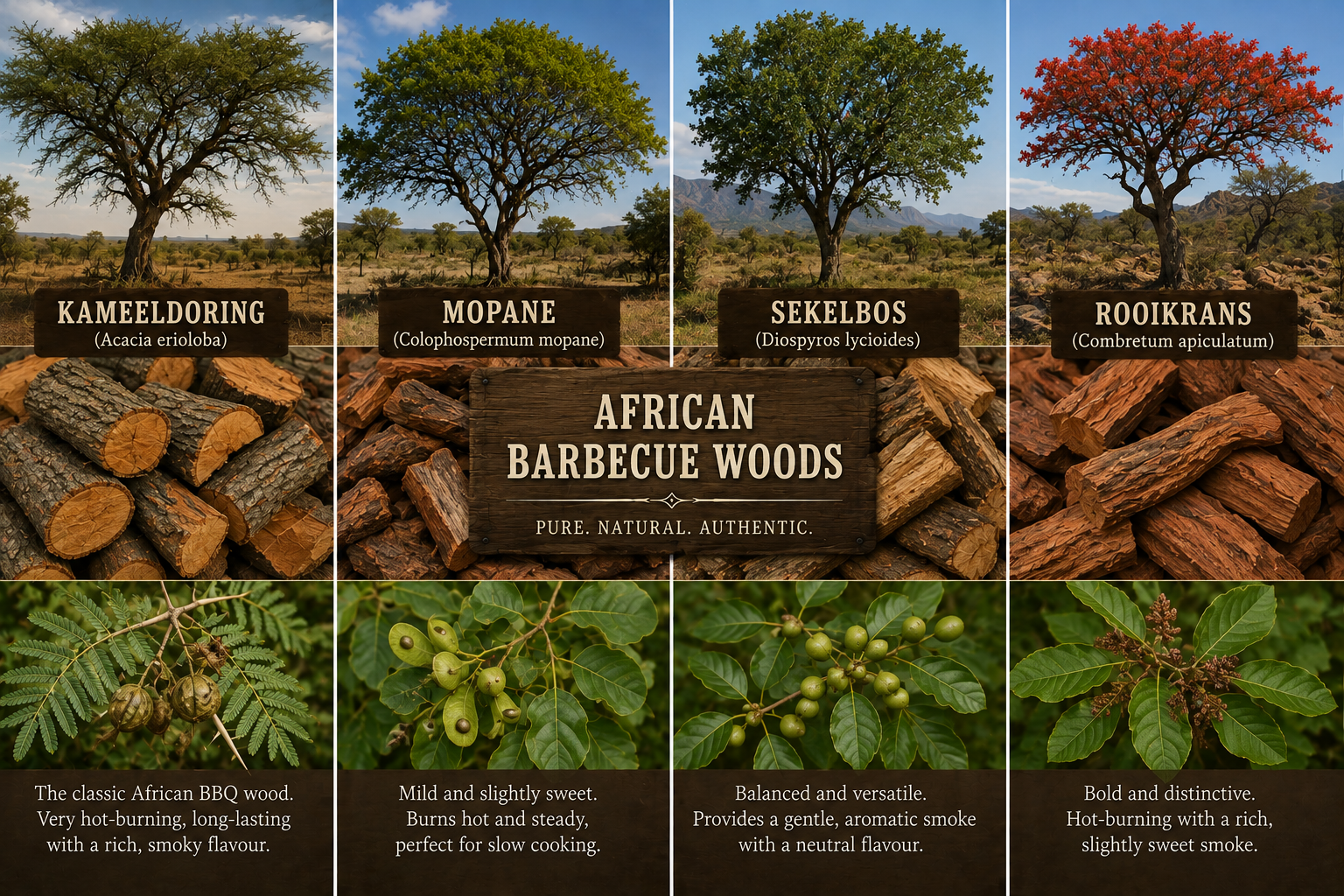
Kameeldoring is the reason South Africans argue about firewood. It grows in the driest country on the subcontinent, so the standing wood carries less moisture than almost any other hardwood, which means it wastes almost no energy boiling water off before it can produce heat. The camel thorn, as it is known in English, gives very little smoke, a slow musky scent, and a coal bed that will still be usable two hours after you thought the fire was finished.
It is also a protected species. In Namibia and in parts of South Africa, harvesting requires permits and is meant to be restricted to dead wood. The species is a keystone of Kalahari ecology — it fixes nitrogen, holds dune systems together and feeds a great deal of wildlife with its pods — and a slow-growing tree in a desert does not come back quickly. A quantity of illegally cut kameeldoring reaches the market each year, and the trade has been the subject of repeated enforcement action.
Hardekool is under similar protection and for similar reasons. Growth rings on mature specimens run to a millimetre or less in a good year.
Rooikrans and black wattle are the opposite case, and they are the easy conscience-free choice. Both are Australian imports that have gone spectacularly wrong in South Africa — rooikrans through the Cape fynbos, wattle along watercourses across the eastern half of the country — and both consume very large volumes of water that the catchments need. Clearing programmes have been running for decades. Buying rooikrans for the braai is on the right side of that effort, and it happens to be excellent wood: quick to light, quick to coal, hot enough for anything.
Sekelbos occupies a similar position. It is a bush encroacher, spreading into grassland and degrading grazing across large areas of southern Africa. The sickle bush, as English names it, burns with an aromatic character that most of the dense arid-land woods lack.
The fine woods
| Wood | Smoke | Notes |
|---|---|---|
| Vaalbos (Tarchonanthus camphoratus) | Camphor-scented, strong | Aromatic; pleasant in small quantities, overpowering in large. The English name is camphor bush |
| Bushwillow (Combretum spp., other than leadwood) | Neutral | Common, dense, sound fuel |
| Guava (Psidium guajava) | Sweet, mild | Orchard wood; pleasant with pork and poultry |
| Mango (Mangifera indica) | Sweet | Widely used in East and West Africa. Note the family below |
| Casuarina / beefwood (Casuarina equisetifolia) | Neutral | Coastal plantations; hot and quick |
| Cashew trunk wood, seasoned (Anacardium occidentale) | Mild | Burned in West Africa. The nut shells are a different material entirely and are dangerous — see below |
Woods to avoid
- Syringa / Persian lilac (Melia azedarach). Naturalised and invasive across southern Africa, and commonly cut and burned as a result. The wood itself is burned widely without reported harm, so it is not in the same class as the spurges, but the fruit is genuinely toxic to people and to livestock and there is better wood in the same hedgerow.
- Sneezewood (Ptaeroxylon obliquum). Not poisonous, but the dust and smoke provoke violent, sustained sneezing and irritate the eyes and airways. The name is not decorative. It is superb fence-post timber and miserable firewood.
- Marula (Sclerocarya birrea). Protected across much of southern Africa and far too valuable as a fruit tree. Burning it is both illegal in places and a waste.
- Green mopane and green thorn wood. These woods are dense enough that unseasoned pieces will simply refuse to burn properly.
- Baobab. The timber is spongy and full of water and produces almost no heat.
- Mangrove (Rhizophora mucronata) from East African coasts. It makes excellent charcoal, which is exactly the problem — mangrove cutting for charcoal has stripped large areas of the Kenyan and Tanzanian coast, and the forests are now protected and being replanted.
- Any driftwood. Salt-laden wood produces chlorinated compounds when burned.
Dangerous woods
Tamboti — tambotie (Spirostachys africana). This is the one everybody in southern Africa knows about, and the knowledge is hard-won. Tamboti is a spurge, which is to say one of the Euphorbiaceae — the family that runs from poinsettia to rubber tree, and whose defining feature is a milky latex. Cut the bark and it bleeds a white latex that raises blisters on skin and can do serious damage to eyes. Burn it and the smoke carries the same compounds: the fumes cause headaches, the meat cooked over it is tainted, and people who have eaten it describe severe nausea and diarrhoea some hours later. The wood is beautiful, densely figured and sweetly scented, which is precisely how it ends up on camp fires — it looks and smells like a treat. It should never be used for cooking, and campers in the lowveld and the Kruger region are warned about it specifically.
Euphorbias (Euphorbia ingens, E. tirucalli, E. cooperi). The candelabra trees. Same family as tamboti, same caustic latex, capable of causing severe eye injury and skin blistering. The smoke is a serious irritant. These are not firewood in any sense.
African poison ivy (Smodingium argutum). Also called rainforest poison ivy or pepper tree, found in the eastern parts of South Africa. It is in the same family as poison ivy and cashew, and it carries related compounds. The smoke can produce a severe reaction on skin and in the airways.
Poison arrow tree (Acokanthera oppositifolia). Contains ouabain, a cardiac glycoside so potent it was used on hunting arrows across eastern and southern Africa. Nothing about this tree belongs near a fire.
Cashew nut shells (Anacardium occidentale). The shell liquid contains anacardic acid and cardol, which blister skin on contact — this is why cashews are never sold in the shell. Burning shells or green cashew wood produces smoke that blisters skin and inflames airways. Seasoned cashew trunk wood is a different and much less hazardous material, but the distinction is worth being certain about before you rely on it.
Oleander (Nerium oleander). An ornamental across North Africa and southern Africa’s towns. Cardiac glycosides in every part of the plant.
Treated timber, old sleepers and painted offcuts. Creosote, arsenical preservatives, and whatever the paint was. The commonest genuinely harmful fuel on any continent.
Sourcing in Britain
Southern African braai wood is far easier to buy in Britain than you would expect. Several importers now specialise in it, and kameeldoring, rooikrans and sekelbos are all sold here by the box, alongside Namibian lumpwood charcoal — some of it Ready to Burn certified. It has moved beyond the specialists, too; you can buy Namibian kameeldoring from a high street homeware chain.
Kameeldoring is the one to think about before you order. Harvesting in Namibia is permit-regulated and meant to be restricted to dead wood, and the established importers operate inside that system. Set against that: the tree is a slow-growing keystone of Kalahari ecology, illegal cutting is a documented problem, and European demand is part of what drives it. A serious supplier should be able to tell you where their wood came from and under what permit.
Rooikrans, sekelbos and black wattle carry none of that difficulty. All three are invasive, all three need cutting, and all three make excellent coals. A good bag of Cape invasive-species charcoal is among the better fuels available in Britain.
For the flavour rather than the fuel, the North African end of the list is easy: olive wood chunks are widely sold, and citrus prunings can be had from anyone with a lemon tree in a pot and a pair of secateurs.
For the southern African arid-land character — very dense, very little smoke, coals that outlast the meal — the closest domestic substitute is hornbeam, with well-seasoned oak behind it.
Next in this series: The Middle East. See also Britain and Europe for what is actually available naturally on this side of the Atlantic