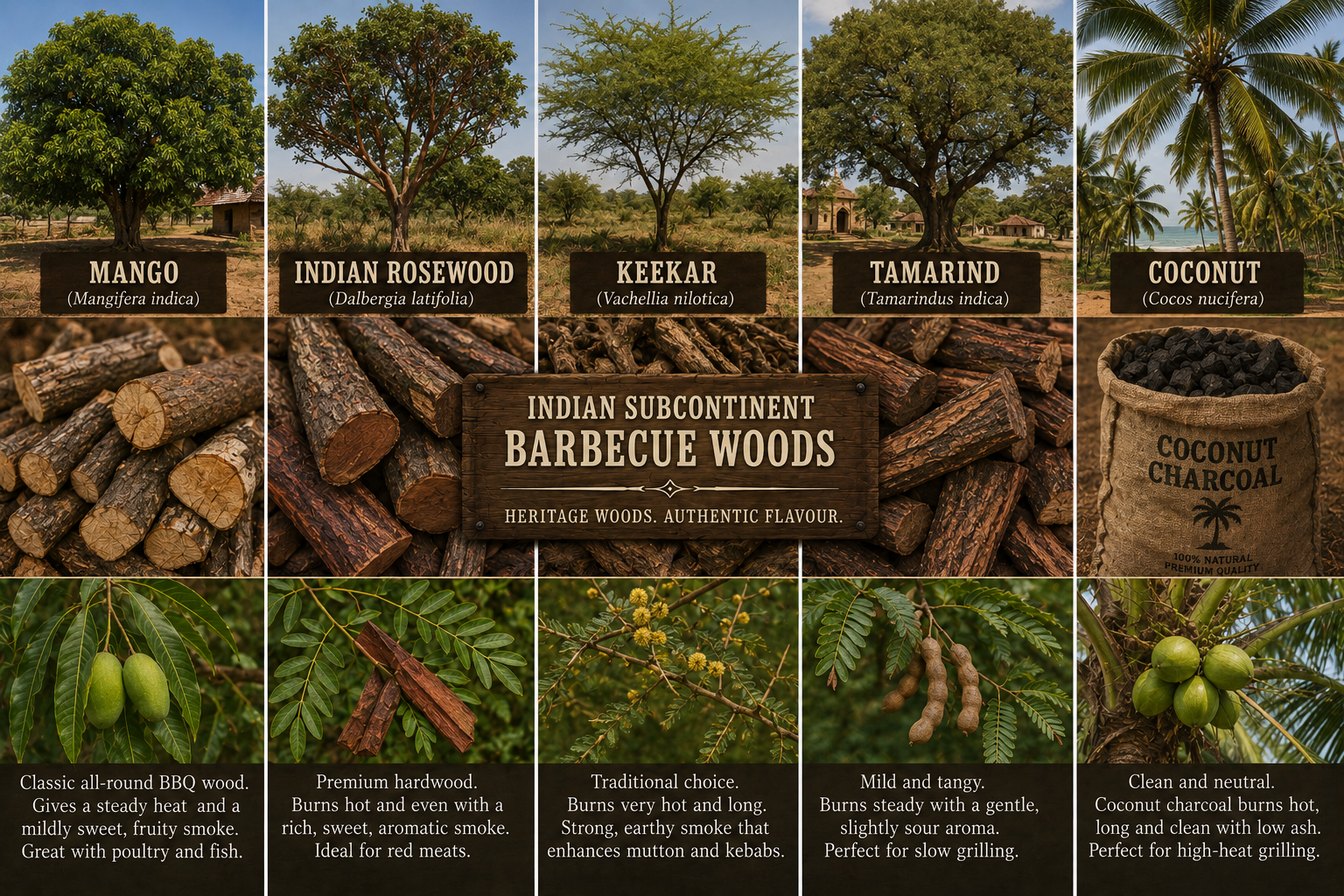
Indian Subcontinent Barbecue Wood: Mango, Keekar, Tamarind
Indian subcontinent barbecue wood, from mango and keekar to tamarind, sheesham and coconut shell — what the tandoor and the sigri actually burn, and the spurges and cashew relatives that are dangerous. Part of a world tour of wood-fired cooking.
Green bamboo explodes. A bamboo stem — properly a culm, since bamboo is a giant grass rather than a tree — is divided along its length into sealed chambers holding air and water, and when one heats the pressure has nowhere to go until the wall splits, which it does with a crack like a shotgun and a spray of embers. Anyone who has camped in bamboo country has been startled by it. It is also, incidentally, why bamboo makes such a good cooking vessel and such a poor log — the same sealed chambers that burst in a fire will steam rice or fish beautifully if you fill them first and lay them beside the coals rather than in them.
The fires that wood serves here — the tandoor, the sigri, dum, dhungar, the Sri Lankan hearth — are covered in Fire Cooking Across the Indian Subcontinent. This is the guide to the trees.
What matters for choosing one is that almost none of those fires cook directly over flame. The wood is converted first, to charcoal or to a settled bed of embers, and only then used. So density, cleanliness and coal life are the qualities that count, with aroma a distant fourth.
Before the lists
None of this is authoritative. It is gathered largely from what is published online, alongside regional cooking traditions and general reading, and I am a cook rather than a botanist or a toxicologist. Common names cover several different trees, species get muddled between countries, and the same wood is often described in contradictory ways by people who all sound confident.
Use it as a basis for your own research rather than a reliable indication of what is safe to cook over. If you are not certain what a piece of wood is or what harm it might do to you, do not put food above it.
The four tiers
Great — worth going out of your way for. Burns clean, holds heat, and either adds a flavour you want or stays usefully out of the way.
Fine — sound fuel. It will cook your dinner and nobody will ask what you used.
Avoid — not harmful, but the food or the fire suffers: poor heat, foul smoke, or a flavour that fights what you are cooking.
Dangerous — the smoke, sap, dust or ash can genuinely injure. No technique makes these acceptable. The subcontinent has more entries here than any other region in the series, mostly because it has more spurges and more of the cashew family.
A few entries are aromatics rather than fuels: burned by the handful for scent, never used to cook over. Those are marked in place.
The great woods
| Wood | Where | Smoke | Burn | Best with |
|---|---|---|---|---|
| Mango (Mangifera indica) | Across the subcontinent | Sweet, mild, faintly resinous | Good heat, steady coals | Tandoori breads, fish, poultry. The best-loved cooking wood in India |
| Keekar / babool (Vachellia nilotica) | Punjab, Sindh, Rajasthan, the Gangetic plain | Light, clean | Very dense, very hot, long coals | The traditional charcoal for a tandoor |
| Sheesham / Indian rosewood (Dalbergia sissoo) | North India, Pakistan, Nepal | Neutral to slightly sweet | Hot and steady | Tandoor and open grill alike |
| Tamarind (Tamarindus indica) | South India, Sri Lanka, Deccan | Mild, slightly sour-sweet | Extremely dense; outstanding charcoal | Long cooks; south Indian charcoal at its best |
| Jamun (Syzygium cumini) | Across India | Sweet, clean | Dense, good coals | Grilling and tandoor |
| Coconut shell charcoal (Cocos nucifera) | Kerala, Sri Lanka, coastal Tamil Nadu, Bangladesh | Neutral, slightly sweet | Very hot, quick, very clean | Fish, prawns, anything fast. A by-product rather than a felled tree |
| Coconut shell, husk and frond, raw | The same coasts | Smoky | Hot and fast, but sooty | The everyday hearth fuel under a pot; not a grilling fuel |
| Jackfruit (Artocarpus heterophyllus) | Kerala, Sri Lanka, Bengal | Sweet, gentle | Moderate heat, decent coals | Fish and poultry |
| Guava (Psidium guajava) | Widespread | Sweet, mild | Moderate | Poultry, pork |
| Sal (Shorea robusta) | Central and eastern India, Nepal, Bengal | Slightly resinous | Very dense, long | General fuel across the sal belt |
| Ber / Indian jujube (Ziziphus mauritiana) | Rajasthan, Punjab, Deccan | Light | Dense, hot | Arid-country cooking |
| Mahua (Madhuca longifolia) | Central India | Mild | Good heat | Usually deadwood only; the tree is far too valuable for its flowers |
| Apricot, apple, walnut (Prunus, Malus, Juglans) | Kashmir, Himachal, Gilgit-Baltistan | Sweet and fruity | Moderate | Himalayan orchard prunings, used for grilling and for charcoal |
| Casuarina (Casuarina equisetifolia) | Coastal Tamil Nadu, Andhra, Odisha, Sri Lanka | Neutral | Very hot, fast | Plantation-grown at scale; a workhorse |
Notes on four of them
Mango is the wood most Indian cooks name first, and there is a good reason for it beyond sentiment. Commercial mango orchards are pruned annually and replanted on a rotation of perhaps forty years, which produces a steady supply of wood from trees that were going to come out anyway. The smoke is sweet without being cloying, and it suits the breads and the marinated meats of tandoor cooking better than any harder-charactered wood would.
The tree carries a great deal of ritual weight across the subcontinent — mango wood is used in havan fires and in funeral pyres — and in some places that makes casual burning of it a matter of some sensitivity. Worth knowing before you assume it is simply firewood.
Keekar is what a tandoor actually runs on when it is being run properly. It is a thorny acacia of dry country, extremely dense, and it makes charcoal that holds a steady radiant heat for hours in the base of a clay oven. Most restaurant tandoors outside the subcontinent now run on gas or on generic imported lump charcoal, which is one of the reasons the bread is rarely the same.
Tamarind is the southern equivalent, and if anything the better charcoal wood. It is heavy, close-grained and burns down to a coal that lasts. It is also a tree people plant for shade and fruit and are reluctant to cut, so the wood generally comes from storm damage and old age rather than from felling.
Prosopis juliflora — seemai karuvelam, mathenge, vilayati babul. This one deserves its own paragraph because it is now the source of a very large share of south Indian charcoal, and because opinion on it is genuinely divided. It is a Central American mesquite introduced in the nineteenth century, it has spread across enormous areas of Tamil Nadu, Rajasthan and Gujarat, it drinks water that other things need, and Indian courts have at various points ordered its removal. It also burns hot, makes good charcoal, and gives a sweet mesquite-family smoke. Cutting it is, on balance, doing everyone a favour.
The fine woods
| Wood | Smoke | Notes |
|---|---|---|
| Subabul (Leucaena leucocephala) | Neutral | Plantation fuelwood, fast-growing, unexciting and reliable |
| Rubberwood (Hevea brasiliensis) | Neutral | The by-product of Kerala’s replanting cycle; sound fuel once properly seasoned |
| Chinar / oriental plane (Platanus orientalis) | Neutral | Kashmir. Adequate; the leaves are traditionally used for charcoal |
| Teak (Tectona grandis) | Slightly oily | Offcuts burn very hot. The dust is a known skin and airway irritant, so avoid sawmill sweepings |
| Siris (Albizia lebbeck) | Mild | Common, dense enough, unremarkable |
| Palmyra and coconut trunk (Borassus, Cocos) | Sharp when green | Fibrous and awkward as logs; better as charcoal |
| Bamboo (dry, split) | Light, grassy | Fine once split and dried. See the warning about green bamboo |
| Cow dung cakes | Heavy, distinctive | Not wood, but the traditional fuel for a great many dishes and hearths. It burns slowly and evenly and produces a lot of smoke |
Woods to avoid
- Green bamboo. Sealed internodes burst violently. Split it before it goes on a fire.
- Neem (Azadirachta indica) — burns perfectly well and is used across the subcontinent, but the bitter, medicinal note carries into the food more than most people expect. Sound under a closed pot; wrong under anything you are going to taste.
- Chir pine and deodar (Pinus roxburghii, Cedrus deodara). Himalayan, resinous, and in the case of deodar a slow-growing tree under considerable pressure. Neither belongs under food.
- Eucalyptus as a log. Planted across India in enormous quantity. The oils give a medicinal note; converted to charcoal it behaves much better.
- Sundarbans mangrove and other coastal mangrove (Rhizophora, Avicennia, Sonneratia). Excellent charcoal and legally protected across India and Bangladesh, for reasons that have to do with cyclone protection for millions of people.
- Anything green. Monsoon-season wood in particular needs real drying time.
- Painted, treated or salvaged construction timber. See below.
Dangerous woods
Blind-your-eye mangrove — geoa, thillai (Excoecaria agallocha). Grows through the Sundarbans, the Odisha coast, the Keralan backwaters, Sri Lanka and on into Southeast Asia and Australia. It is a spurge — one of the Euphorbiaceae, the great milky-latex family — and it bleeds a sap that causes intense pain, blistering and, if it reaches the eyes, corneal damage and temporary blindness. The English name is a warning rather than a nickname. It is not firewood under any circumstances, and the smoke should be avoided as well as the sap.
Suicide tree — othalanga, pong-pong (Cerbera odollam). Coastal Kerala, Sri Lanka, the Andamans, and across Southeast Asia. The kernel contains cerberin, a cardiac glycoside, and the tree is responsible for a substantial number of poisoning deaths every year in Kerala alone. The whole plant is toxic. It grows along backwaters and canal banks where driftwood and fallen branches are routinely collected for fuel, which is what makes it worth knowing by sight.
Marking nut — bhilawa, ballataka (Semecarpus anacardium). In the same family as cashew and poison ivy. The black sap was used for centuries to mark laundry, because it stains permanently and will not wash out; it also raises severe blisters on any skin it touches. Smoke from burning the wood or the nuts carries the same compounds. Cases of serious dermatitis from exposure are well documented in Indian medical literature.
Oleander — kaner (Nerium oleander) and yellow oleander — pila kaner (Cascabela thevetia). Both are planted everywhere as ornamentals and hedges, from Delhi roundabouts to Sri Lankan gardens. Both carry cardiac glycosides. Yellow oleander seed poisoning has been a major public health problem in Sri Lanka in particular. Cuttings from a hedge trim look exactly like ordinary brush.
Aak / madar (Calotropis procera, C. gigantea). The wasteland shrub with the thick grey-green leaves and the copious white latex, found on every stretch of scrubby ground in northern India and Pakistan. The latex blisters skin and causes serious eye injury. It is soft and burns poorly, which is fortunate.
Hedge euphorbias (Euphorbia tirucalli, E. nivulia, E. antiquorum). Grown as living fences across rural India. Same family, same caustic latex, same rule.
Holigarna and Gluta species. Western Ghats and northeast India, both in the cashew family, both with irritant sap. Locally well known and worth respecting.
Cashew shells (Anacardium occidentale). Cashew is grown at scale in Kerala, Goa, Tamil Nadu and Sri Lanka. The shell liquid is caustic enough that shelling is an industrial process; burning the shells produces smoke that blisters skin and inflames airways.
Treated and salvaged timber. Painted shuttering ply, old furniture, laminate, and any wood that has been near a preservative. This category injures more people every year than every plant listed above it.
The uncomfortable part
Household air pollution from cooking on solid fuel — wood, dung, crop residue and charcoal, burned in unventilated or poorly ventilated indoor spaces — is one of the largest environmental health burdens in the world, and the subcontinent carries a very substantial share of it. The World Health Organization attributes millions of premature deaths a year globally to it, falling disproportionately on women and young children.
That is a different subject from choosing a wood for a barbecue in Hampshire, and it would be dishonest to write a guide to Indian cooking woods without saying so.
Buying it in Britain
Coconut shell charcoal briquettes are the easy win. They are stocked by mainstream British barbecue suppliers in 10kg boxes, burn far longer than ordinary lump, produce almost no smoke and very little ash. The smaller cubes sold for shisha in Middle Eastern grocers are the same material in a different shape.
Mango is harder than I expected. British smoking-wood merchants run on apple, cherry, oak, hickory, maple and whisky oak, and mango is not a standard line — if you want it you will be asking specially or looking abroad. Apple is the nearest substitute in character, a shade sweeter and less resinous.
Keekar and tamarind charcoal are hard to find. British hornbeam or well-seasoned oak will give the dense, long-lived, low-aroma coal bed a tandoor wants.
If you have a tandoor and are running it on gas, the single change that will make the most difference is a bed of good hardwood lump charcoal underneath. The radiant heat off a charcoal bed and the radiant heat off a gas burner are not the same heat, and the bread knows.
Next in this series: Southeast Asia, where several of these same dangerous species reappear. See also Britain and Europe for what is actually available naturally on this side of the Atlantic.