Thirty Years of Compulsory Learning. Now What?
On the hunger to learn, the imagination that went quiet, and what it actually takes to keep the mind sharp.
I spent thirty years in a career that required — every single year, without exception — two simulator checks, a medical, a Safety Equipment and Procedures exam, and various ad hoc self-learning requirements. The manuals changed just enough each time to make complacency inadvisable.
I hated exams at school.
And then I chose a career that turned out to be an exam, every year, for thirty years.
An irony I noticed with every trip to the simulators.
Whilst every pilot knows the checks are essential — they keep us competent, current, and practised under pressure — I doubt many would give much thought to a more hidden benefit. It keeps your mind sharp.
The simulator check — not your standard exam
The simulator check is not what most people imagine when they think of an exam.
It is not primarily about recall — about sitting down and learning material and then showing the examiner how much you have retained. It is about application. The check will throw situations at you that you have not specifically prepared for, in combinations you haven’t rehearsed, usually with less fuel than you’d like. Occasionally with something on fire. And not much help coming from the other seat — because the examiner has briefed him to pretend he’s had a heart attack — watching these performances over the years leads me to believe that many pilots are frustrated actors.
The question it is really asking is: can you apply what you know under conditions that don’t look like the conditions you studied for?
Which makes the revision itself an interesting problem. The material is largely familiar — you’ve seen most of it before, many times. The procedures haven’t changed dramatically. And yet you can’t afford to scan it on autopilot. Change they do — and usually in ways that are small and significant in equal measure. Miss the changes in the updated manual or have a hole in your knowledge and the check will find it for you, at the worst possible moment.
So you read everything again. Carefully. Looking for what’s different, not confirming what you already know. It is, I now think, a rather sophisticated cognitive exercise — reading what it actually says rather than what you think it says, though at the time it felt like a chore. The kind of chore you had to pay attention to because you will be tested on it in a moving box that replicates a cockpit, with someone next to you whose enthusiasm for his heart attack makes me suspect that he has an upcoming audition for a play.
The moment it stopped being mandatory
Retirement removed all of it at once. No simulator check. No medical. No SEP exam. No requirement to update anything, verify anything, or demonstrate competence to anyone — except for my wife, who has started to notice lots of jobs that need doing around the house.
The first response was relief.
The second was unexpected.
I missed having something to learn.
For thirty years I had assumed the studying was attached to the job. The job disappeared on retirement but the urge to learn has refused to retire with it.
Which suggests the learning was never really part of the career at all. It had simply been hiding inside it.
I don’t miss the pressure of it. Not the exam. Definitely not the exam. But the structure of it — the sense of a subject that needed engaging with properly, the purpose that directed the reading, the goal that made the effort cohere. Without it, the hunger to learn was still there. The direction was gone.
It’s a bit like retiring from a long-distance running career — and I’m guessing here — and discovering that your legs still want to go somewhere, but nobody has told you where.
Curiosity, it turns out, does not submit its resignation when you do.
The imagination problem
There was something else, which I noticed slightly later.
After thirty years of reading technical manuals, operational procedures, and navigation documentation — all of which are written to be unambiguous and to communicate exactly what they say and no more — I discovered that something had quietly changed about the way I read fiction.
I used to read novels and see them. The scenes had a visual specificity that I didn’t have to work for. Characters had faces. Rooms had dimensions. The story existed somewhere in my head with the textural solidity of a film playing to an audience of one.
It had dimmed. Not gone — but noticeably less vivid than I remembered. Years of reading that actively discouraged imagination, that rewarded precision over imagery and procedural clarity over descriptive richness, had taken a toll I hadn’t noticed while it was happening.
The fix, I’ve found, is not complicated but it requires permission. Slow down. Luxuriate rather than rush. This sounds obvious. It is made slightly less obvious by thirty years of reading material where lingering on a sentence had operational consequences.
Read the paragraph again if the picture isn’t forming. Let the reading be the thing, not the getting-through-it. There is no deadline to finish the story and no sim check to be ready for.
I’ve noticed I’m getting better again at making it vivid — perhaps not to the level of the scenes I imagined at sixteen, but closer.
It turns out it wasn’t gone. It had simply adapted to thirty years of reading in a manner designed for a completely different purpose.
Fiction, unlike an aircraft manual, occasionally benefits from wondering what happens between the lines.
There is, though, a qualification worth making. Imagination does have a role in aviation — just not when ploughing through the manuals.
Armchair flying is a real technique. You sit in a chair, close your eyes, and imagine an emergency procedure in as much detail as you can: the sequence, the calls, where your hand goes, what the other seat is doing. The imagination, far from being discouraged, is actively recruited — just pointed in a very specific direction.
The problem with the manuals was never that they killed imagination. It was that there simply wasn’t enough time to let it breathe. Getting through everything that needed getting through left no room for the kind of unhurried wandering that fiction actually requires.
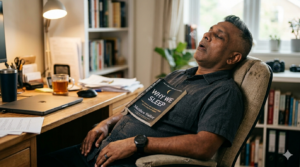
My wife could tell the difference between armchair flying and having a nap by the presence of snoring. One of those two activities involves snoring.
What could help keep the brain alive
Since I was apparently going to carry on learning whether I intended to or not, I started looking into what was actually worth doing. What follows is not a prescribed programme — it’s a partial account of what I’ve found through reading and some internet research.
Learning a language is probably the single most evidence-backed thing you can do for long-term cognitive health. Studies in older adults have consistently shown improvements in working memory and attention.
Britain, of course, seems to have a well-established reputation on this front, which is that we assume that English is sufficient and hope for the best — perhaps repeating ourselves louder if it didn’t work the first time.
The research, however, suggests it might be worth reconsidering.
Reading — real reading, unhurried reading — matters more than I’d credited before I stopped doing it properly. Not scrolling. Not skimming. Reading a book that asks something of you, at a pace that lets you actually think about it.
The distinction between reading and reading-shaped activity turns out to be significant.
Physical exercise and the brain are not separate subjects. Aerobic exercise increases blood flow to the brain, stimulates the production of BDNF — brain-derived neurotrophic factor, which supports the growth of new neural connections, though admittedly a name that sounds as if it could benefit from a meeting with the marketing department — and is associated with reduced risk of cognitive decline, as explored in the sleep article on this site.
The movement bit and the staying-sharp bit are, it turns out, the same bit.
Learning something creative matters for different reasons. Music, art, craft, writing — anything that requires the brain to work in unfamiliar territory appears to build capabilities that routine activities simply don’t demand.
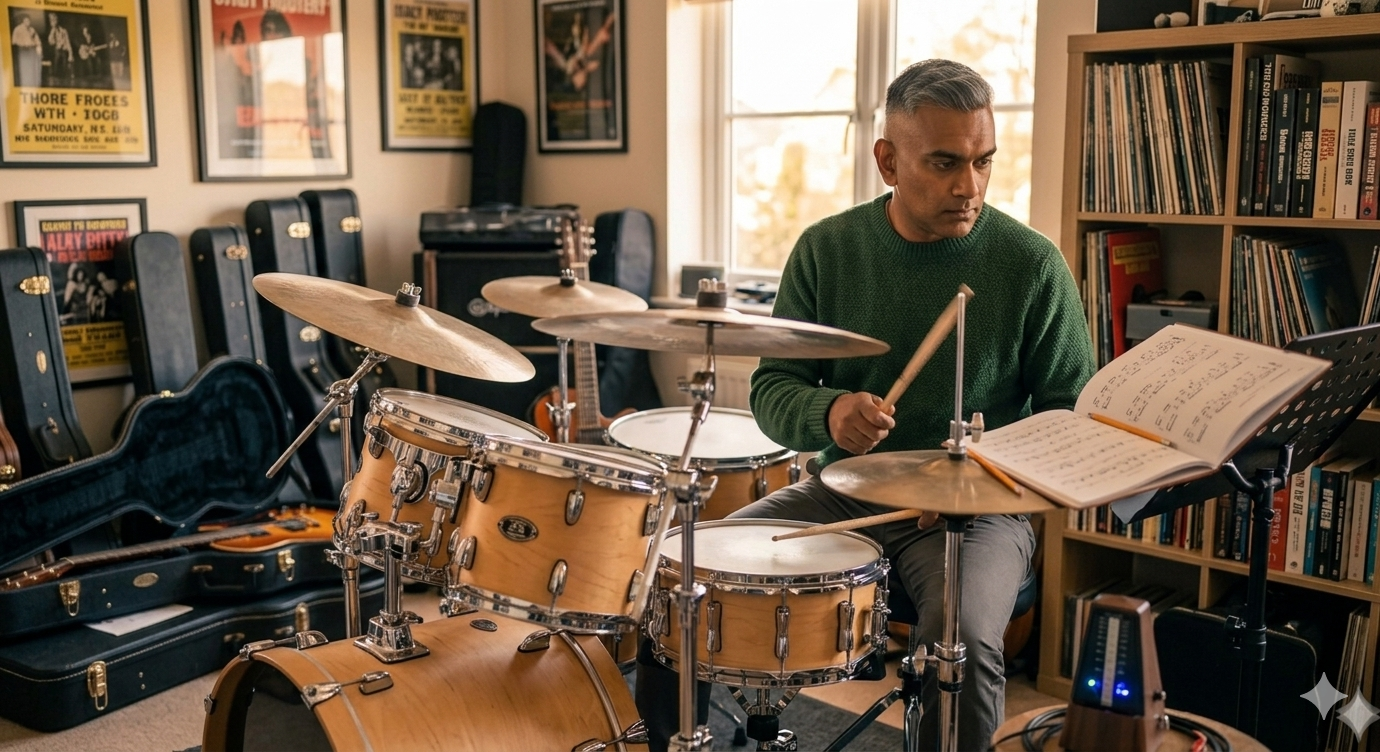
I’ve recently returned to drumming and am a keen cook. Both share the same motivation: I enjoy them—though I suspect my drumming is a little less universally appreciated than my cooking.
I’m being honest about motivation because you’d rightly never believe it was part of a health strategy.
Apps are useful, but they are tools rather than solutions.
Brilliant makes you think. Duolingo makes you practise. Both are worthwhile.
Neither is a substitute for reading a difficult book, learning an instrument, writing something, or spending an afternoon wrestling with an idea that refuses to cooperate.
The dementia question — the idea that an active, engaged, learning mind builds resilience against decline — has substantial and consistent evidence behind it.
No single activity is a guarantee.
No lifestyle is an insurance policy.
But the cumulative evidence points in a certain direction: keep learning, stay curious, move your body, and continue engaging with the world.
The alternative — assuming that what you already know is sufficient and closing the door behind you — appears to be the riskier option.
So what does this look like in practice?
What I’m actually doing
Learning.
Imperfectly, without a structured programme, and with no exam at the end of it.
Reading more deliberately than I have in years.
Returning to something creative.
Looking at language learning with more serious intent than I’ve previously given it.
And writing this, which has involved more active thinking than anything I’ve done in a while. Designing the look and feel of the blog, learning how to use WordPress, and how web hosting works. Exploring creativity and technical knowledge at the same time has been unexpectedly fulfilling and is a lot of fun.
The simulator revision was frustrating because I had to do it.
The reading I’m doing now is enjoyable because I choose to do it.
The strange thing is that, looked at closely enough, they are not entirely different activities.
Both are attempts to understand something slightly better than I did yesterday.
The exam was never the point.
The learning was always the point.
For thirty years I thought my curiosity belonged to the job.
Retirement revealed that it belonged to me.
Further reading
If this has opened a question or two, these are worth exploring further.
On sleep and the brain: Why We Sleep by Matthew Walker. Already referenced in the sleep article on this site, because Walker’s argument that sleep is when the brain consolidates learning applies directly to everything in this piece. — Available here
On how to learn anything better: A Mind for Numbers by Barbara Oakley. Don’t be put off by the title — this is a book about how the brain actually learns, applicable to any subject. The accompanying free Coursera course, Learning How to Learn, is one of the most-taken online courses ever made. — Book | Free course
On neuroplasticity — the brain’s ability to change: The Brain That Changes Itself by Norman Doidge. The accessible, case-study-driven introduction to the idea that the brain is not fixed and continues to adapt throughout life. Reassuring reading. — Available here
On language learning: Duolingo (duolingo.com) for daily habit and genuine cognitive benefits; Babbel (babbel.com) for more structured adult-oriented learning; Pimsleur for audio-first learners who want conversational ability rather than written fluency.
On structured thinking and STEM subjects: Brilliant (brilliant.org) — problem-solving rather than memorisation. Different from most apps in that it asks you to think, not just to recall.