Middle Eastern Barbecue Wood: Olive, Oak, Apricot
Middle Eastern barbecue wood, from olive and oak to apricot, citrus and samr acacia — where to find them in Britain, and the oleander to keep well away from food. Part of a world tour of wood-fired cooking.
An olive tree is pruned every year of its working life, and a working life runs into centuries. Across Turkey, the Levant and North Africa, that adds up to a yearly supply of hard, dense, oil-rich wood — a by-product that happens to make excellent fuel.
That is the shape of the Middle Eastern wood list. Very little of it comes from trees felled for fuel. It is orchard prunings, grubbed-out stumps, sawmill offcuts and the residue of the olive harvest, with charcoal — much of it now arriving by ship — doing the rest.
The fires these woods serve are covered elsewhere. The mangal, the ocakbaşı, masgouf on the Tigris and mandi in a buried tannour are all in The Fires of the Middle East. This is the guide to what goes in them.
What all of those methods want is the same thing: dense, dry, low-resin hardwood with no strong voice of its own.
Before the lists
None of this is authoritative. It is gathered largely from what is published online, alongside regional cooking traditions and general reading, and I am a cook rather than a botanist or a toxicologist. Common names cover several different trees, species get muddled between countries, and the same wood is often described in contradictory ways by people who all sound confident.
Use it as a basis for your own research rather than a reliable indication of what is safe to cook over. If you are not certain what a piece of wood is or what harm it might do to you, do not put food above it.
The four tiers
Great — worth going out of your way for. Burns clean, holds heat, and either adds a flavour you want or stays usefully out of the way.
Fine — sound fuel. It will cook your dinner and nobody will ask what you used.
Avoid — not harmful, but the food or the fire suffers: poor heat, foul smoke, or a flavour that fights what you are cooking.
Dangerous — the smoke, sap, dust or ash can genuinely injure. No technique makes these acceptable.
A few entries are aromatics rather than fuels: burned by the handful for scent, never used to cook over. Those are marked in place.
The great woods
| Wood | Where | Smoke | Burn | Best with |
|---|---|---|---|---|
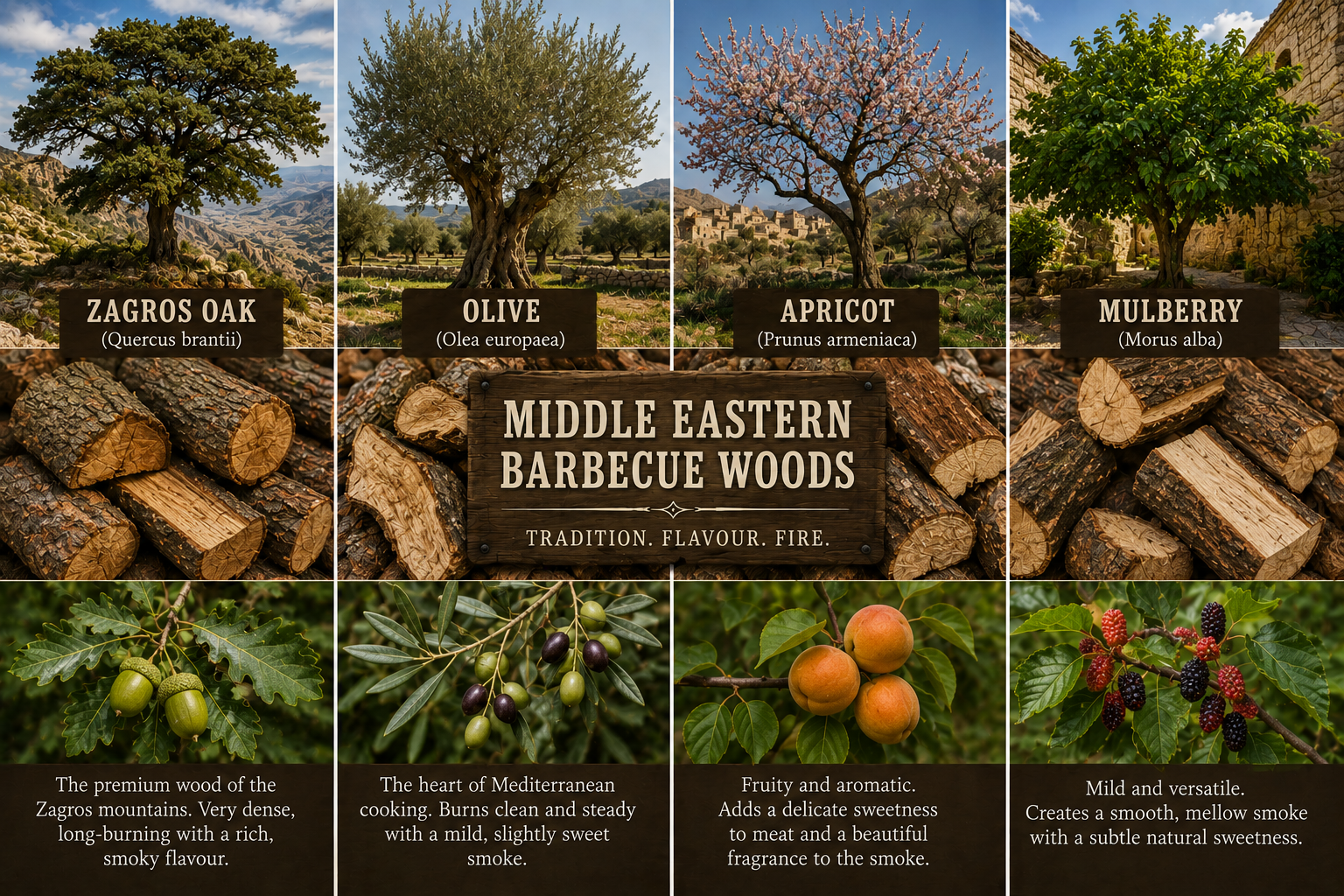
| Olive (Olea europaea) | Levant, Turkey, Syria, Jordan, Palestine | Savoury, faintly peppery | Very dense, long, hot | Lamb, fish, vegetables. The regional standard |
| Palestine oak (Quercus calliprinos) | Levant hills | Clean, medium | Long burn, excellent coals | Everything; also the classic Levantine charcoal |
| Persian / Zagros oak (Quercus brantii) | Iran, Iraqi Kurdistan | Clean, medium, dry | Very long, dense coals | Kebab, whole lamb. See the note on the Zagros below |
| Turkish oak (Quercusspp., meşe) | Anatolia, Black Sea | Neutral to medium | Superb coals | Meşe kömürü — oak charcoal — is the fuel of the Turkish ocakbaşı |
| Beech (Fagus orientalis) | Black Sea coast, northern Turkey | Mild, clean | Hot, even, good coals | Charcoal for grilling; the northern Turkish alternative to oak |
| Hornbeam (Carpinus betulus, C. orientalis) | Anatolia, Caucasus | Almost none | The densest common wood in the region | Long cooks; excellent charcoal |
| Apricot (Prunus armeniaca) | Iraq, Iran, Turkey, Central Asia | Sweet, light, fruity | Moderate heat, decent coals | Fish — the traditional wood for Baghdad masgouf |
| Mulberry (Morus alba, M. nigra) | Iran, Turkey, Levant, Central Asia | Sweet, mild | Good heat, quick coals | Poultry, lamb, fish |
| Pomegranate (Punica granatum) | Iran, Turkey, Caucasus | Sharp, slightly tart | Burns fast, modest coals | Quick grilling; small quantities |
| Almond (Prunus dulcis) | Turkey, Iran, Levant | Sweet, nutty | Hot, good coals | Kebab, poultry |
| Citrus — orange, lemon (Citrus spp.) | Coastal Levant, Cyprus, Egypt | Bright and citric | Moderate, burns fairly fast | Fish and poultry above all |
| Vine prunings (Vitis vinifera) | Turkey, Lebanon, Levant | Sharp, tangy | Blazes and dies | Fast cooking of thin cuts |
| Samr / umbrella thorn (Vachellia tortilis) | Arabian Peninsula, Sinai, Negev | Light | Very dense, very hot, long coals | Bedouin cooking; also the source of much local charcoal |
| Date palm (Phoenix dactylifera) | Iraq, the Gulf, Egypt, Saudi Arabia | Slightly sweet, sharp when green | Fronds and stalks burn fast; the trunk is fibrous and poor | Best used as kindling, or converted to charcoal |
| Pistachio and terebinth (Pistacia vera, P. atlantica) | Iran, Turkey, Syria | Resinous, aromatic | Dense, hot | Distinctive; good in moderation |
Notes on four of them
Olive is to the Levant and Anatolia what oak is to England. It is dense enough to burn for hours, the prunings come round on an annual cycle from an industry that spans the whole region, and it carries a savoury note that suits lamb better than any fruitwood does. Old olive wood — from grubbed-out trees rather than prunings — is denser still, and burns almost like a mineral.
The mills leave a second fuel behind them. Pomace, the pressed residue of skins and stones after the oil is out, is dried and burned across Turkey, Greece and the Levant. It is pure waste stream, it burns hot and long, and it costs a fraction of the wood.
Zagros oak is the fuel behind a great deal of Iranian, Iraqi and Kurdish cooking, and it comes with a serious caveat. The Zagros oak forests have been in decline for decades under a combination of drought, oak decline disease, grazing pressure, war and charcoal cutting. Iranian and Iraqi charcoal production has been a documented driver of that loss. It is a superb cooking wood from a forest that is not in a position to keep supplying it.
Apricot is the wood that turns up whenever anybody writes about masgouf, and the reason is straightforward: Iraq’s river valleys grow apricots, the prunings are free, and the smoke is gentle enough not to fight a freshwater fish that is already fairly assertive. Other fruitwoods do the job; apricot is the one the tradition names.
Ghaf (Prosopis cineraria) is here as history, not as a recommendation. It is a superb desert hardwood and was burned across Arabia for centuries. It is also the national tree of the United Arab Emirates, and it is protected accordingly: cutting wild plants is prohibited under federal law, and damaging one carries fines running into tens of thousands of dirhams. The same protection covers sidr (Ziziphus spina-christi) and samr — the umbrella thorn in the table above.
Oman regulates wood on the same principle. Cutting requires a licence, storing or moving quantities without approval is an offence, and the export of Omani wood and charcoal is prohibited except for imported stock being re-exported. Both governments name illegal firewood collection as a pressure on what native woodland remains.
Which is why, if you are cooking in the Gulf, you are cooking on imported charcoal.
The one distinction that matters for wood
Nearly every fire in the region burns its fuel out of sight — converted to charcoal first, or burned down to embers in a pit before the food goes anywhere near — so the species contributes heat and very little else. Masgouf is the exception. It cooks from open flame at a distance, with the smoke reaching the fish while the fire is still burning, and it is the one method here where the wood is genuinely tasted. Which is why the tradition names apricot, and why nothing else on this list is named by any tradition at all.
The fine woods
| Wood | Smoke | Notes |
|---|---|---|
| Fig (Ficus carica) | Mild, slightly sweet | Prunings burn quickly; pleasant enough |
| Walnut (Juglans regia) | Heavy, can turn bitter alone | Blend with fruitwood. Common in Iran and eastern Turkey |
| Carob (Ceratonia siliqua) | Faintly sweet | Very dense; underrated |
| Plane (Platanus orientalis) | Neutral, unremarkable | Ubiquitous street tree; adequate fuel, nothing more |
| Eucalyptus | Medicinal as a log, clean as charcoal | Heavily planted in Israel, Egypt and Iraq |
| Casuarina (Casuarina equisetifolia) | Neutral | Coastal windbreaks; hot and quick |
Woods to avoid
- Pine, cypress, cedar and juniper as fuel. Aleppo pine and cypress are everywhere across the eastern Mediterranean and both are resinous. Cedar of Lebanon is additionally a protected remnant species, so the question of whether it cooks well is beside the point.
- Green date palm trunk. Wet, fibrous, smoky and produces almost no usable coal. The dried fronds and midribs are a different matter and make good kindling.
- Tamarisk (Tamarix spp.) — grows in saline ground and carries the salt with it, and salt in the wood means chlorides in the smoke.
- Poplar (Populus spp.) — grown for timber across Iran and Central Asia, but low heat and gone fast. Filler at best.
- Driftwood and anything salvaged from a shoreline. Same chloride problem, more so.
- Oleaster / Russian olive (Elaeagnus angustifolia) — burns poorly and smells odd. It is not the same plant as olive despite the name.
- Construction waste. In much of the region this is the most readily available free burnable material, which is exactly why it needs saying. Details in the next section.
Dangerous woods
Oleander (Nerium oleander). This is the regional hazard, and it is not obscure. Oleander is planted along motorways, around car parks, in hotel grounds and as hedging from Morocco to Iran, precisely because it survives heat, drought and neglect. Every part of it contains cardiac glycosides which act directly on heart rhythm. The plant kills livestock every year. Cuttings from a hedge trim look like any other brush, and they must not go on a fire that anyone is cooking over or standing beside. If you are given a bundle of local scrub in the eastern Mediterranean, this is the plant to check for.
Yellow oleander (Cascabela thevetia). A planted ornamental in the warmer parts of the region, unrelated to true oleander but carrying its own cardiac glycosides. Same rule.
Sodom apple (Calotropis procera). Widespread through the Arabian Peninsula, Sinai, the Jordan Valley and the Sahel. Breaking a stem releases a copious white latex that blisters skin and can cause serious eye injury. It is a soft-wooded shrub rather than proper firewood, which is the only reason it does not cause more trouble than it does.
Euphorbias (Euphorbia tirucalli and relations). Same caustic latex problem, same family as several of the world’s most dangerous cooking woods. Grown as hedging in parts of the region.
Rhododendron and Rhododendron luteum, Black Sea Turkey. The grayanotoxins responsible for the region’s notorious deli bal — mad honey — are present in the plant as well as in the honey. The shrub is cleared and burned in places along the Pontic coast; the smoke is not something to cook over.
Yew (Taxus baccata). Present in the mountains of northern Turkey, Lebanon and Iran, and planted ornamentally. Cardiotoxic taxine alkaloids throughout.
Treated, painted and salvaged timber. Across the Gulf in particular, construction offcuts, shuttering ply, painted pallets and old scaffold boards are abundant and free. They carry preservatives, adhesives, formaldehyde resins and paint. Pallets marked MB have been fumigated with methyl bromide and must never be burned; HT indicates heat treatment and is broadly acceptable. Unmarked timber of unknown history is not worth the saving.
A short note on charcoal
More than in any other region in this series, Middle Eastern fire cooking runs on charcoal rather than logs, and the charcoal is very often imported. Gulf states in particular bring in bagged charcoal in volume — Indonesian hardwood and coconut shell above all, with East African and Southeast Asian mangrove moving through the same trade.
Two things follow from that. The first is practical: the quality varies enormously, and the difference between good hardwood lump and cheap compressed dust is the difference between an hour of steady heat and twenty minutes of sparks. The second is that a bag of charcoal in a Gulf supermarket may well have started as an East African mangrove or a Paraguayan quebracho, and there is no obligation on anyone to tell you which.
Where a bag names the species — oak, olive, orange — it is usually worth the premium.
Buying it in Britain
The Middle Eastern end of this list is easier to find here than most of the others in the series, because the Mediterranean woods are common and the Turkish grill trade has grown.
Olive wood chunks are stocked by most barbecue suppliers. Turkish oak charcoal is sold here in restaurant grades by the specialist barbecue merchants, some of it made from timber-milling offcuts, and it is genuinely good: hot, long-burning, low ash. Turkish and Kurdish grocers in the larger British cities are the other place to look. Orange and lemon wood chunks are easy to find. Apricot is harder, though any garden with an apricot or plum tree will supply the same character.
Next in this series: The Indian Subcontinent. See also Britain and Europe for what is actually available naturally on this side of the Atlantic