Australian and Pacific Barbecue Wood: Ironbark, Manuka
Australian and Pacific barbecue wood, from ironbark, gidgee and mallee root to New Zealand mānuka and Hawaiian kiawe — and why treated pine, not any tree, is the real hazard. Part of a world tour of wood-fired cooking.
A mallee root is not a root and not a log. It is a lignotuber — a swollen woody burl that sits mostly underground, storing starch and dormant buds, so that when fire takes the top of the plant off the whole thing can regrow from underneath. Mallee eucalypts have been doing this for a very long time in country that burns regularly.
Dug up and dried, that burl is one of the hottest and cleanest-burning fuels in Australia. It is dense, gnarled, awkward to stack and it burns with almost no smoke. It also comes out of semi-arid mallee country that has already lost a great deal of its original vegetation to agriculture, and harvesting is regulated in some states and contentious in others.
Australia is the region where the reputation of a whole genus needs correcting. Most of the world’s barbecue writing says eucalyptus is a bad cooking wood, and most of the world’s barbecue writing has only ever met green blue gum. Australians cook over eucalypt constantly and get magnificent results, because they distinguish between species in a way outsiders do not.
Before the lists
None of this is authoritative. It is gathered largely from what is published online, alongside regional cooking traditions and general reading, and I am a cook rather than a botanist or a toxicologist. Common names cover several different trees, species get muddled between countries, and the same wood is often described in contradictory ways by people who all sound confident.
Use it as a basis for your own research rather than a reliable indication of what is safe to cook over. If you are not certain what a piece of wood is or what harm it might do to you, do not put food above it.
The four tiers
Great — worth going out of your way for. Burns clean, holds heat, and either adds a flavour you want or stays usefully out of the way.
Fine — sound fuel. It will cook your dinner and nobody will ask what you used.
Avoid — not harmful, but the food or the fire suffers: poor heat, foul smoke, or a flavour that fights what you are cooking.
Dangerous — the smoke, sap, dust or ash can genuinely injure. No technique makes these acceptable. Australia’s most serious entry is not a plant at all.
A few entries are aromatics rather than fuels: burned by the handful for scent, never used to cook over. Those are marked in place.
The great woods
Australia
| Wood | Where | Smoke | Burn | Best with |
|---|---|---|---|---|
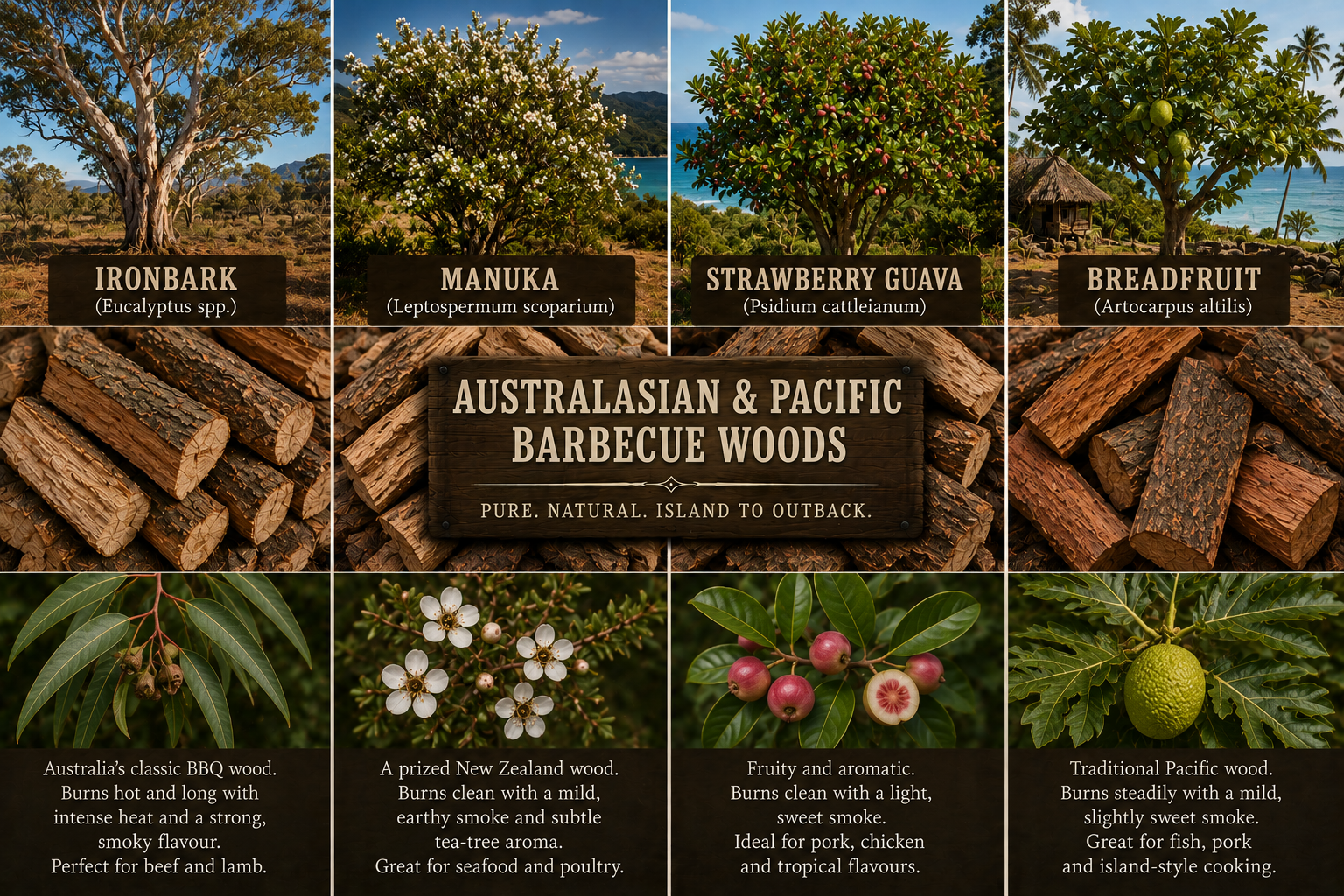
| Ironbark (Eucalyptus crebra, E. paniculata, E. sideroxylon) | Queensland, NSW | Medium, clean, faintly sweet | Extremely dense; will hold a low-and-slow temperature for ten hours or more | Beef — brisket, ribs, anything long |
| River red gum (Eucalyptus camaldulensis) | Murray-Darling basin, widespread | Firm, earthy | Hot, solid coals | Beef, lamb, sausage, game |
| Jarrah (Eucalyptus marginata) | Southwest Western Australia | Heavy, assertive | Enormously dense, very long coals | Beef and smallgoods; use less of it than you think |
| Gidgee (Acacia cambagei) | Inland Queensland, NSW | Sweet, distinctive | The densest common Australian firewood; superb charcoal | Everything. Widely rated the best Australian barbecue wood |
| Mulga (Acacia aneura) | Arid inland | Mild, sweet | Very dense, very long | Slow cooking, charcoal |
| Brigalow (Acacia harpophylla) | Queensland | Mild | Dense, hot | Good, though the surviving brigalow country is a fraction of what it was |
| Mallee root (Eucalyptusspp., lignotuber) | Victoria, South Australia, WA | Very little | Intense, clean heat | Direct grilling; the classic Australian charcoal feedstock |
| Yellow box, grey box (E. melliodora, E. microcarpa) | Southeast Australia | Mild, clean | Excellent heat and coals | General cooking |
| Spotted gum (Corymbia maculata) | East coast | Clean, medium | Dense, long | General cooking |
| Sheoak (Allocasuarina, Casuarina spp.) | Australia-wide | Neutral to slightly sweet | Very hot, quick | Long used in Aboriginal cooking; excellent fast fuel |
| Macadamia shell (Macadamia integrifolia) | Queensland, northern NSW | Sweet, nutty | Very hot, clean; excellent briquettes | A processing by-product; underrated |
| Banksia (Banksia spp.) | Coastal Australia | Neutral | Hot; the cones burn a long time | Local and modest, but sound |
New Zealand and the Pacific
| Wood | Where | Smoke | Burn | Best with |
|---|---|---|---|---|
| Mānuka (Leptospermum scoparium) | New Zealand | Strong, sweet, resinous, unmistakable | Hot, fast, moderate coals | Smoked fish, mussels, chicken. The defining New Zealand smoking wood |
| Kānuka (Kunzea ericoides) | New Zealand | Similar to mānuka, a little lighter | Very hot, dense for its size | Heating stones for a hāngī; general cooking |
| Pōhutukawa (Metrosideros excelsa) | Northern New Zealand | Neutral | Very dense, long | Culturally significant and often protected; use fallen wood only |
| Kiawe (Prosopis pallida) | Hawai’i | Sweet, nutty, caramel-like | Very hot, long coals | The Hawaiian mesquite; excellent for grilling and for charcoal |
| Strawberry guava (Psidium cattleyanum) | Hawai’i | Sweet, fruity | Moderate | An aggressive invasive, so cutting it helps |
| Ironwood (Casuarina equisetifolia) | Hawai’i, Pacific islands | Neutral | Hot, fast | Widely naturalised; abundant |
| Breadfruit — ‘ulu(Artocarpus altilis) | Polynesia, Micronesia | Mild, sweet | Moderate | Island cooking; the tree is grown for food, so windfall only |
| Coconut shell and husk (Cocos nucifera) | Pacific-wide | Neutral to sweet | Very hot, clean | Umu, lovo, general grilling. Pure by-product |
The four to understand
Ironbark is Australia’s post oak — the wood that a whole style of cooking has organised itself around. It is dense enough to hold a smoker at 110°C for ten hours on a single load, and the smoke sits in the medium register that beef wants. Australian barbecue has grown enormously in the last fifteen years and ironbark is the wood most of it runs on.
Gidgee is the connoisseur’s choice, and it comes with a good name. It is also called stinking wattle, because after rain the foliage gives off a smell somewhere between boiled cabbage and worse. The seasoned heartwood does nothing of the kind — it burns sweet and clean and makes charcoal that competes with anything in this series.
Mānuka is the one New Zealand exports, and it deserves the reputation. The smoke is assertive, resinous and slightly sweet, and it is the correct wood for hot-smoked fish in a way that few pairings in this series are genuinely correct. Used heavily on red meat it becomes overpowering. Used on kahawai, kingfish, salmon or mussels it is the thing itself.
Kiawe arrived in Hawai’i in 1828, from a single tree, and has spread across the dry lowlands of every island since. It is a Prosopis — the same genus as mesquite and algarrobo — and the smoke is a touch sweeter and less brutal than Texan mesquite. It is now the standard Hawaiian grilling wood and the basis of a small charcoal industry.
The fine woods
| Wood | Smoke | Notes |
|---|---|---|
| Blackbutt (Eucalyptus pilularis) | Clean, medium | Sound fuel, widely available |
| Wandoo (Eucalyptus wandoo) | Neutral | Western Australian; very dense and good |
| Lilly pilly (Syzygium spp.) | Sweet, mild | Same genus as jamun; pleasant and modest |
| Wattle generally (Acacia spp.) | Neutral to sweet | Enormous variation between species. Test in small quantities |
| Mango, avocado, citrus prunings | Sweet | Queensland and Pacific orchards |
| Tea tree (Melaleuca spp.) | Aromatic, medicinal | Related to mānuka and much more variable. Try before committing |
Woods to avoid
- Green eucalyptus of any species. This is the source of the genus’s bad reputation. Unseasoned eucalypt is full of volatile oils and produces exactly the medicinal, cough-sweet smoke people complain about. Seasoned properly — twelve months minimum for the dense species — it behaves completely differently.
- The high-oil eucalypts even when seasoned — blue gum (E. globulus), narrow-leaved peppermint (E. radiata), lemon-scented gum (Corymbia citriodora). These are the species grown for eucalyptus oil. The clue is in the industry.
- Macrocarpa (Cupressus macrocarpa) — New Zealand shelter-belt timber, and a cypress. Some use it for cold smoking. It is not a grilling fuel.
- Radiata pine and other plantation conifers. Resinous, sooty, and in Australia very often treated. See below.
- Kauri, rimu, tōtara, Huon pine. Slow-growing, culturally and ecologically significant, and in several cases protected. Also resinous.
- Ōhi’a lehua (Metrosideros polymorpha) in Hawai’i. Traditionally used to heat imu stones, but Rapid ‘Ōhi’a Death has led to quarantine restrictions on moving ‘ōhi’a wood between and within Hawaiian islands. Check the current rules rather than assume.
- Driftwood. Chlorides in the smoke.
Dangerous woods
CCA-treated pine. This is Australia’s real hazard and it dwarfs everything botanical on the list. Copper chrome arsenate treated pine — the green-tinged timber used for decking, fencing, retaining walls, pergolas and, for years, children’s playgrounds — is everywhere, it is often free at the end of a renovation, and it looks exactly like firewood. Burning it concentrates arsenic in the ash. There have been documented cases in Australia of serious arsenic poisoning from campfires built with CCA offcuts, including from people handling or being exposed to the ash afterwards. A single offcut on a barbecue is enough to matter. If timber has a greenish cast, small incision marks across the surface, or came off a deck, it does not go on a fire.
Rhus tree (Toxicodendron succedaneum). Introduced as an ornamental for its autumn colour and now a declared noxious weed in Victoria and New South Wales precisely because of the harm it does. It carries urushiol, the poison ivy compound. Contact causes severe, prolonged dermatitis, and the smoke from burning it carries the compound into the airways. Councils issue removal notices for it, which means it gets cut, which means it ends up in green waste and on bonfires.
Milky mangrove (Excoecaria agallocha). Northern Queensland, the Northern Territory and across the Top End. A spurge, one of the milky-latex Euphorbiaceae, with sap that causes intense skin blistering and, in the eyes, temporary blindness. Listed by the Queensland Poisons Information Centre. It shares its habitat with perfectly good mangrove wood, which is the problem.
Stinging trees (Dendrocnide moroides, D. excelsa). The gympie gympie and the giant stinging tree, of Queensland and northern NSW rainforest. The whole plant is covered in silica hairs that deliver a neurotoxin, and the hairs remain active on dead and dried material for months. Disturbing or burning the wood makes those hairs airborne. Nobody who has met one needs telling twice.
Oleander (Nerium oleander). Planted across Australia and the Pacific in gardens, along highways and around car parks. Cardiac glycosides throughout.
Yellow oleander and pong-pong (Cascabela thevetia, Cerbera manghas). Both present in tropical Queensland and across the Pacific islands. Both carry cardiac glycosides.
White cedar (Melia azedarach). Native to eastern Australia and widely planted as a street tree. The berries are toxic to people, dogs and livestock.
Silky oak (Grevillea robusta). Not in the same league as the others, but real: the sap and sawdust contain compounds related to those in poison ivy, and cause contact dermatitis in sensitised people. Woodworkers treat it with respect.
Sleepers, poles and painted salvage. Creosote and preservatives, on top of everything already said about the treated pine.
Buying it in Britain
Australian wood is easier to get here than you might expect, because the eucalypts that make good barbecue fuel are also grown as plantation timber in Spain, Portugal and South America, and because Australian charcoal has a following.
Australian charcoal is the difficult one. Gidgee, ironbark and mallee root lump are all made and sold in Australia, and they are as good as the reputation suggests, but they are largely a domestic product — I could not find them stocked in Britain, and shipping heavy charcoal around the world would undo most of the point. Mallee root is in any case getting scarcer at home, since the lignotubers are a slow resource and the good country has been dug over.
For the same behaviour from something on this side of the world, quebracho or Namibian lump will give you the density and the burn time.
Mānuka chips and chunks are widely available for smoking. They are strong. Start with about half what you would use of apple, and put them under fish before you put them under anything else.
Kiawe is sold in the United States and rarely here; ordinary mesquite is close enough in character.
For ironbark itself, the honest answer is that British oak does the same job in the same register and is sitting in a merchant’s yard down the road. The Australian achievement is not really the species. It is having worked out, faster than most, that a properly seasoned dense hardwood will hold a smoker steady all day and that everything else is detail.
That completes the series. The other eight: Britain and Europe, North America, South America, Africa, The Middle East, The Indian Subcontinent, Southeast Asia, The Far East.
See also Britain and Europe for what is actually available naturally on this side of the Atlantic.